Best Food to Eat When Blood Sugar Is Low
The best food to eat when blood sugar is low: fast-acting carbs, the 15-15 rule, follow-up snacks, and what to keep in every emergency kit.

In this article(16)
Knowing the best food to eat when blood sugar is low can be the difference between a quick recovery and a frightening spiral that ends with you sweating on the kitchen floor. Hypoglycemia moves fast, your brain runs on glucose, and the wrong choice in that moment can stretch a five-minute scare into an hour-long mess.
The right foods are simple, boring, and predictable. The wrong ones are usually whatever is closest, which is often a handful of nuts, a chocolate bar, or a "healthy" snack with too much fat to work in time. This guide walks through what to grab, how much to eat, and how to follow up so the low does not come right back.
The Best Food to Eat When Blood Sugar Is Low: The Essentials
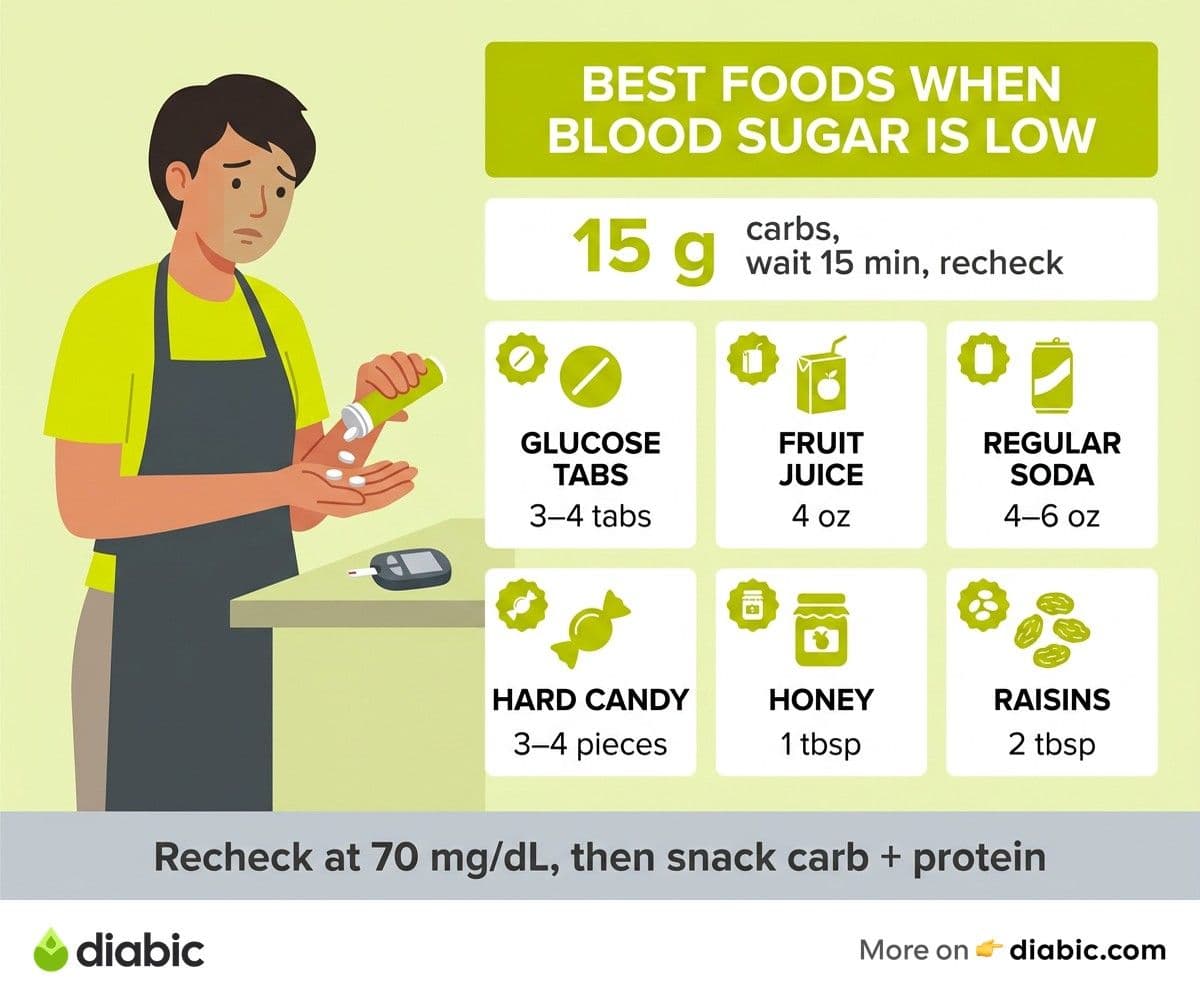
The food to eat when blood sugar is low is, almost always, a fast-acting carbohydrate without much fat or protein. According to American Diabetes Association guidance on hypoglycemia, the standard first response is the 15-15 rule: eat 15 grams of fast-acting carbs, wait 15 minutes, then check your blood sugar again. If you are still under 70 mg/dL, repeat with another 15 grams. Once you are back above 70, follow up with a small snack or your next meal.
Fifteen grams sounds tiny, and that is the point. Most lows respond to a small, well-timed dose of glucose, and over-treating is one of the most common reasons people swing into a high blood sugar an hour later. Hunger and panic often push us to eat the entire pantry. The fix is to measure once, dose, set a 15-minute timer, and resist the urge to keep eating until you "feel better," because the feeling lags behind the number.
Endocrine Society clinical guidelines lean on the same principle and add an important nuance for severe lows. If someone is confused, unable to swallow safely, or unconscious, food is no longer the answer. That is when injectable or nasal glucagon becomes the right call, ideally with a 911 follow-up. Treating a low with food only works while the person is awake and able to chew or swallow.
Treating the low and preventing the next one are two different jobs. The first is fast carbs. The second is a balanced snack or meal. Skipping the second step is how a 60 mg/dL reading at 2 p.m. becomes another 65 at 3:30.
From my experience: After 14 years living with type 1, I have learned to keep the same boring tools nearby in every room I spend time in. A tube of glucose tabs in my bedside drawer, juice boxes in the car door, and an extra stash in my work bag. I used to treat lows with whatever was closest, and almost every time I either over-treated and spiked or under-treated and dropped again. Boring works. Variety on the menu is for meals, not for hypos.
Best Foods for Low Blood Sugar Episodes
When the question is what food to eat for low blood sugar, the shortlist is short on purpose. These options absorb fast, dose easily, and travel well.
- Glucose tablets (3 to 4 tabs). The fastest, most predictable option. Each tablet is usually 4 grams of carb, so three to four tabs equals roughly 15 grams. No fat, no fiber, no guesswork.
- Glucose gel (1 packet). Works for people who cannot chew or who feel queasy. Squeeze into the side of the cheek and swallow.
- Fruit juice (4 oz / 1/2 cup). Apple, orange, or grape juice all work. Keep individual juice boxes around so you do not have to measure mid-low.
- Regular soda, not diet (4 to 6 oz). Sugar-sweetened cola or lemon-lime delivers fast glucose. Diet soda has zero usable carbs and will not help.
- Hard candy (3 to 4 pieces, depending on size). Read the label and aim for about 15 grams of carb total. Avoid sugar-free versions.
- Honey or table sugar (1 tablespoon). Useful when nothing else is around. Goes down quickly, no fat, no fiber.
- Raisins (2 tablespoons). A reasonable backup, slightly slower than juice but easy to portion and carry.
Skip chocolate, peanut butter crackers, granola bars, and trail mix during the actual low. Research summarized in the Diabetes Care journal consistently shows that fat and protein slow gastric emptying and delay glucose absorption. They are great for the follow-up snack. They are not what you reach for at minute one.
Good Foods to Follow Up With
Once you are back above 70 mg/dL, the next move is a follow-up snack that pairs a slower carb with protein or fat. This is the part most people skip, and it is the most common reason hypoglycemia comes back within an hour or two. If your next meal is within about 30 to 45 minutes, you can usually just eat that meal. If it is two hours away, you need a bridge.
Good food for low blood sugar follow-up looks like:
- A few whole-grain crackers with a tablespoon of peanut butter
- A slice of whole-grain toast with cheese
- Half a turkey sandwich on whole-grain bread
- An apple with a small handful of almonds
- A cup of plain Greek yogurt with a few berries
These pairings give you about 15 to 20 grams of slower carbs plus protein or fat, which keeps glucose steady while your liver and muscles top up their reserves. If you are also working on smarter everyday choices to avoid sharp swings in the first place, our guide to foods that spike blood sugar and what to eat instead is a useful next read.
One small note on portion size. The follow-up snack is a snack, not a meal. Eating a 600-calorie sandwich after a low is how you end up at 220 mg/dL two hours later, which sets you up for another correction and another rebound. Modest, balanced, predictable.
Snacks That Help Raise Low Blood Sugar
The best snacks help raise low blood sugar without requiring you to think clearly, because thinking clearly is hard when your glucose is dropping. The trick is to build emergency kits in advance and keep them everywhere you might need one.
For a portable kit that lives in your bag or pocket, glucose tablets are still the gold standard. They do not melt, they do not leak, and they last a year or more in their tube. A backup tube of gel, a juice box, and a single-serve packet of honey covers most situations. JDRF and Breakthrough T1D resources recommend always keeping fast-acting glucose within arm's reach, especially during sleep, exercise, and travel.
For shelf-stable home and work kits, you can stretch a little:
- A small box of mini juice boxes
- A jar of hard candy that does not melt (no chocolate)
- A tube of glucose tablets in every drawer you regularly open
- A box of plain raisins, divided into 2-tablespoon snack bags
For the car, heat is your enemy. Glucose tablets and juice boxes survive most temperatures. Avoid leaving anything chocolate-coated in a hot car, since by the time you need it the dose will be melted and harder to gauge.
If you hate the chalky texture of glucose tablets, you are not alone. Liquid glucose shots, fruit juice boxes, and dextrose gel all do the same job in different formats. Try a few options on a calm, non-low day so you know what is tolerable when you are shaky and frustrated.
What to Eat Depending on the Situation
What should you eat when your blood sugar drops depends on how low you are, what time it is, and what you were doing right before. The 15-15 rule is the starting point, but real life rarely sticks to a single template.
Mild lows (55 to 70 mg/dL)
Standard 15-15 treatment is usually enough. Glucose tabs, juice, or hard candy, then recheck. Most mild lows resolve in 15 to 20 minutes if you treat them promptly.
Moderate to severe lows (below 55 mg/dL)
You may need a slightly larger initial dose, around 20 to 30 grams of fast-acting carb, especially if symptoms are strong. Severe lows where someone cannot self-treat call for glucagon, not food. If you live with someone who has type 1, learn how the glucagon device works before you ever need it.
Nighttime lows
Overnight lows are some of the most dangerous because you may not feel them until they are deep. If you treat a low at 2 a.m., follow with a small protein-and-carb snack, like a few crackers with cheese, before going back to sleep. If overnight lows are happening more than occasionally, talk to your provider about basal insulin or pump settings rather than trying to out-snack the problem.
Exercise-induced lows
Lows during or after exercise often need a slightly bigger initial treatment, because muscles are still pulling glucose out of the bloodstream. Have fast carbs ready before you start, and learn what your body does in the hours after a workout. Our guide to exercising safely with type 1 diabetes goes deeper into the timing and insulin adjustments that prevent these in the first place.
Lows after alcohol
Alcohol blocks the liver's ability to release stored glucose, which is why lows after drinking can be deeper, longer, and harder to recognize. Always pair alcohol with food, never go to bed without checking, and keep fast carbs at the bedside. If you are out, tell at least one friend that you live with diabetes so they know what is happening if you slur or stagger.
Foods That Raise Blood Sugar Fast vs Steady
The best food to eat for low blood sugar depends on whether you need a fast lift or a sustained one. Sorting your options by speed makes choosing easier in the moment.
At a glance, here is how the common options compare:
The fast group resolves the immediate low. The medium group bridges to a meal. The slow group is for the follow-up once you are back above 70 mg/dL.
Fast and predictable (use for the acute low):
- Glucose tablets and gel
- Fruit juice, especially apple or orange
- Regular soda
- Honey, syrup, or sugar dissolved in water
- Hard candy without chocolate or caramel coating
Medium speed (use as a bridge or for milder lows when you are eating soon):
- A banana or applesauce cup
- A slice of plain bread or toast
- Plain crackers
- A small box of raisins
Slow and steady (use for follow-up, not for emergencies):
- Nuts and nut butter
- Cheese and yogurt
- Protein bars
- Whole-grain bread with peanut butter or hummus
The reason the slow group is bad for acute lows is the same reason it is good for prevention. Fat, fiber, and protein delay gastric emptying. That is what you want overnight, between meals, or before exercise. It is the opposite of what you want when your CGM arrow is pointing straight down. For more on the flip side, including the foods that raise blood sugar fast and how to keep the right ones on hand, we have a separate guide built around emergency response.
A practical wrap-up: the best food to eat when blood sugar is low is rarely exciting, and that is exactly the point. Pick two or three reliable options, stash them in the places you live, work, sleep, and travel, and use them the same way every time. The boring routine is the one that protects you when your brain is foggy and your hands are shaking.
FAQ
What should you eat when your blood sugar drops?
Start with 15 grams of fast-acting carbohydrate, like three to four glucose tablets, 4 oz of fruit juice, a tablespoon of honey, or three to four pieces of hard candy. Wait 15 minutes, recheck your blood sugar, and repeat the same dose if you are still under 70 mg/dL. Once you are stable, follow up with a snack that pairs a slower carb with protein, such as crackers with peanut butter.
What snacks help raise low blood sugar?
Glucose tablets, juice boxes, regular soda, hard candy, honey packets, and raisins are the fastest snack-format options for an active low. For the follow-up snack after the initial treatment, pair a complex carb with protein, such as whole-grain crackers and cheese, an apple with almonds, or Greek yogurt with berries. Build small emergency kits for home, work, the car, and travel so you are never far from one.
How long does it take for food to raise low blood sugar?
Pure glucose, juice, and regular soda usually start raising blood sugar within 5 to 10 minutes, with a noticeable rise by 15 minutes. Foods that contain fat or fiber, like chocolate or peanut butter crackers, can take 30 minutes or more, which is too slow for an acute low. Always treat with fast carbs first, then add the slower follow-up.
Can I treat low blood sugar with chocolate or peanut butter?
Not as the first treatment. Chocolate, peanut butter, and most "balanced" snacks contain enough fat to delay glucose absorption, which means your blood sugar stays low longer than it needs to. The best food to eat when blood sugar is low is plain glucose, juice, or hard candy, then bring in protein and fat for the follow-up snack once you are back above 70 mg/dL.
Shahriar P. Shuvo is the founder of Diabic. He has lived with diabetes for over 14 years, and built Diabic to deliver the practical, evidence-based self-management tools he wished existed when he was first diagnosed. By trade, Shahriar is a senior design and frontend engineer with 6+ years shipping products at Agora, Timescale (now Tiger Data), and ShareTrip. He writes from the intersection of lived diabetes experience and product craft, focused on what works in daily management rather than what sounds good in a textbook.
Medically reviewed by
Dr. Shanto Arian is an internal medicine physician now specializing in clinical and aesthetic dermatology, with a parallel academic focus on epidemiology and public health. He holds an MBBS, MPH, MSc (UK), MRCP (UK), MRCPI (Ireland), Diploma in Dermatology (UK), and Diploma in Aesthetic Medicine (USA). Dr. Arian trained in internal medicine, including hospital work on hematology cases such as graft-versus-host disease, before moving toward dermatology. Skin is one of the earliest places diabetes shows itself, from acanthosis nigricans and diabetic dermopathy to slow foot wound healing, and that intersection is where his clinical and Diabic-review work meet. On Diabic, Dr. Arian medically reviews content on diabetes diagnosis, complications, dermatologic manifestations, and pharmacotherapy, ensuring every claim aligns with current ADA, NICE, and peer-reviewed literature.
More from Treatment & Medication
View all
Dawn Phenomenon vs Somogyi Effect: Night Spikes
Dawn phenomenon vs Somogyi effect explained. Learn why blood sugar spikes overnight, how to test for each, and what to talk to your provider about.

Glucose Test During Pregnancy: What to Expect
A warm, plain-language glucose test pregnancy guide covering the one-hour screening, three-hour OGTT, prep tips, and what your results actually mean.

What Is Type 3 Diabetes? A Closer Look
Type 3 diabetes is an unofficial term for brain insulin resistance linked to Alzheimer's. Learn what the research shows and how to protect cognitive.
Clinician-reviewed habits, plain-language guides, and honest answers - the small shifts that make living with diabetes feel lighter, every day.