Food to Raise Blood Sugar Fast: What Works in Minutes
Need food to raise blood sugar fast? See which fast-acting carbs work in minutes, how much to eat, and how to prevent rebounds after a low.

In this article(17)
A low blood sugar episode does not give you time to think. Your hands shake, your vision blurs, and the kitchen suddenly feels twice as far away. When you need food to raise blood sugar fast, the choice you make in the next sixty seconds matters more than almost any other food decision you will make all day.
The challenge is that not every sugary food works at the same speed. Picking the wrong option can leave you waiting and worsening, or send your numbers crashing again an hour later. This guide walks through what to reach for, how much to use, and how to keep a second low from sneaking up on you.
The Best Food to Raise Blood Sugar Quickly
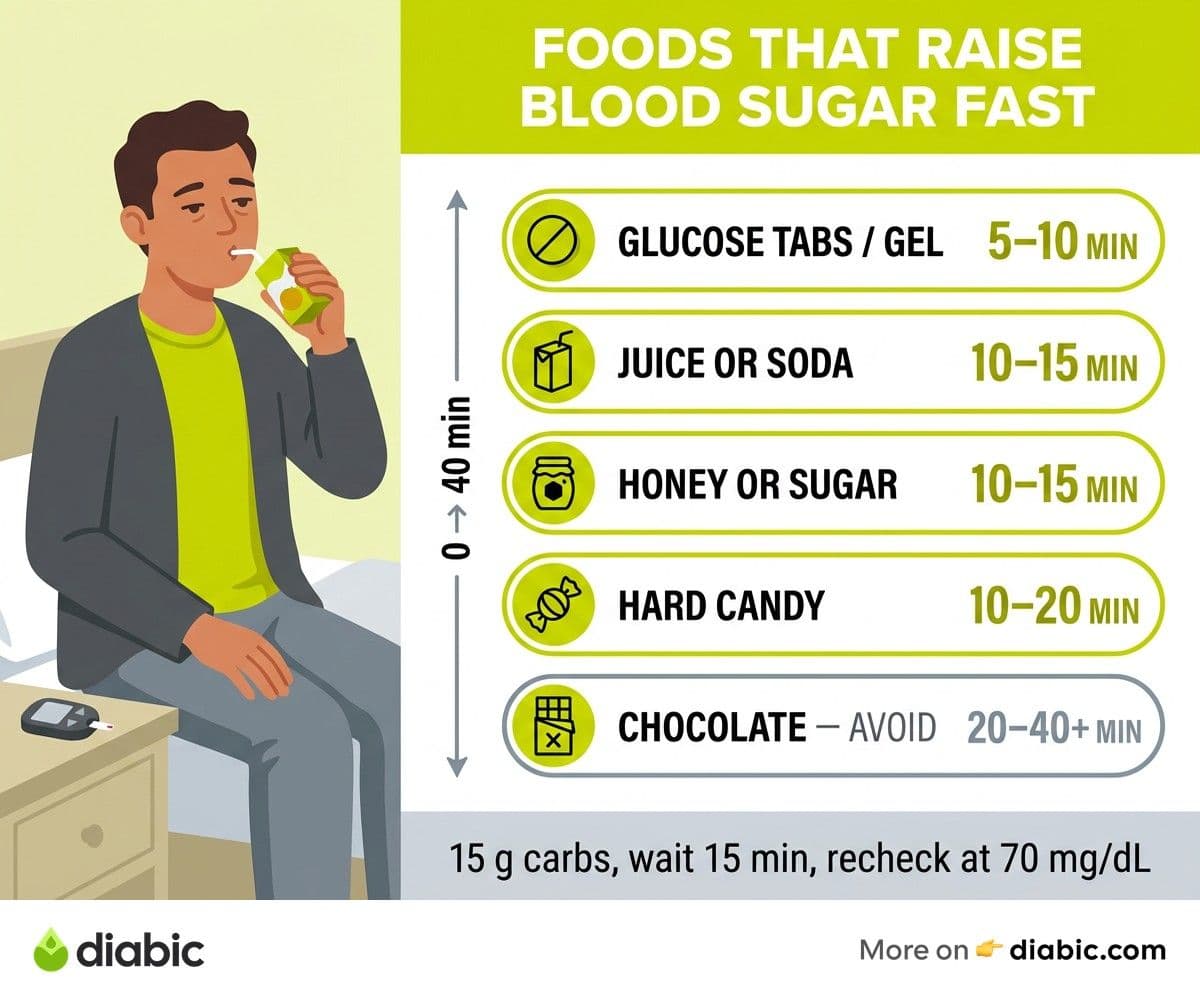
Speed depends on how easily a food turns into glucose in your bloodstream. The faster the sugar hits, the faster you feel relief. According to the Endocrine Society's hypoglycemia guidelines, the goal is to use simple, fast-acting carbohydrates that absorb within five to fifteen minutes.
Here are the options that work best:
- Glucose tablets and gels. These are designed for exactly this moment. Each tablet contains a measured 4 grams of pure glucose, so four tablets give you the standard 15-gram dose. They absorb within minutes.
- Fruit juice (apple or orange). A 4-ounce serving (half a small juice box) is the target. Skip "no sugar added" varieties during a low.
- Regular soda. Half a can of regular Coke or Sprite delivers around 15 grams of carbs. It works fast, but the bubbles can make it harder to drink quickly when you feel awful.
- Hard candy. Three or four pieces of hard candy (Lifesavers, Jolly Ranchers) give roughly 15 grams of carbs. Suck, do not chew, for fastest absorption.
- Honey or table sugar dissolved in water. A tablespoon of honey or three teaspoons of sugar in a small glass of water also works in a pinch.
From my experience: after fourteen years of living with diabetes, the single biggest upgrade I made was keeping glucose tablets in every coat pocket, my desk drawer, and the car console. Juice in the fridge is great until the low hits at 2 a.m. or in the parking lot.
Foods That Bring Blood Sugar Up Reliably
The reason simple carbs work so quickly comes down to digestion. Complex carbs have to be broken down by enzymes before they hit your bloodstream as glucose, while simple sugars head straight in. When you need food to bring up blood sugar in a hurry, simplicity wins.
Different sugars also work at different speeds. Pure glucose (the sugar in glucose tablets and dextrose candies) hits the bloodstream fastest because your body does not have to convert it. Sucrose (table sugar) is half glucose and half fructose, so it takes a beat longer. Fructose alone, the main sugar in fruit, is the slowest of the three, which is why apple juice is fine but raw apples are not the best choice during a low.
Liquids also generally absorb faster than solids. Your stomach empties liquids quickly, while it has to break solid food down first. That is why juice and regular soda often beat candy when seconds matter.
One last variable: what is already in your stomach. On an empty stomach, fast carbs hit fast. After a heavy, fatty meal, even glucose tablets can take longer to do their job because the rest of the meal slows everything down.
How Much Food Is Needed to Raise Blood Sugar
The American Diabetes Association recommends the 15-15 rule for treating a low: eat 15 grams of fast-acting carbohydrate, wait 15 minutes, then recheck. If you are still below 70 mg/dL, repeat. If you are back in range, follow up with a small balanced snack.
Fifteen grams is enough to nudge most adults from a mild low into a safer range without overshooting. Eating much more, which is tempting when you feel awful, is what causes the dreaded rebound high two hours later. That post-low spike often leads to over-correcting with insulin, which can trigger the next low, and the cycle continues.
The hard part is measuring carbs when your hands are shaking and your brain is foggy. This is why pre-portioned options are worth their weight in gold. Glucose tablets come in a tube. Juice boxes come in fixed sizes. Individually wrapped hard candies stop you from eating the whole bag. The fewer decisions you have to make mid-low, the better.
A quick reference for hitting roughly 15 grams of fast carbs:
- 4 glucose tablets
- 1 glucose gel pouch
- 4 ounces (half a cup) of regular fruit juice
- 4 ounces of regular (not diet) soda
- 1 tablespoon of honey, syrup, or sugar
- 3 to 4 hard candies
Raising Blood Sugar Quickly in Different Situations
Where you are when a low hits changes which option makes sense. The food to raise blood sugar quickly at your kitchen counter is not always the same as what you can grab at your desk or behind the steering wheel.
At home
Keep juice boxes, glucose tablets, and honey packets where you actually go during a low: bedside, kitchen, and bathroom if needed. Mixing your low supplies in with regular pantry food is a small mistake that costs time.
At work
A small zip-top pouch in your bag with two juice boxes and a tube of glucose tablets covers nearly every workday low. Avoid relying on the office vending machine. Half the time the snack you need is sold out or stuck behind the coil.
While driving
The JDRF emergency preparedness guidance for hypoglycemia is straightforward: pull over before treating, every time. Keep glucose tablets or shelf-stable juice in the glove box, not the trunk where heat can ruin them. Replace the stash every few months.
During exercise
If you are using insulin and exercising, mid-workout lows are common. Sport gels, glucose tablets, or a small juice pouch in your pocket are easier to use than a sandwich. For a deeper look at managing this, see our guide on exercising safely with type 1 diabetes.
At night
Bedside lows are the scariest. Keep glucose tablets, a juice box with the straw already attached, and your meter on the nightstand. You should not have to walk to the kitchen at 3 a.m. to fix a 52 mg/dL.
What Raises Blood Sugar the Fastest?
When people ask what food raises blood sugar the fastest, they usually expect the answer to be juice. The actual winner is pure glucose. Research published in Diabetes Care comparing oral glucose treatments has consistently shown glucose tablets and gels raise blood sugar more quickly and predictably than mixed-sugar foods like candy or fruit juice.
Here is a rough speed comparison most clinicians use:
Anything fatty is the wrong tool for the job during a low. Chocolate, peanut butter crackers, and ice cream all contain enough fat to noticeably slow glucose absorption. They are great snacks. They are not foods that spike blood sugar quickly enough to fix a low. Save them for after the recovery, not during.
Juice tends to beat hard candy in real-world conditions for one simple reason: you can swallow it, even when you are too shaky to suck on a Lifesaver. Pick the food you can actually get into your body in under thirty seconds.
After the Low: Preventing the Next Drop
Treating the low is only half the job. Many people feel fine fifteen minutes later, go back to whatever they were doing, and end up low again within an hour. This happens because fast carbs work fast and leave fast.
Once you are back above 70 mg/dL, eat a small follow-up snack with both carbs and protein, especially if your next meal is more than an hour away. A slice of whole-grain toast with peanut butter, a string cheese with a few crackers, or a small apple with almond butter all work. The protein and fiber slow digestion and keep your numbers steadier. Our guide on the best food to eat when blood sugar is low goes deeper into smart follow-up snacks.
Recheck your blood sugar 15 minutes after treating, again at 30 to 45 minutes, and once more an hour later if you are still uncertain. If you wear a continuous glucose monitor, watch the trend arrow as much as the number. A flat arrow at 90 mg/dL is reassuring. A diagonal-down arrow at 90 mg/dL means another low is on the way.
After the dust settles, take a few minutes to figure out what caused the low. Was it a missed meal? An unusual workout? More insulin than the carbs warranted? Logging the cause, even briefly in your phone, helps you and your care team spot patterns. Repeat lows at the same time of day or after the same activity are usually fixable with a small adjustment, not just better treatment.
FAQ
What food raises blood sugar the fastest?
Glucose tablets and gels are the fastest, designed to absorb within five to ten minutes. Regular soda and 4 ounces of fruit juice are close behind. Avoid chocolate, peanut butter, or anything with a lot of fat during a low, since fat slows glucose absorption and delays relief.
How do you quickly raise blood sugar when it drops?
Use the 15-15 rule from the ADA. Eat or drink 15 grams of fast-acting carbohydrate (4 glucose tablets, 4 ounces of juice, or a tablespoon of honey), wait 15 minutes, and recheck. Repeat if you are still below 70 mg/dL. Once stable, follow up with a small protein-and-carb snack to prevent another drop.
How much juice does it take to raise blood sugar?
Four ounces, or half a small juice box, is the standard 15-gram dose for treating a low. Drinking the whole 8-ounce box doubles the dose and often causes a rebound high. Measure once with a real cup so you know what 4 ounces of your usual juice looks like in a glass.
Can I treat a low with milk?
Milk works, but more slowly than pure carbs. The fat and protein in regular milk slow absorption, so it is not the best choice for a fast fix. It can be a reasonable follow-up snack after you have already treated with glucose tablets or juice.
What is the safest food to keep on hand for lows?
Glucose tablets are the most practical because they are pre-portioned, shelf-stable, and predictable. Keep tubes in your bag, your car, your nightstand, and at your desk. Replace them when they expire. Talk to your doctor or diabetes educator about building a low-blood-sugar kit that fits your routine.
When the next low hits, the right food to raise blood sugar fast should already be within arm's reach. Stocking the right supplies in the right places turns a stressful moment into a routine fix, and gives you back the time and headspace to keep living your day.
Shahriar P. Shuvo is the founder of Diabic. He has lived with diabetes for over 14 years, and built Diabic to deliver the practical, evidence-based self-management tools he wished existed when he was first diagnosed. By trade, Shahriar is a senior design and frontend engineer with 6+ years shipping products at Agora, Timescale (now Tiger Data), and ShareTrip. He writes from the intersection of lived diabetes experience and product craft, focused on what works in daily management rather than what sounds good in a textbook.
Medically reviewed by
Dr. Shanto Arian is an internal medicine physician now specializing in clinical and aesthetic dermatology, with a parallel academic focus on epidemiology and public health. He holds an MBBS, MPH, MSc (UK), MRCP (UK), MRCPI (Ireland), Diploma in Dermatology (UK), and Diploma in Aesthetic Medicine (USA). Dr. Arian trained in internal medicine, including hospital work on hematology cases such as graft-versus-host disease, before moving toward dermatology. Skin is one of the earliest places diabetes shows itself, from acanthosis nigricans and diabetic dermopathy to slow foot wound healing, and that intersection is where his clinical and Diabic-review work meet. On Diabic, Dr. Arian medically reviews content on diabetes diagnosis, complications, dermatologic manifestations, and pharmacotherapy, ensuring every claim aligns with current ADA, NICE, and peer-reviewed literature.
More from Treatment & Medication
View all
Dawn Phenomenon vs Somogyi Effect: Night Spikes
Dawn phenomenon vs Somogyi effect explained. Learn why blood sugar spikes overnight, how to test for each, and what to talk to your provider about.

Glucose Test During Pregnancy: What to Expect
A warm, plain-language glucose test pregnancy guide covering the one-hour screening, three-hour OGTT, prep tips, and what your results actually mean.

What Is Type 3 Diabetes? A Closer Look
Type 3 diabetes is an unofficial term for brain insulin resistance linked to Alzheimer's. Learn what the research shows and how to protect cognitive.
Clinician-reviewed habits, plain-language guides, and honest answers - the small shifts that make living with diabetes feel lighter, every day.