Dawn Phenomenon vs Somogyi Effect: Night Spikes
Dawn phenomenon vs Somogyi effect explained. Learn why blood sugar spikes overnight, how to test for each, and what to talk to your provider about.

In this article(10)
Waking up with high blood sugar after doing everything right the night before is one of the most frustrating parts of living with diabetes. You ate a reasonable dinner, took your meds on schedule, maybe even went for a walk, and the morning number still climbs higher than it should. Understanding the dawn phenomenon vs Somogyi effect is the first step to fixing those overnight spikes, because each one has a different cause and a different solution.
We hear from a lot of people who blame themselves for those numbers, assuming they slipped up somewhere or that their body is just not cooperating. The truth is that overnight glucose patterns are driven by hormones, sleep, and timing factors that have nothing to do with willpower. Once you can spot which pattern is happening, the fix becomes a clear conversation with your provider rather than a guessing game.
This article walks through what each pattern looks like, how to tell them apart with a simple test, and why getting the right diagnosis matters before any changes are made to your treatment plan.
From my experience: I chased a stubborn 180 mg/dL fasting reading for months back in 2019 before I switched to a Dexcom G6 and finally saw the overnight curve. My number was not spiking at dawn the way I assumed, it was dropping into the high 60s around 3 AM and rebounding by sunrise, and the difference between a 3 AM low and a 3 PM low is that you sleep right through the alarm bells your body is sending. Once my endo and I had two weeks of CGM data on the screen, the basal change took about ten minutes to talk through.
What Is the Dawn Phenomenon?
The dawn phenomenon is a natural early-morning surge of blood sugar caused by the body's normal hormone cycle. Between roughly 3 AM and 8 AM, your body releases cortisol, growth hormone, glucagon, and adrenaline to prepare you to wake up and face the day. These hormones tell the liver to release stored glucose into the bloodstream so you have energy on tap when your alarm goes off.
Everyone experiences this morning surge, even people without diabetes. The difference is that a healthy pancreas releases just enough insulin to keep blood sugar steady through that hormonal wave. With Type 1 diabetes, there is no internal insulin response to balance the glucose release, so blood sugar climbs unchecked. With Type 2 diabetes and insulin resistance, the body's insulin response is blunted, and the morning rise becomes more pronounced.
According to the American Diabetes Association, the dawn phenomenon affects most people with diabetes to some degree, and the typical pattern is a steady rise in blood sugar starting in the early morning hours that peaks shortly after waking. Research published in Diabetes Care has documented how growth hormone pulses during sleep drive much of this overnight insulin resistance, which is why the timing is so consistent night after night.
The hallmark of the dawn phenomenon is what your numbers do between bedtime and morning. If you check at 3 AM and your blood sugar is in range or slightly elevated, then climbs by breakfast, the dawn phenomenon is the likely culprit. The rise is gradual, not a sudden spike, and it is rarely preceded by any low.
What Is the Somogyi Effect?
The Somogyi effect, sometimes called rebound hyperglycemia, describes a different mechanism that produces a similar morning result. It happens when blood sugar drops too low overnight, often without you waking up, and the body responds with a flood of counter-regulatory hormones to pull glucose back up. Those hormones can overshoot the target, leaving you with a high reading by morning that looks identical to a dawn-driven rise.
The mechanism is essentially a panic response from your liver. Glucagon, cortisol, and adrenaline all dump glucose into the bloodstream to rescue you from the low, and because they keep working after the immediate crisis passes, blood sugar rebounds higher than where it started. Studies in the Journal of Clinical Endocrinology & Metabolism have explored this rebound phenomenon, though its frequency in real-world practice is debated, with some research suggesting it is rarer than once believed.
Common triggers for a Somogyi pattern include too much basal insulin at bedtime, an evening dose that peaks during the deepest stretch of sleep, exercise late in the day without compensating carbs, and a missed bedtime snack when your routine called for one. Alcohol with dinner can also lower overnight glucose because the liver focuses on processing alcohol instead of releasing glucose, setting up a rebound later in the night.
If you ever wake up sweaty, with a headache, after vivid dreams or nightmares, that is your body telling you a low likely happened while you slept. The next morning's high reading might be the rebound, not a dawn rise. Knowing the difference between treating a low and managing rebound highs is why we keep a guide on hypoglycemia emergency treatment close at hand for anyone using insulin.
Dawn Phenomenon vs Somogyi Effect: Telling Them Apart
The simplest way to separate the dawn phenomenon from the Somogyi effect is the 3 AM blood sugar test. For two or three nights in a row, set an alarm and check your blood sugar in the middle of the night. If your readings at 3 AM are in your target range or slightly above, and your morning numbers are higher, that points to the dawn phenomenon. If your 3 AM reading is low, especially under 70 mg/dL, and the morning is high, the Somogyi effect is on the table.
Continuous glucose monitor data makes this far easier and more accurate. A CGM gives you a full overnight curve, so you can see whether blood sugar is gradually climbing from the early morning hours or whether it dipped low first and bounced back. The Cleveland Clinic notes that CGM patterns are now the gold standard for sorting these two causes, and many people find the visual story of an overnight curve more useful than any single fingerstick.
If your morning numbers are inconsistent with what your meter reads, comparing them against a normal blood sugar levels chart can help you and your provider see how far off target the pattern actually is. Bring at least one or two weeks of data to your appointment, ideally with timestamps and meal notes, so the conversation has something concrete to work with.
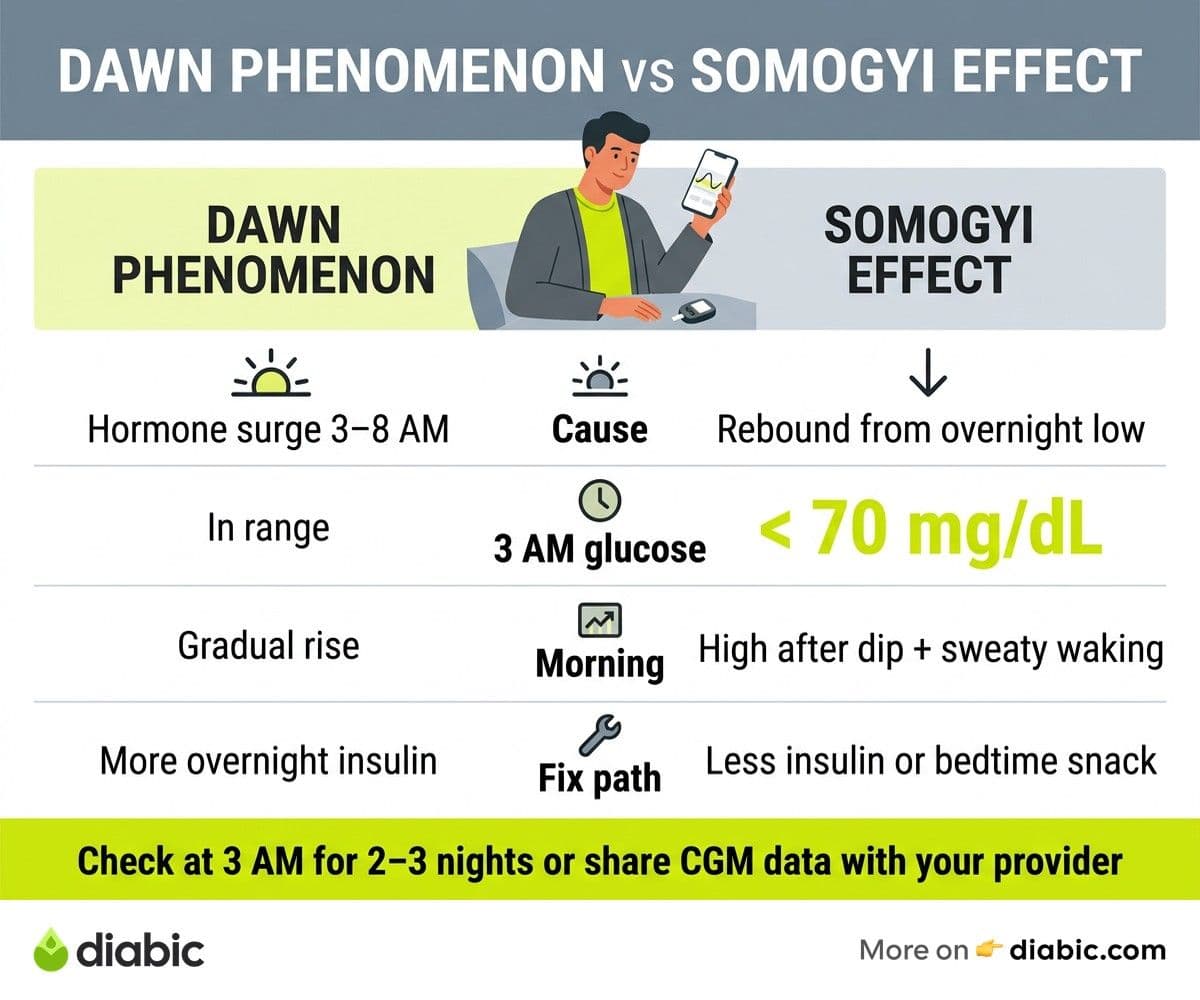
Here is how the two patterns compare side by side:
The two patterns can produce identical morning numbers, which is why the 3 AM data point or a CGM trace is the only reliable way to tell them apart before any treatment change.
Getting this diagnosis right matters because the treatments push in opposite directions. Treating a dawn phenomenon as if it were Somogyi would mean reducing insulin, which could send morning numbers even higher. Treating Somogyi as if it were dawn phenomenon would mean adding insulin, which could deepen the overnight low and create a more dangerous cycle. This is why we never recommend self-adjusting medication based on a guess, and why your provider needs the data before any changes are made.
Managing the Dawn Phenomenon
Managing the dawn phenomenon is part of a bigger diabetes management strategy that your provider will tailor to your medications and lifestyle. For people on long-acting basal insulin, the timing or dose may need to be shifted so that more insulin is available during the early morning hours, but those changes belong in a clinical conversation rather than a self-experiment. Insulin pump users sometimes program a higher overnight basal rate that ramps up around 3 AM, which can blunt the rise without affecting the rest of the day.
Evening exercise is another lever worth discussing with your provider. Light to moderate activity in the late afternoon or early evening has been shown to improve overnight insulin sensitivity for some people, which softens the dawn rise. Walking after dinner is one of the most accessible options, and many find that even 20 to 30 minutes makes a measurable difference on their CGM the next morning.
Dinner composition also plays a role. Heavier carb loads late in the evening can extend the overnight glucose curve, especially when paired with high-fat meals that slow digestion and push absorption into the early morning hours. Working with a dietitian on dinner timing and carb distribution can take pressure off the dawn window without forcing major dietary changes.
For people with Type 1, our overview of insulin therapy for type 1 diabetes covers how basal-bolus regimens are structured and why timing changes belong in a provider conversation. If you are noticing a stubborn morning pattern, schedule a visit and bring your data rather than tweaking on your own.
Managing the Somogyi Effect
If overnight lows are driving rebound highs, the management approach focuses on preventing the low in the first place. That usually means a careful look at evening insulin timing, dose, and any exercise or alcohol that could be amplifying the effect. Your provider may suggest moving a long-acting dose earlier or shifting toward a flatter-profile insulin, but again, those calls should come from your care team after reviewing your data.
Bedtime snacks are a tool worth talking about. A small protein-and-carb combination before bed can keep overnight glucose more stable, especially after evening exercise or on days when dinner was lighter than usual. The right snack varies by person, so this is something to test under your provider's guidance rather than copy from a generic list.
CGM data really shines for fine-tuning a Somogyi pattern. Once you can see the timing of the overnight low, your provider can pinpoint which adjustment is most likely to help. Some patterns respond best to insulin timing changes, others to a snack, and others to a combination. The benefit of having continuous data is that you can see the result of any change within a night or two rather than waiting weeks.
It is worth noting that some clinicians believe Somogyi rebounds are less common than the textbook makes them sound, and that morning highs are more often dawn-driven. Either way, the only safe path is testing, sharing the data, and making changes as a team. Self-adjusting bedtime insulin without a clear picture of what is happening overnight is one of the most common ways people end up in a worse spot.
The Role of Insulin Resistance in Overnight Blood Sugar
Insulin resistance plays a quiet but important role in overnight blood sugar patterns, particularly for people with Type 2 diabetes. When your tissues respond less efficiently to insulin, the same morning hormone surge that produces a small rise in someone without diabetes can produce a much larger rise in you. The dawn phenomenon and insulin resistance often amplify each other, which is why fasting numbers can be the hardest to bring into range.
Body composition, sleep quality, and overall metabolic health all influence overnight insulin sensitivity. The Endocrine Society describes insulin resistance as a treatable, modifiable factor, and small steps like consistent sleep, modest weight loss, and regular activity can shift fasting numbers over time. None of these are quick fixes, but they tend to compound in the right direction with patience.
Metformin timing is one area where research has explored a more direct effect on dawn patterns. An extended-release dose taken at dinner instead of in the morning can blunt overnight glucose production for some people, though this is exactly the kind of change to discuss with your provider rather than try on your own. If you want to dig deeper into the underlying mechanism, our article on can you reverse insulin resistance covers what the evidence says about lifestyle interventions and where the realistic ceiling sits.
The bigger point is that overnight blood sugar is rarely about a single cause. Dawn hormones, insulin sensitivity, dinner composition, sleep, stress, and medication timing all interact, and improvements usually come from addressing two or three of these together. Patience and good data win this game over time.
FAQ
Why does blood sugar go up at night without eating?
Blood sugar can rise overnight even without eating because of the body's natural hormone cycle. Cortisol, growth hormone, and glucagon trigger the liver to release stored glucose, which is the dawn phenomenon. Insulin resistance amplifies this rise. In some cases, an overnight low can also trigger a hormonal rebound that pushes morning numbers up.
How to tell if it is the dawn phenomenon or Somogyi effect?
The simplest test is checking blood sugar at 3 AM for two or three consecutive nights, or reviewing CGM data over the same window. If 3 AM readings are in range or slightly high and morning numbers climb, that suggests the dawn phenomenon. If 3 AM readings dip low and morning numbers rebound high, that suggests the Somogyi effect. Share this data with your provider before making any treatment changes.
Can the dawn phenomenon be cured?
The dawn phenomenon is a natural hormonal process, so it cannot be cured outright. It can be managed effectively through medication adjustments, exercise timing, dinner composition, and improving overall insulin sensitivity. Most people see meaningful improvement once they identify the pattern and work with their provider on a plan tailored to their numbers.
Sorting out the dawn phenomenon vs Somogyi effect is rarely a one-night job, and it is not a problem you should try to solve alone. A few mid-night fingersticks or a couple of weeks of CGM data, paired with a frank conversation with your provider, will get you further than any self-adjusted dose. The patterns are real, the fixes exist, and the right starting point is always data first, change second.
Shahriar P. Shuvo is the founder of Diabic. He has lived with diabetes for over 14 years, and built Diabic to deliver the practical, evidence-based self-management tools he wished existed when he was first diagnosed. By trade, Shahriar is a senior design and frontend engineer with 6+ years shipping products at Agora, Timescale (now Tiger Data), and ShareTrip. He writes from the intersection of lived diabetes experience and product craft, focused on what works in daily management rather than what sounds good in a textbook.
Medically reviewed by
Dr. Shanto Arian is an internal medicine physician now specializing in clinical and aesthetic dermatology, with a parallel academic focus on epidemiology and public health. He holds an MBBS, MPH, MSc (UK), MRCP (UK), MRCPI (Ireland), Diploma in Dermatology (UK), and Diploma in Aesthetic Medicine (USA). Dr. Arian trained in internal medicine, including hospital work on hematology cases such as graft-versus-host disease, before moving toward dermatology. Skin is one of the earliest places diabetes shows itself, from acanthosis nigricans and diabetic dermopathy to slow foot wound healing, and that intersection is where his clinical and Diabic-review work meet. On Diabic, Dr. Arian medically reviews content on diabetes diagnosis, complications, dermatologic manifestations, and pharmacotherapy, ensuring every claim aligns with current ADA, NICE, and peer-reviewed literature.
More from Treatment & Medication
View all
Glucose Test During Pregnancy: What to Expect
A warm, plain-language glucose test pregnancy guide covering the one-hour screening, three-hour OGTT, prep tips, and what your results actually mean.

What Is Type 3 Diabetes? A Closer Look
Type 3 diabetes is an unofficial term for brain insulin resistance linked to Alzheimer's. Learn what the research shows and how to protect cognitive.

Desmopressin for Diabetes Insipidus Explained
Learn how desmopressin for diabetes insipidus works, who it helps, common side effects, and what to expect from this hormone replacement therapy.
Clinician-reviewed habits, plain-language guides, and honest answers - the small shifts that make living with diabetes feel lighter, every day.