Glucose Test During Pregnancy: What to Expect
A warm, plain-language glucose test pregnancy guide covering the one-hour screening, three-hour OGTT, prep tips, and what your results actually mean.

In this article(9)
The glucose test pregnancy screening is one of those appointments that catches many expectant parents off guard. One minute you are talking through baby names at a routine prenatal visit, and the next your provider is handing you paperwork about a sugary drink, a one-hour wait, and a blood draw. If your appointment is coming up and your stomach is already in knots, we want to walk through it with you so the actual day feels much less mysterious.
We hear from a lot of expectant parents who feel anxious about this particular test, partly because the name "gestational diabetes" sounds heavy and partly because nobody has explained what really happens in the lab. The good news is that the screening is straightforward, and most people pass without ever needing a follow-up. Even if you do need a second test, that is not the same thing as a diagnosis, and we will get into what that means below.
Why a Glucose Test Pregnancy Screening Matters
Pregnancy changes how your body handles sugar in ways that have nothing to do with what you ate for breakfast. The placenta produces hormones that help your baby grow, and those same hormones make your cells less responsive to insulin. That increased insulin resistance is normal and expected, but for some people it tips into a range that needs extra attention, which is exactly what the glucose fasting blood test pregnancy screening is designed to catch.
According to the Centers for Disease Control and Prevention, gestational diabetes affects between 2 and 10 percent of pregnancies in the United States each year. Untreated gestational diabetes can raise the chance of a larger-than-average baby, delivery complications, and low blood sugar in the newborn shortly after birth. Most cases are managed well once they are identified, which is exactly why screening exists.
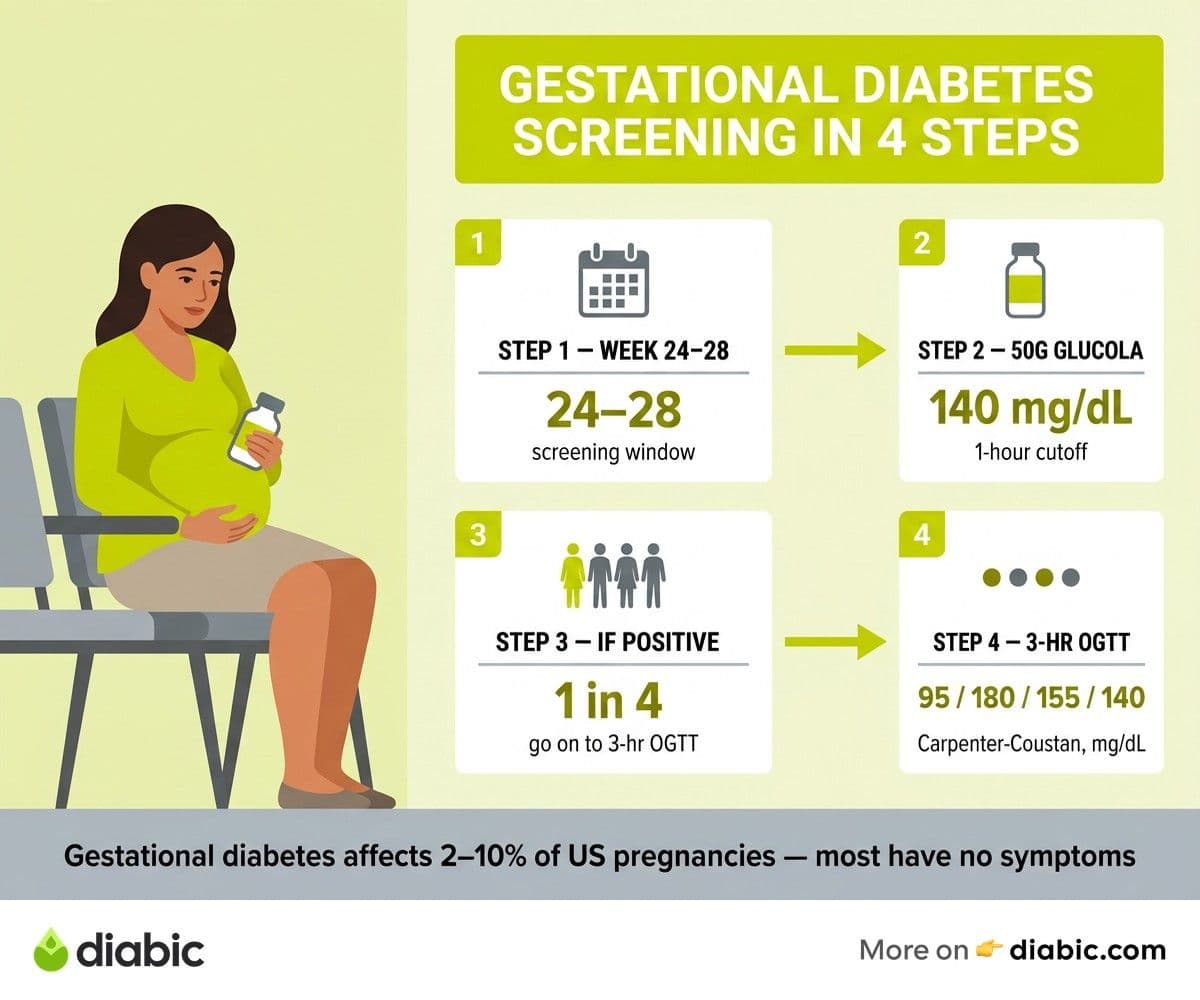
The American College of Obstetricians and Gynecologists recommends that most pregnant people be screened between weeks 24 and 28, when placental hormones are at the level where the test gives the clearest picture. If you have certain risk factors, like a previous pregnancy with gestational diabetes, a family history of type 2 diabetes, polycystic ovary syndrome, or a higher body mass index at the start of pregnancy, your provider may suggest earlier screening too. Talk to your doctor about timing if you are unsure where you fall on that risk spectrum, since each clinic has its own protocol.
How the One-Hour Glucose Screening Works
The first appointment is called a glucose challenge test, and it is the shorter of the two. You arrive at the lab, drink a measured bottle of a sweet liquid called glucola, and then sit in the waiting area for exactly one hour before a quick blood draw. Most people are in and out in about 75 minutes, and the drink contains roughly 50 grams of glucose.
You do not need to fast for this initial screening, and many providers actually encourage you to eat a normal balanced meal earlier in the day. We say "balanced" because loading up on pancakes and syrup right before can skew the result, while a meal with some protein, fiber, and complex carbs gives you a steadier baseline. If you want to refresh your memory on what a steady baseline looks like outside of pregnancy, our piece on understanding blood sugar ranges walks through the typical numbers.
Most people compare the taste of glucola to flat orange soda or very sugary fruit punch, and you have about five minutes to finish the bottle. Some clinics chill it ahead of time, which makes it more pleasant, so it never hurts to ask. Sip steadily rather than chugging, since downing it too fast on a sensitive stomach is a common reason people feel queasy during the wait.
After the blood draw, the lab measures your blood sugar test level and compares it to the cutoff your clinic uses. Most US providers consider a one-hour value at or above 140 mg/dL to be a positive screen, though some use 130 or 135 mg/dL depending on local guidelines. A positive screen is not the same as a diagnosis, and it just means the result was high enough to deserve a closer look with the longer test. Roughly one in four people who screen positive go on to be diagnosed, which means most second tests come back reassuring.
The Three-Hour Glucose Tolerance Test Explained
If you do need the follow-up, the three-hour glucose tolerance test is more involved but still doable. You will fast for 8 to 14 hours beforehand, usually overnight, drinking only water. The lab takes a fasting blood draw first, then has you drink a stronger glucola containing 100 grams of glucose, and draws blood again at the one-hour, two-hour, and three-hour marks.
Plan to be at the lab for the full three hours, since the timing of each draw has to stay precise. We suggest packing a book, headphones, a phone charger, and a snack to eat the moment your last draw is finished. The fasting plus the sugar drink can leave you feeling shaky or queasy, so if you start feeling truly unwell during the wait, tell the lab staff right away rather than pushing through.
The American Diabetes Association Standards of Care and supporting research published in Diabetes Care outline the diagnostic thresholds your clinic will likely use. Under the most common Carpenter-Coustan criteria, two or more of the four values being elevated meets the threshold for gestational diabetes, with cutoffs of 95 mg/dL fasting, 180 mg/dL at one hour, 155 mg/dL at two hours, and 140 mg/dL at three hours. If only one value is high, your provider may still want to follow up with home monitoring or a repeat test, but it does not automatically mean diagnosis.
Some people also wonder how this fits with A1C results they may have heard about, since A1C is the test most often associated with type 2 diabetes. Our explainer on what your A1C number means covers the distinction. A1C reflects the average of the past two to three months, while the OGTT captures how your body responds to a sugar load in real time, which is why the OGTT remains the gold standard during pregnancy.
Gestational Diabetes Symptoms to Watch For
Here is the part that surprises a lot of people. Most cases of gestational diabetes have no obvious symptoms, which is exactly why universal screening is the standard rather than waiting for someone to feel sick. Your body can be running higher blood sugars without giving you any clear warning, and that is true for many people right up until the day of the test.
When gestational diabetes symptoms do show up, they often blend into the background noise of pregnancy. Excessive thirst, frequent urination, and bone-deep fatigue are all on the symptom list, and they are also things almost every pregnant person experiences in some form. Blurred vision, recurring yeast or urinary tract infections, and unusual hunger after eating can be more specific red flags, but they still are not reliable enough to skip screening over.
The National Institute of Diabetes and Digestive and Kidney Diseases is clear that symptoms alone should never be used for diagnosis. If something feels off between appointments, especially intense thirst paired with frequent nighttime urination, mention it to your care team. Do not panic if you do not feel any of those things either, because the point of screening is to catch what you cannot feel on your own.
What Happens If You Fail the Glucose Test
Let us start with the language, because words matter when you are already worried. "Failing" the one-hour test simply means your number was high enough to warrant the longer test. It does not mean you have gestational diabetes, it does not mean you did anything wrong, and it does not mean your baby is in danger. We have heard from readers who cried in the parking lot after that first call, and we want you to know your reaction is completely understandable.
If the three-hour test confirms gestational diabetes, your care plan typically starts with nutrition guidance, gentle physical activity suited to pregnancy, and home blood sugar monitoring several times a day. You will check your numbers fasting and after meals, and your team will use that data to fine-tune the plan. Many people manage gestational diabetes with these steps alone, and some need insulin or oral medication added later, which is a normal escalation rather than a failure.
A diagnosis also opens the door to extra prenatal monitoring, like additional ultrasounds and non-stress tests near the end of pregnancy. If you have heard the word prediabetes in your medical history, what prediabetes means for you is a useful read, since the lifestyle tools overlap. After delivery, most people see their blood sugar return to typical levels, though follow-up testing is recommended at the postpartum visit and periodically afterward, because a history of gestational diabetes raises lifetime risk for type 2 diabetes.
Tips for Getting Through the Glucose Test
Small bits of preparation make the appointment feel much more manageable. For the one-hour screening, eat a balanced meal a couple of hours before, hydrate well, and avoid loading up on extra sweets or sugary drinks that morning. The drink itself is easier to tolerate cold, so ask the lab if they can chill it, and sip through it steadily rather than chugging on an empty stomach.
Bring something to occupy your mind during the wait. A downloaded show, a book, or a quiet walk around the block (if your lab allows it) can make 60 minutes pass much faster than staring at the clock. We also suggest bringing a snack and a water bottle for after the draw, since some people feel a little wobbly once the sugar wears off.
For the three-hour test, the same basics apply with a few extras. Wear comfortable clothes with sleeves that roll up easily, since you will have multiple blood draws from the same arm. Set an alarm the night before so you are not rushing to the lab, since stress and a missed fasting window can both affect your numbers. If you feel anxious about needles, let the phlebotomist know so they can take their time with you.
Finally, give yourself permission to ask questions. A few worth writing down: What cutoff does this lab use? When will I get my results, and how will you contact me? If I need the three-hour test, can we schedule it now? If results come back high, what is the next step? You are an active partner in your glucose test pregnancy care, and a good team will welcome every one of those questions.
Frequently Asked Questions
What happens if you fail the glucose test during pregnancy?
If your one-hour screening result is above the cutoff, your provider will schedule a longer three-hour glucose tolerance test to confirm or rule out gestational diabetes. A single high reading does not mean you have gestational diabetes, since only about one in four people who screen positive go on to be diagnosed. The three-hour test involves an overnight fast, a stronger glucola drink, and four blood draws spaced an hour apart.
How to prepare for the glucose tolerance test in pregnancy?
For the one-hour screening, no fasting is typically required, though your provider may suggest avoiding sugary foods that morning and eating a balanced meal a few hours before. For the three-hour test, you will need to fast for 8 to 14 hours beforehand, drinking only water. Talk to your doctor about specific preparation instructions, including medication timing, and pack a snack for after your final blood draw.
Dr. Rezwana Parvin Rumpa is an obstetrics and gynaecology specialist with clinical focus on gestational diabetes, PCOS, and fertility. She holds the MRCOG (Final Part) from the Royal College of Obstetricians and Gynaecologists in London, the MRCPI (Final Part) from the Royal College of Physicians of Ireland, and an MBBS from Shaheed Monsur Ali Medical College under Dhaka University. Dr. Rumpa serves as a Senior Medical Officer in the Obs and Gynae department at BRB Hospitals Ltd, where she has spent three years managing prenatal care, emergency obstetric cases, and women's-health surgery. On Diabic, she medically reviews content for women living with diabetes, with particular attention to pregnancy, PCOS, and reproductive-health intersections.
Medically reviewed by
Dr. Shanto Arian is an internal medicine physician now specializing in clinical and aesthetic dermatology, with a parallel academic focus on epidemiology and public health. He holds an MBBS, MPH, MSc (UK), MRCP (UK), MRCPI (Ireland), Diploma in Dermatology (UK), and Diploma in Aesthetic Medicine (USA). Dr. Arian trained in internal medicine, including hospital work on hematology cases such as graft-versus-host disease, before moving toward dermatology. Skin is one of the earliest places diabetes shows itself, from acanthosis nigricans and diabetic dermopathy to slow foot wound healing, and that intersection is where his clinical and Diabic-review work meet. On Diabic, Dr. Arian medically reviews content on diabetes diagnosis, complications, dermatologic manifestations, and pharmacotherapy, ensuring every claim aligns with current ADA, NICE, and peer-reviewed literature.
More from Treatment & Medication
View all
Dawn Phenomenon vs Somogyi Effect: Night Spikes
Dawn phenomenon vs Somogyi effect explained. Learn why blood sugar spikes overnight, how to test for each, and what to talk to your provider about.

What Is Type 3 Diabetes? A Closer Look
Type 3 diabetes is an unofficial term for brain insulin resistance linked to Alzheimer's. Learn what the research shows and how to protect cognitive.

Desmopressin for Diabetes Insipidus Explained
Learn how desmopressin for diabetes insipidus works, who it helps, common side effects, and what to expect from this hormone replacement therapy.
Clinician-reviewed habits, plain-language guides, and honest answers - the small shifts that make living with diabetes feel lighter, every day.