What Is Type 3 Diabetes? A Closer Look
Type 3 diabetes is an unofficial term for brain insulin resistance linked to Alzheimer's. Learn what the research shows and how to protect cognitive.

In this article(12)
Type 3 diabetes is a phrase you may have stumbled across in a podcast, a magazine article, or a worried text from a family member who just read about Alzheimer's disease. The term sounds clinical and definitive, yet it does not appear in your doctor's diagnostic manual or on any lab report you will ever receive. Researchers coined it to describe something specific and still under investigation, which is the way insulin resistance shows up inside the brain rather than the rest of the body.
The reason this concept matters is straightforward. People living with type 2 diabetes face a meaningfully higher risk of developing Alzheimer's, and scientists are working to understand why. If the link runs through brain insulin signaling, then the daily habits you already use to manage blood sugar may also be doing quiet work for your long-term cognitive health.
This article walks through what the term actually means, what the research currently supports, and what practical steps you can take. We will keep the language plain, cite the studies that matter, and steer clear of the alarmist framing that sometimes surrounds this topic.
What Does Type 3 Diabetes Actually Mean
The label was popularized around 2005 by neuropathologist Suzanne de la Monte and colleagues at Brown University, who used it to describe insulin resistance and impaired insulin signaling within the brain. Their work, published in the Journal of Alzheimer's Disease, proposed that Alzheimer's disease shares enough metabolic features with diabetes to be considered a brain-specific form of the condition. The term stuck in research circles, even though it never moved into formal diagnostic use.
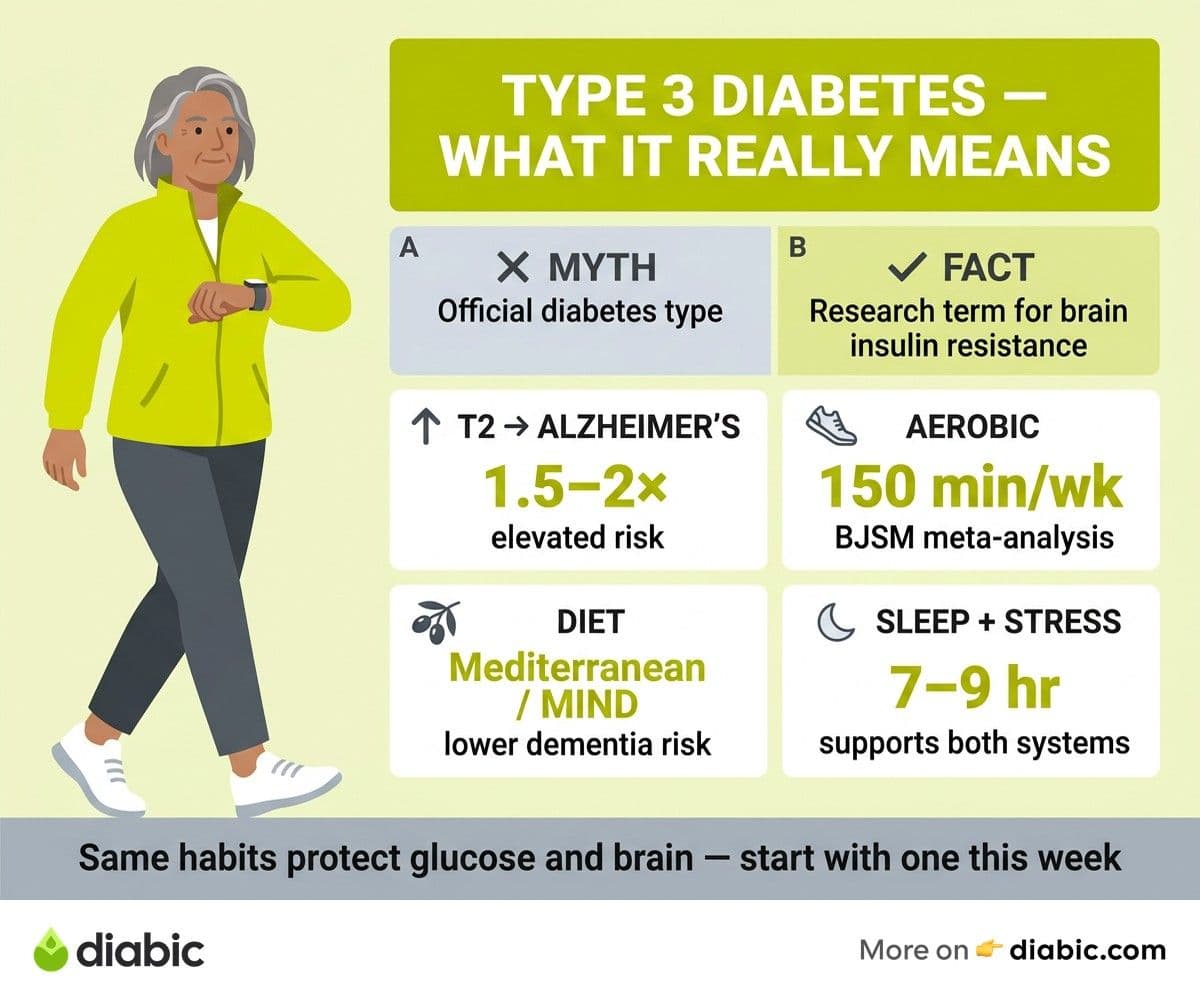
It helps to be clear about what this concept is not. It is not currently recognized as an official diabetes classification by the American Diabetes Association or the World Health Organization. The official ADA Standards of Care list type 1, type 2, gestational diabetes, and several less common forms tied to specific genetic or medical causes. Type 3 sits outside this list as a research concept, useful for shaping hypotheses but not for diagnosing patients.
The distinction matters because the word "diabetes" already does heavy lifting in everyday conversation. When someone hears that label, they may picture a third sibling alongside type 1 and type 2, complete with its own blood sugar criteria. The reality is closer to a metaphor that researchers found productive. The brain in some forms of cognitive decline behaves a bit like a body with diabetes, which is a striking observation but a different kind of claim than a clinical diagnosis. If you want a refresher on the established types, our breakdown of the differences between type 1 and type 2 is a good starting point.
Why Researchers Use the Term
Scientists keep returning to this phrase because it captures something the standard Alzheimer's framework leaves out. Postmortem studies of brain tissue from people with Alzheimer's disease have repeatedly shown reduced insulin signaling, lower expression of insulin receptors, and patterns of glucose metabolism that look strikingly similar to peripheral insulin resistance. A frequently cited review in Diabetes Care summarized this overlap and argued that brain insulin resistance deserves a central place in Alzheimer's research.
The term is shorthand, and that is both its strength and its weakness. It compresses a complex set of findings into a memorable phrase, which is useful for grant applications and headlines. It also invites confusion, which is why many neurologists prefer the more precise term "brain insulin resistance" when speaking with patients.
The Link Between Diabetes and Alzheimer's Disease
The connection between diabetes and Alzheimer's is not speculative. A large body of population research, including data summarized by the Alzheimer's Association, shows that people with type 2 diabetes have roughly 1.5 to 2 times the risk of developing Alzheimer's compared to people without diabetes. The risk also appears to extend, though less strongly, to people with prediabetes and severe insulin resistance.
To understand why, it helps to know that the brain is one of the most insulin-sensitive organs in the body. Insulin receptors are concentrated in the hippocampus and cortex, regions that handle memory and executive function. Insulin in the brain helps regulate synaptic plasticity, supports neuron survival, and influences how neurons take up glucose for energy. When insulin signaling in these regions falters, memory consolidation and learning take a hit. Our explainer on what insulin does in your body covers the basics of how this hormone works outside the brain, which makes the brain-specific story easier to follow.
Researchers have identified several overlapping mechanisms that may connect the two diseases. Chronic hyperglycemia generates advanced glycation end products, which contribute to inflammation and damage to small blood vessels including those in the brain. Insulin resistance interferes with the clearance of amyloid beta, the protein that accumulates in Alzheimer's plaques. Both conditions also share elevated oxidative stress and a tendency toward chronic low-grade inflammation, factors that show up repeatedly in studies funded by the National Institute on Aging.
Why Some Researchers Call Alzheimer's a Metabolic Disease
The "metabolic disease" framing for Alzheimer's is not universally accepted, but it has gained ground over the past two decades. Proponents point to brain imaging studies that show reduced glucose uptake in specific regions years before clinical symptoms appear, a pattern that resembles what happens in insulin-resistant tissue elsewhere in the body. They also point to clinical trials of intranasal insulin, which have shown modest cognitive benefits in some early-stage Alzheimer's patients, suggesting that supporting brain insulin signaling can directly affect symptoms.
Skeptics note that not every person with Alzheimer's has clear evidence of brain insulin resistance, and not every person with type 2 diabetes develops dementia. The relationship is real but partial, which is exactly the kind of finding that produces decades of follow-up research. For now, the most defensible summary is that diabetes and Alzheimer's share enough biology that managing one may help the other, while accepting that the full picture is still being assembled.
Risk Factors That Connect Diabetes and Brain Health
If brain insulin resistance is part of the story, then the same factors that drive insulin resistance in the body deserve attention for cognitive health. Chronic high blood sugar damages the inner lining of blood vessels, including the small vessels that supply the brain. Over years, this can lead to subtle reductions in blood flow that show up as white matter changes on MRI scans, even in people who feel cognitively well.
Cardiovascular risk factors layer on top of this. High blood pressure, elevated LDL cholesterol, and abdominal obesity all travel with type 2 diabetes and all independently raise dementia risk. The CDC's diabetes and brain health summary notes that the same vascular damage that drives heart disease also affects the brain, which is why doctors increasingly think about heart and brain health as a single project. Understanding how to know if you have diabetes earlier rather than later may matter for cognitive outcomes too, since longer exposure to elevated glucose generally carries higher risk.
Age and genetics shape the baseline. Both diabetes and Alzheimer's risk climb with age, and certain genes including APOE4 raise dementia risk independently. You cannot change your age or genome, but you can change the lifestyle factors that interact with them. Sleep quality, physical activity, dietary patterns, and stress management all influence both insulin sensitivity and brain function, often through overlapping pathways.
Where Type 1 Diabetes Fits In
Most of the diabetes-Alzheimer's research focuses on type 2 diabetes, but type 1 is part of the conversation too. Studies suggest people with type 1 diabetes also face a modestly elevated risk of cognitive changes later in life, particularly if they have experienced repeated severe hypoglycemia or long stretches of poorly managed glucose. The mechanisms differ somewhat from type 2, but the bottom line is similar. Steadier glucose levels appear to support steadier cognitive function over time.
From my experience: I have lived with type 1 diabetes for 14 years, and the cognitive angle is the part of long-term research that pushed me to take time in range more seriously than any A1C goal. I cannot change that I have an autoimmune condition, but I can make choices that protect the brain that has to live alongside it. That reframe, less about avoiding fear and more about caring for a single connected body, has been one of the most useful shifts in how I think about daily management.
What You Can Do to Protect Your Brain
The most reassuring part of this research is also the most practical. Many of the same habits that help with blood sugar management appear to support brain health, which means you do not need a separate plan for your hippocampus. Steady glucose, regular movement, and a thoughtful diet seem to help on both fronts.
Physical activity is the closest thing to a brain-health superpower. A meta-analysis published in the British Journal of Sports Medicine linked regular aerobic exercise to measurable improvements in executive function and memory across age groups. The same activity also improves insulin sensitivity, lowers blood pressure, and supports cardiovascular health. You do not need to train like an athlete. The studies that find brain benefits typically use 150 minutes per week of moderate activity, which can be a daily walk and a couple of strength sessions.
Dietary patterns associated with better metabolic health also tend to associate with better cognitive aging. The Mediterranean and MIND diets, both rich in vegetables, legumes, fish, nuts, and olive oil, show consistent links to lower dementia risk in observational studies cited by the NIH National Institute on Aging. These same patterns tend to support steadier blood glucose. You do not have to follow them perfectly to benefit, and small shifts add up. If you are working on insulin sensitivity specifically, our piece on reversing insulin resistance covers the food, sleep, and movement habits with the strongest evidence.
Working With Your Care Team on Cognitive Concerns
Regular checkups give you a structured place to track risk factors that touch both diabetes and cognition. Annual labs that include A1C, lipid panel, blood pressure, and kidney function paint a useful picture, and your provider can flag changes early. If you notice memory shifts or mental fog that feels new, talk to your doctor about it sooner rather than later. Many cognitive changes have reversible causes including thyroid issues, B12 deficiency, sleep apnea, and medication side effects, and ruling these in or out is worth doing.
Be honest with your team about what is hard. The research concept is not a diagnosis you will receive, but the day-to-day work of supporting your brain through blood sugar management is real and worth their input. Asking specifically about cognitive risk and what you can track tends to produce a different conversation than asking about A1C alone.
FAQ
What is type 3 diabetes and how is it related to Alzheimer's?
It is an informal research term for insulin resistance that occurs in the brain. Studies suggest this impaired insulin signaling may contribute to the development of Alzheimer's disease, possibly by interfering with how neurons clear amyloid beta and use glucose for energy. The relationship is well documented but still being studied, and not every researcher uses the term in the same way.
Is type 3 diabetes real?
It is a real research concept but not an officially recognized medical diagnosis. The American Diabetes Association does not include it in its classification of diabetes types, and you will not see it on a lab report. The phrase describes a biological pattern of brain insulin resistance that scientists are actively investigating, particularly in the context of Alzheimer's disease.
Can managing type 2 diabetes lower Alzheimer's risk?
Research suggests that consistent blood sugar management, along with attention to blood pressure, cholesterol, sleep, and physical activity, may lower the risk of cognitive decline in people with type 2 diabetes. Direct evidence from randomized trials is still limited, but the overlap between metabolic and brain health pathways is strong enough that most major guidelines now recommend a combined approach. Talk to your doctor about what makes sense for your situation.
The phrase type 3 diabetes is best treated as a useful pointer rather than a destination. It points toward a real connection between blood sugar regulation and brain health, and toward habits that quietly serve both. If you take one thing from this post, let it be that the steady, unglamorous work of caring for your metabolism is also caring for the brain that has to live with it. Pick one small lever this week, whether that is a daily walk, a slightly earlier bedtime, or a check-in with your provider, and let the rest follow from there.
Shahriar P. Shuvo is the founder of Diabic. He has lived with diabetes for over 14 years, and built Diabic to deliver the practical, evidence-based self-management tools he wished existed when he was first diagnosed. By trade, Shahriar is a senior design and frontend engineer with 6+ years shipping products at Agora, Timescale (now Tiger Data), and ShareTrip. He writes from the intersection of lived diabetes experience and product craft, focused on what works in daily management rather than what sounds good in a textbook.
Medically reviewed by
Dr. Rezwana Parvin Rumpa is an obstetrics and gynaecology specialist with clinical focus on gestational diabetes, PCOS, and fertility. She holds the MRCOG (Final Part) from the Royal College of Obstetricians and Gynaecologists in London, the MRCPI (Final Part) from the Royal College of Physicians of Ireland, and an MBBS from Shaheed Monsur Ali Medical College under Dhaka University. Dr. Rumpa serves as a Senior Medical Officer in the Obs and Gynae department at BRB Hospitals Ltd, where she has spent three years managing prenatal care, emergency obstetric cases, and women's-health surgery. On Diabic, she medically reviews content for women living with diabetes, with particular attention to pregnancy, PCOS, and reproductive-health intersections.
More from Treatment & Medication
View all
Dawn Phenomenon vs Somogyi Effect: Night Spikes
Dawn phenomenon vs Somogyi effect explained. Learn why blood sugar spikes overnight, how to test for each, and what to talk to your provider about.

Glucose Test During Pregnancy: What to Expect
A warm, plain-language glucose test pregnancy guide covering the one-hour screening, three-hour OGTT, prep tips, and what your results actually mean.

Desmopressin for Diabetes Insipidus Explained
Learn how desmopressin for diabetes insipidus works, who it helps, common side effects, and what to expect from this hormone replacement therapy.
Clinician-reviewed habits, plain-language guides, and honest answers - the small shifts that make living with diabetes feel lighter, every day.