How to Exercise Safely With Type 1 Diabetes
Diabetes exercise type 1 guide: blood sugar targets, insulin adjustments, fueling strategies, and the safest workout types for people with T1D.

In this article(13)
Diabetes exercise type 1 looks different from a type 2 routine, even when the workout itself is the same. The same 30-minute jog can drop your glucose 80 points one day and push it 60 points higher the next, depending on insulin on board, time of day, and whether you ate breakfast. That uncertainty is what stops a lot of people with T1D from training the way they want to.
The fix is not to give up on exercise. It is to learn the patterns, build a few simple protocols, and treat your CGM or meter as part of your gear. With the right adjustments, exercise becomes one of the most useful tools you have for managing your diabetes long-term.
How Diabetes Exercise Type 1 Affects Blood Sugar
Type one diabetes exercise behaves in two opposite ways depending on the activity. Steady aerobic work like walking, easy cycling, or swimming tends to lower blood sugar, sometimes quickly. Sprint intervals, heavy lifting, and competitive sports often push it higher in the moment, then bring it down hours later.
The reason is hormones. During moderate aerobic exercise, your muscles pull glucose out of the bloodstream and your insulin sensitivity rises, which is why a person without diabetes does not need extra glucose mid-run. With type 1, insulin is on board from a previous bolus or basal delivery, so the same effect can drop you into a low. According to ADA exercise guidelines for type 1 diabetes, this drop typically begins within 20 to 60 minutes of starting moderate cardio.
High-intensity work flips the script. Adrenaline and cortisol surge, the liver dumps stored glucose into the bloodstream, and your blood sugar can climb during a hard set or a fast sprint, even though you are working hard. After that effort ends, the muscles spend the next several hours restocking their glycogen stores, which is when the delayed low shows up. Overnight lows after evening workouts are a known pattern and one of the trickier parts of T1D training.
There is also the post-exercise tail. Even after a single bout of moderate exercise, insulin sensitivity can stay elevated for 12 to 48 hours, which is why a Tuesday afternoon ride might still be lowering your overnight numbers on Wednesday. Tracking these patterns is more useful than memorizing a single rule.
From my experience: Living with type 1 for 14 years, the single biggest unlock for me was accepting that exercise data is messy and you only learn from your own. Two people on identical pumps doing the same workout can need wildly different adjustments. I keep a simple note on my phone, just date, workout type, blood sugar before, blood sugar after, insulin reduction, and carbs eaten. Six weeks of that beats six articles.
Planning Your Workout Around Blood Sugar
Exercise in diabetes type 1 starts with a check, not a warm-up. Look at your blood sugar, your insulin on board, and the clock. Then decide what to do.
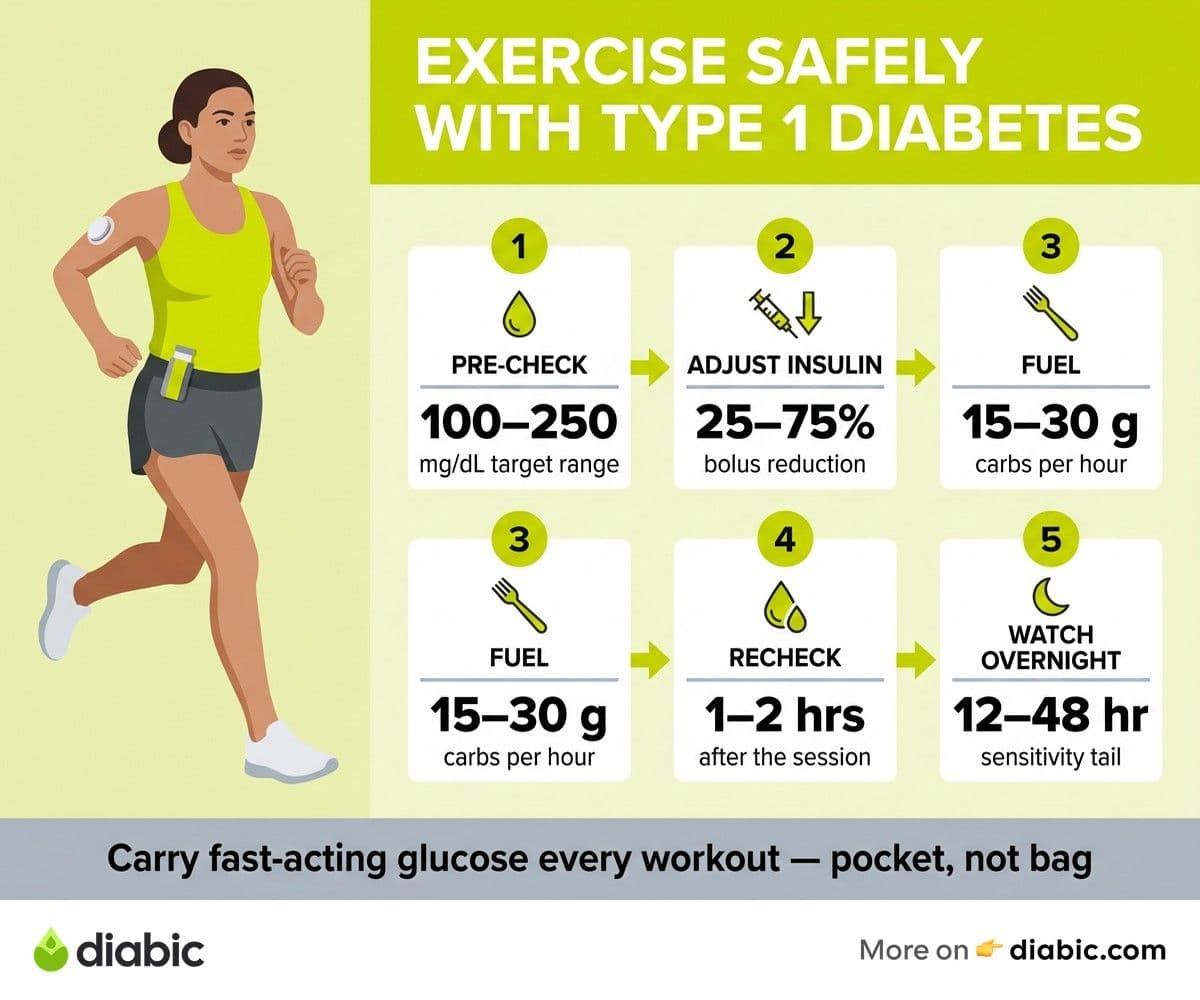
A widely used target range for starting most workouts is 100 to 250 mg/dL, with adjustments based on whether you have insulin on board and what kind of session you are about to do. Below roughly 100 mg/dL, eat 15 to 20 grams of fast-acting carbs and recheck before you begin. Above 250 mg/dL, especially if ketones are present, hold off until your numbers come down, since exercise with high glucose and ketones can push you toward DKA.
A few other rules of thumb that show up across major guidelines:
- Check before, every 30 minutes during longer sessions, and immediately after.
- Carry fast-acting glucose every single workout, even short ones.
- If you wear a CGM, set a low alert with enough buffer that you can react before you are deep in the red.
- Wear a medical ID, especially when you train outdoors or alone.
JDRF and Breakthrough T1D exercise resources recommend postponing a workout when you are sick, when blood sugar is unstable, or when ketones are present in your urine or blood. If you are still figuring out general exercise principles before adding insulin complexity, our companion guide on exercise for type 2 diabetes and where to start covers the basics that apply to everyone.
The pre-workout check also tells you what kind of session is realistic. A trending-down arrow at 110 mg/dL is a different story than a flat 110. Same number, different decision. With a little practice, the check becomes automatic and adds maybe 60 seconds to your routine.
Managing Insulin and Food Around Exercise
Juvenile diabetes and exercise have been studied enough to give us reasonable starting points for insulin adjustments, though every body is its own experiment. A consensus statement published in Diabetes Care lays out tiered recommendations based on workout intensity and timing, and the highlights are easy to translate.
For a planned aerobic workout within 1 to 2 hours of a meal, reducing the bolus for that meal by 25 to 75 percent is a common starting range. Steady, longer sessions need bigger reductions. Short, intense sessions usually need smaller ones, sometimes none. If you use a pump, a temporary basal reduction starting 60 to 90 minutes before exercise can also help.
When the workout is unplanned or comes between meals, food becomes the main lever. A small carb snack before starting, around 15 grams for most people, helps offset the drop without spiking you. For longer workouts beyond 60 minutes, plan to take in 15 to 30 grams of carbs per hour. Endurance athletes with T1D often work with their care team to dial these numbers in precisely.
The post-workout window is where most people get caught off guard. Eat a balanced snack or meal within 30 to 60 minutes after finishing, especially if you trained hard. Pair carbs with protein, since protein supports recovery and carbs replenish muscle glycogen. If you exercised in the evening, plan a small bedtime snack and consider reducing your overnight basal if your team agrees.
You also need to keep food to raise blood sugar fast within arm's reach throughout the workout. Glucose tablets, gel packets, or juice boxes are reliable. A granola bar is not, since the fat slows absorption right when you need speed. Treat fast carbs as part of your gear, the same way you treat shoes and water.
A practical insulin-and-food checklist for most planned workouts:
- Check blood sugar 30 to 60 minutes before starting.
- If you bolused for a recent meal, consider reducing future doses based on past patterns.
- Adjust the pre-workout snack based on the trend, not just the number.
- Carry fast-acting glucose in a pocket, not in a bag across the gym.
- Recheck immediately after, then again 1 to 2 hours later.
- Eat a balanced post-workout snack and lower your guard, not your awareness, for the next 12 to 24 hours.
Best Exercise Types for Type 1 Diabetes
Almost every form of exercise can be done safely with type 1 diabetes once you understand how it affects your numbers. The differences between activity types are mostly about how aggressively glucose moves and how soon you should expect a low.
Aerobic exercise: walking, swimming, cycling
Aerobic activity is usually the most predictable for blood sugar response. Walking is the easiest entry point and rarely causes dramatic drops. Swimming and cycling at a steady pace tend to lower blood sugar gradually, which gives you time to react. The catch with swimming is that you cannot easily check or treat in the water, so plan extra carefully and never swim alone if you tend to drop fast.
If you are looking to deepen your understanding of the different cardio styles and their effects, our piece on aerobic exercise and 5 proven benefits explains how steady-state work supports long-term insulin sensitivity.
Strength training
Resistance work is sometimes more friendly to blood sugar than long cardio. Heavy lifting can push glucose up briefly thanks to the adrenaline response, then bring it gently back down. For people who run lows easily during cardio, lifting can be a useful way to get exercise in without constantly chasing glucose.
A common pattern is to do strength work first and cardio second within the same session, since starting with lifting can help stabilize blood sugar before the cardio brings it down. Mileage varies, so test it.
Mixed exercise
Mixed sessions, like circuit training or sports practice, often deliver the best blood-sugar profile. Short bursts of intensity prevent the steady decline of pure cardio, while the cardio component still gives you the long-term benefits. Many people with T1D find that interval-style training, group fitness classes, and team sports feel "easier" on their numbers than 60 minutes on a treadmill.
Sports and competition
Competition adds adrenaline, anxiety, and unpredictable timing, all of which affect blood sugar. Pre-game spikes are common and not always a sign that you need correction insulin. Talk with your care team before competition season about a game-day playbook, including warm-up checks, halftime fueling, and post-game monitoring. Many T1D athletes use slightly higher target ranges on competition days than on training days.
Type 1 diabetes does not disqualify you from any sport. Pro athletes, marathoners, and CrossFitters with T1D have shown that with planning and the right tools, the limits are smaller than they feel from the inside.
FAQ
Is it safe to exercise with type 1 diabetes?
Yes, exercise is safe and beneficial for most people with type 1 diabetes when planned thoughtfully. The keys are checking blood sugar before, during, and after, adjusting insulin and food intake based on workout type, and always carrying fast-acting carbs. Build your plan with your diabetes care team and adjust it based on your own data over time.
How to manage blood sugar during exercise with type 1 diabetes?
Check blood sugar before starting and every 30 minutes during longer sessions. Aim to begin most workouts with blood sugar between 100 and 250 mg/dL, with no ketones if you are higher. Reduce your bolus insulin before planned activity, eat 15 to 30 grams of carbs per hour for longer sessions, and keep glucose tablets or juice within reach the entire time.
Can people with type 1 diabetes lift heavy weights or do CrossFit?
Yes, many people with T1D thrive in strength training, CrossFit, and high-intensity interval workouts. Intense exercise often pushes blood sugar up briefly because of adrenaline, then can drop it later, so the protocol shifts a bit compared to steady cardio. Work with your care team on insulin and fueling strategies, and watch out for delayed lows in the hours and overnight after hard sessions.
Why does my blood sugar go up during intense workouts?
Short, intense efforts trigger a stress hormone response, mainly adrenaline and cortisol, which prompts the liver to release stored glucose. Without enough circulating insulin, that glucose stays in the bloodstream and your number climbs. The rise is usually temporary, and many people see a delayed drop several hours later as muscles refill their glycogen stores. Tracking these patterns helps you plan insulin adjustments around your specific routine.
A safe diabetes exercise type 1 plan is rarely about getting it perfect on day one. It is about logging a handful of sessions, spotting your own patterns, and tweaking insulin and fueling until the workouts you want to do feel routine instead of risky.
Shahriar P. Shuvo is the founder of Diabic. He has lived with diabetes for over 14 years, and built Diabic to deliver the practical, evidence-based self-management tools he wished existed when he was first diagnosed. By trade, Shahriar is a senior design and frontend engineer with 6+ years shipping products at Agora, Timescale (now Tiger Data), and ShareTrip. He writes from the intersection of lived diabetes experience and product craft, focused on what works in daily management rather than what sounds good in a textbook.
Medically reviewed by
Dr. Rezwana Parvin Rumpa is an obstetrics and gynaecology specialist with clinical focus on gestational diabetes, PCOS, and fertility. She holds the MRCOG (Final Part) from the Royal College of Obstetricians and Gynaecologists in London, the MRCPI (Final Part) from the Royal College of Physicians of Ireland, and an MBBS from Shaheed Monsur Ali Medical College under Dhaka University. Dr. Rumpa serves as a Senior Medical Officer in the Obs and Gynae department at BRB Hospitals Ltd, where she has spent three years managing prenatal care, emergency obstetric cases, and women's-health surgery. On Diabic, she medically reviews content for women living with diabetes, with particular attention to pregnancy, PCOS, and reproductive-health intersections.
More from Diet & Fitness
View all
7 Sweet Potato Diabetes Recipes That Keep Blood Sugar Steady
Seven sweet potato diabetes recipes with balanced macros, plus the cooking methods and portion tips that keep this naturally sweet vegetable blood-sugar.

Diabetes Pasta Recipes That Won't Spike Blood Sugar
Five diabetes pasta recipes that keep blood sugar steady, plus the cooking trick and pasta swaps that lower glycemic impact for everyday meals.

Chinese Recipes for Diabetes That Taste Like Takeout
Chinese recipes for diabetes that recreate takeout favorites at home with low-sugar swaps, controlled portions, and stir-fries that keep blood sugar.
Clinician-reviewed habits, plain-language guides, and honest answers - the small shifts that make living with diabetes feel lighter, every day.