Is Intermittent Fasting Safe for Type 2 Diabetes
Is intermittent fasting for type 2 diabetes safe? A clear look at the risks, benefits, medication concerns, and how to start with your doctor's input.

In this article(9)
Intermittent fasting for type 2 diabetes is one of those topics where the internet sounds confident and the research sounds careful. Some people swear it transformed their A1C. Others wound up in a hypoglycemic episode within a week of starting. The difference often comes down to medication, monitoring, and how the fast was set up in the first place.
If you have been wondering whether skipping breakfast or running a 16-hour fasting window is actually safe for you, this guide is meant to help you think it through clearly. We will cover how the main fasting patterns work, what the safety picture looks like depending on your treatment, where the real benefits show up, and how to start without putting yourself at risk.
How Intermittent Fasting Works
Intermittent fasting is not a specific diet so much as a schedule. It defines when you eat rather than what you eat. The most common patterns include:
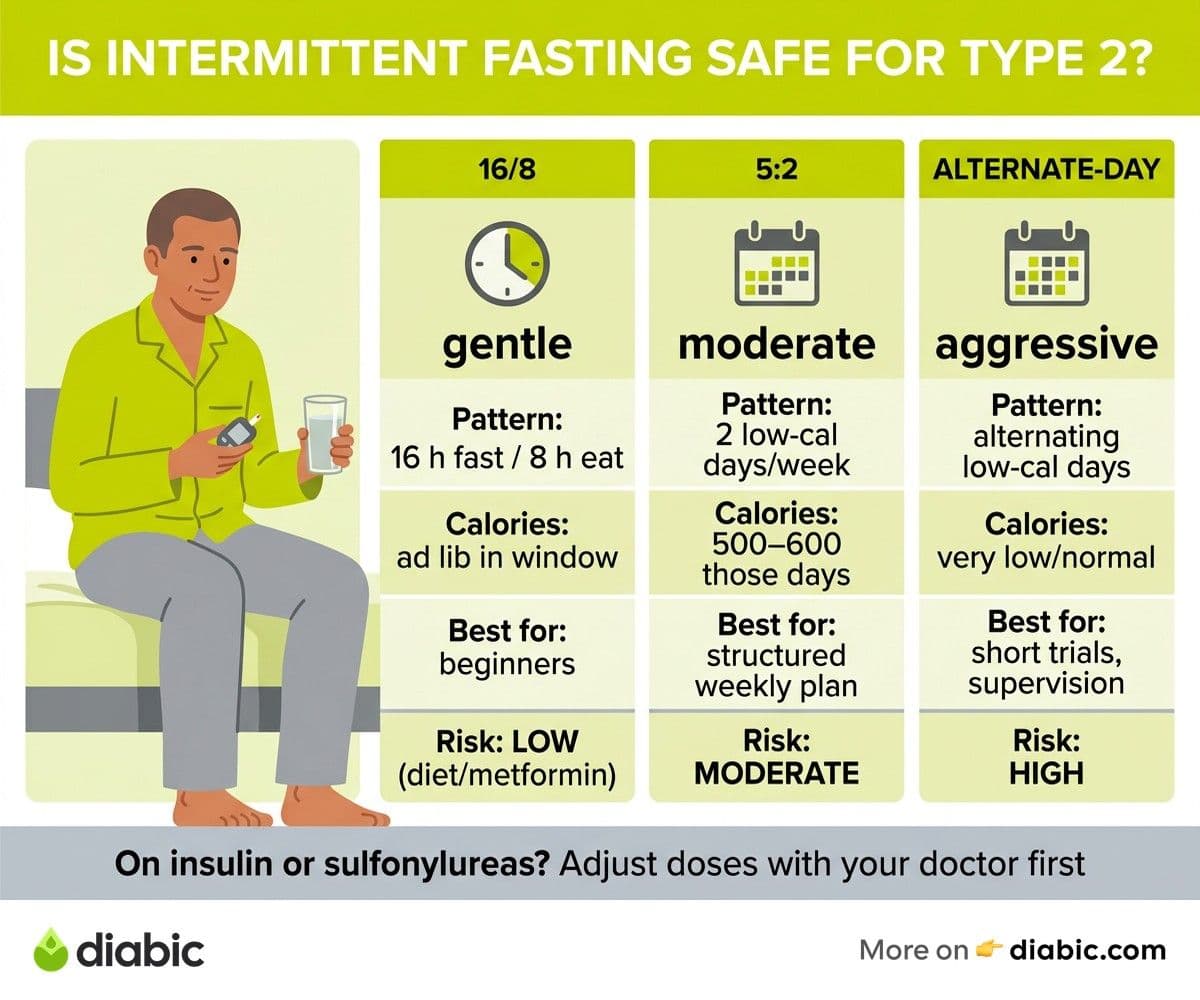
- 16/8 (time-restricted eating): You fast for 16 hours and eat within an 8-hour window, often skipping breakfast and eating between noon and 8 p.m.
- 5:2: You eat normally five days a week and significantly reduce calories (around 500 to 600) on two non-consecutive days.
- Alternate-day fasting: You alternate between regular eating days and very low-calorie days. This is the most aggressive of the common patterns.
Metabolically, when you stop eating, your body gradually shifts from using glucose from your last meal to drawing on stored glycogen, then on fat. Insulin levels drop during the fasting window, which gives insulin-sensitive tissues a break and may, over time, improve how your body responds to insulin during eating windows.
That mechanism is the reason researchers have grown interested in fasting as a tool for type 2 diabetes. If you are new to the topic, our fasting and diabetes overview covers the broader picture before you decide which schedule, if any, fits your life.
Safety of Intermittent Fasting for Type 2 Diabetes
The honest answer to whether intermittent fasting for type 2 diabetes is safe is that it depends on what you are taking. Type 2 diabetes intermittent fasting safety hinges almost entirely on your current treatment plan, your blood sugar history, and whether you are monitored.
For people whose diabetes is managed by diet and lifestyle alone, fasting is generally considered low risk when introduced gradually and with hydration. The main concerns are headaches, irritability, and overeating during the eating window, none of which are dangerous.
For those on metformin alone, the picture is also reasonably safe. Metformin does not typically cause low blood sugar on its own, so fasting windows are usually well tolerated. Some people experience digestive upset if they take metformin without food, which is worth flagging to your doctor.
The risk profile changes meaningfully for people on insulin or sulfonylureas (such as glipizide or glimepiride). These medications can lower blood sugar regardless of whether you have eaten, so a long fasting window can lead to hypoglycemia, which is the medical term for dangerously low blood sugar. The American Diabetes Association has specifically flagged this risk and recommends medical supervision and possible dose adjustments before fasting on these medications.
Frequent blood sugar monitoring becomes non-negotiable in the early weeks of any fasting attempt. Check before, during, and after fasting windows, especially if you are on any medication. Stop the fast and eat carbohydrates if your blood sugar drops below the threshold your doctor sets with you (often around 70 mg/dL).
If 16/8 specifically is what you are considering, our deeper guide to 16/8 intermittent fasting with diabetes walks through the schedule in more detail.
Potential Benefits
Intermittent fasting and type 2 diabetes have been studied in a growing number of trials, and the results are cautiously encouraging. The benefits are real but not magical, and they tend to depend on consistency.
Weight loss and body composition. Most people who follow intermittent fasting consistently lose some weight, often without counting calories. A shorter eating window tends to reduce overall intake naturally. For people with type 2 diabetes, even 5 to 7 percent weight loss is associated with meaningful improvements in glucose control.
Improved insulin sensitivity. Several smaller studies, including work published in Diabetes Care, suggest that time-restricted eating may improve insulin sensitivity, lower fasting glucose, and reduce A1C in people with type 2 diabetes. The effect appears strongest when the eating window is in the earlier part of the day rather than late at night.
Simpler meal planning. The practical benefit gets less attention than the metabolic ones. Eating two larger meals instead of three or four smaller ones can reduce decision fatigue and grocery costs. For some people, that simplicity is what makes the pattern stick.
Possible cardiovascular markers. Some studies show modest improvements in blood pressure, triglycerides, and inflammatory markers, although results vary and longer-term data is still being gathered.
It is worth keeping perspective. Intermittent fasting type 2 diabetes results in trials are typically similar to those from other calorie-restriction approaches. Fasting is one tool, not the only one. For a closer look at the safety question across other patterns, see our guide to fasting with type 2 diabetes safety.
From my experience: I have lived with diabetes for 14 years, and I tried a 14/10 window for a few months. The biggest surprise was not the metabolic effect, which was modest, but how much mental energy I got back from not planning breakfast. I also learned quickly that pushing the window longer when I was sleep-deprived made my morning numbers worse, not better. Listening to that pattern mattered more than chasing a specific schedule.
How to Start IF Safely With Diabetes
If you and your doctor decide to try intermittent fasting, the way you start matters as much as the schedule you choose. A careful ramp-up reduces the chance of low blood sugar, dizziness, and quitting in week one.
Use these steps as a framework, not a prescription, and adjust them with your healthcare team:
- Talk to your doctor before you change anything. Bring your current medications, recent A1C, and any history of low blood sugar to the conversation. If you are on insulin or sulfonylureas, your doctor may need to adjust doses before you start.
- Start with a 12-hour overnight fast. Most people already do this naturally. If dinner ends at 8 p.m. and breakfast starts at 8 a.m., you are at 12 hours. Hold this for a week or two.
- Narrow the window gradually. Move to 13, then 14, then 16 hours over several weeks rather than jumping straight to 16/8. This gives your body time to adjust and gives you data on how your blood sugar responds.
- Plan nutrient-dense meals. Eating windows are not a free-for-all. Build meals around vegetables, lean protein, healthy fats, fiber-rich carbs, and plenty of water. Skipping breakfast and then eating ultra-processed food at noon defeats the purpose.
- Monitor blood sugar more often. Check before meals, before bed, and any time you feel off. Keep a log of what you ate, when you ate, and your readings.
- Know when to break the fast. If your blood sugar drops below the level your doctor set, eat 15 grams of fast-acting carbs (juice, glucose tablets) and stop the fast for the day. Do not try to push through.
- Stop fasting if any of these show up: repeated lows, dizziness, confusion, severe fatigue, or sudden changes in how you feel. These are signals to step back and talk to your provider.
Pregnancy, a history of eating disorders, type 1 diabetes, advanced kidney disease, and a few other conditions are reasons not to fast at all. Your provider is the right person to confirm what is appropriate for you.
FAQ
Is intermittent fasting safe for people with diabetes on medication?
It depends on the medication. People taking metformin alone can usually fast safely with monitoring. Those on insulin or sulfonylureas face a higher risk of low blood sugar and need medical supervision and possible dose adjustments before starting. Never change medication doses on your own, even if your blood sugar improves on a fast.
What type of intermittent fasting is best for type 2 diabetes?
The 16/8 method is the most studied and the easiest for most people to start. The 5:2 method is another option for those who prefer a few low-calorie days rather than a daily window. Some research suggests an earlier eating window (around 8 a.m. to 4 p.m.) may have stronger metabolic benefits than a later one, but the best schedule is the one you can sustain with your doctor's input.
How long does it take to see benefits from intermittent fasting with diabetes?
Some people see fasting glucose improvements within a few weeks. A1C reflects three months of average blood sugar, so meaningful changes typically take 8 to 12 weeks of consistent practice. Weight loss often starts in the first month if the eating window naturally reduces total intake.
Can intermittent fasting reverse type 2 diabetes?
Some studies have shown that combining intermittent fasting with overall calorie reduction and weight loss may help some people achieve diabetes remission, where blood sugar stays in the non-diabetic range without medication. Remission is not the same as a cure, and it is not guaranteed. Talk to your doctor about whether remission is a realistic goal for your situation.
Intermittent fasting for type 2 diabetes is neither a quick fix nor a danger zone. With the right medication review, careful monitoring, and a slow ramp, it can become one useful tool among several. The decision to try it is best made with your healthcare team, not your social media feed.
Shahriar P. Shuvo is the founder of Diabic. He has lived with diabetes for over 14 years, and built Diabic to deliver the practical, evidence-based self-management tools he wished existed when he was first diagnosed. By trade, Shahriar is a senior design and frontend engineer with 6+ years shipping products at Agora, Timescale (now Tiger Data), and ShareTrip. He writes from the intersection of lived diabetes experience and product craft, focused on what works in daily management rather than what sounds good in a textbook.
Medically reviewed by
Dr. Rezwana Parvin Rumpa is an obstetrics and gynaecology specialist with clinical focus on gestational diabetes, PCOS, and fertility. She holds the MRCOG (Final Part) from the Royal College of Obstetricians and Gynaecologists in London, the MRCPI (Final Part) from the Royal College of Physicians of Ireland, and an MBBS from Shaheed Monsur Ali Medical College under Dhaka University. Dr. Rumpa serves as a Senior Medical Officer in the Obs and Gynae department at BRB Hospitals Ltd, where she has spent three years managing prenatal care, emergency obstetric cases, and women's-health surgery. On Diabic, she medically reviews content for women living with diabetes, with particular attention to pregnancy, PCOS, and reproductive-health intersections.
More from Diet & Fitness
View all
7 Sweet Potato Diabetes Recipes That Keep Blood Sugar Steady
Seven sweet potato diabetes recipes with balanced macros, plus the cooking methods and portion tips that keep this naturally sweet vegetable blood-sugar.

Diabetes Pasta Recipes That Won't Spike Blood Sugar
Five diabetes pasta recipes that keep blood sugar steady, plus the cooking trick and pasta swaps that lower glycemic impact for everyday meals.

Chinese Recipes for Diabetes That Taste Like Takeout
Chinese recipes for diabetes that recreate takeout favorites at home with low-sugar swaps, controlled portions, and stir-fries that keep blood sugar.
Clinician-reviewed habits, plain-language guides, and honest answers - the small shifts that make living with diabetes feel lighter, every day.