Can Fasting Reverse Diabetes? What Research Says
Can fasting reverse diabetes? We unpack the latest research on intermittent fasting, remission, and what it really means for your blood sugar.

In this article(9)
You have probably seen the headlines. "Patient reverses diabetes after weeks of fasting." "Intermittent fasting could end type 2 diabetes." Bold claims like these spread quickly, and they raise a question worth asking honestly: can fasting reverse diabetes, or is the truth more complicated?
The short answer is that research is evolving. Some studies show genuinely promising results, particularly for people in the earlier stages of type 2 diabetes. Other findings remind us that what looks like reversal often depends on weight loss, lifestyle change, and ongoing effort rather than fasting alone.
We want to walk through what the science actually shows, where it falls short, and how to think about fasting if you are weighing it as part of your diabetes management plan.
What the Research Shows So Far
When people ask "does fasting help diabetes," they are usually picturing a clean before-and-after story. The reality from clinical studies is more textured. Several small trials suggest intermittent fasting may improve fasting glucose, HbA1c, and insulin sensitivity in people with type 2 diabetes.
A widely discussed case series published in BMJ Case Reports followed three men with type 2 diabetes who used therapeutic fasting protocols under medical supervision. All three were able to stop insulin therapy within a month, and two stopped all diabetes medications. Their HbA1c dropped, and they lost significant weight. It is a striking story, but it is three people, and they had close clinical oversight.
Larger studies tell a similar but more cautious story. Research published in JAMA Network Open found that a 5:2 intermittent fasting protocol (two low-calorie days per week) led to greater HbA1c reductions than standard medication advice over 16 weeks. Many participants reduced or stopped their glucose-lowering drugs.
What these studies tend to share is a mechanism: fasting reduces caloric intake, which leads to weight loss, which appears to lower fat in the liver and pancreas. That last point matters. Researchers like Roy Taylor have proposed a "twin cycle hypothesis" suggesting that excess fat in these organs drives type 2 diabetes, and reducing that fat can restore beta cell function in some people. Fasting is one route to that fat loss. It is not the only route.
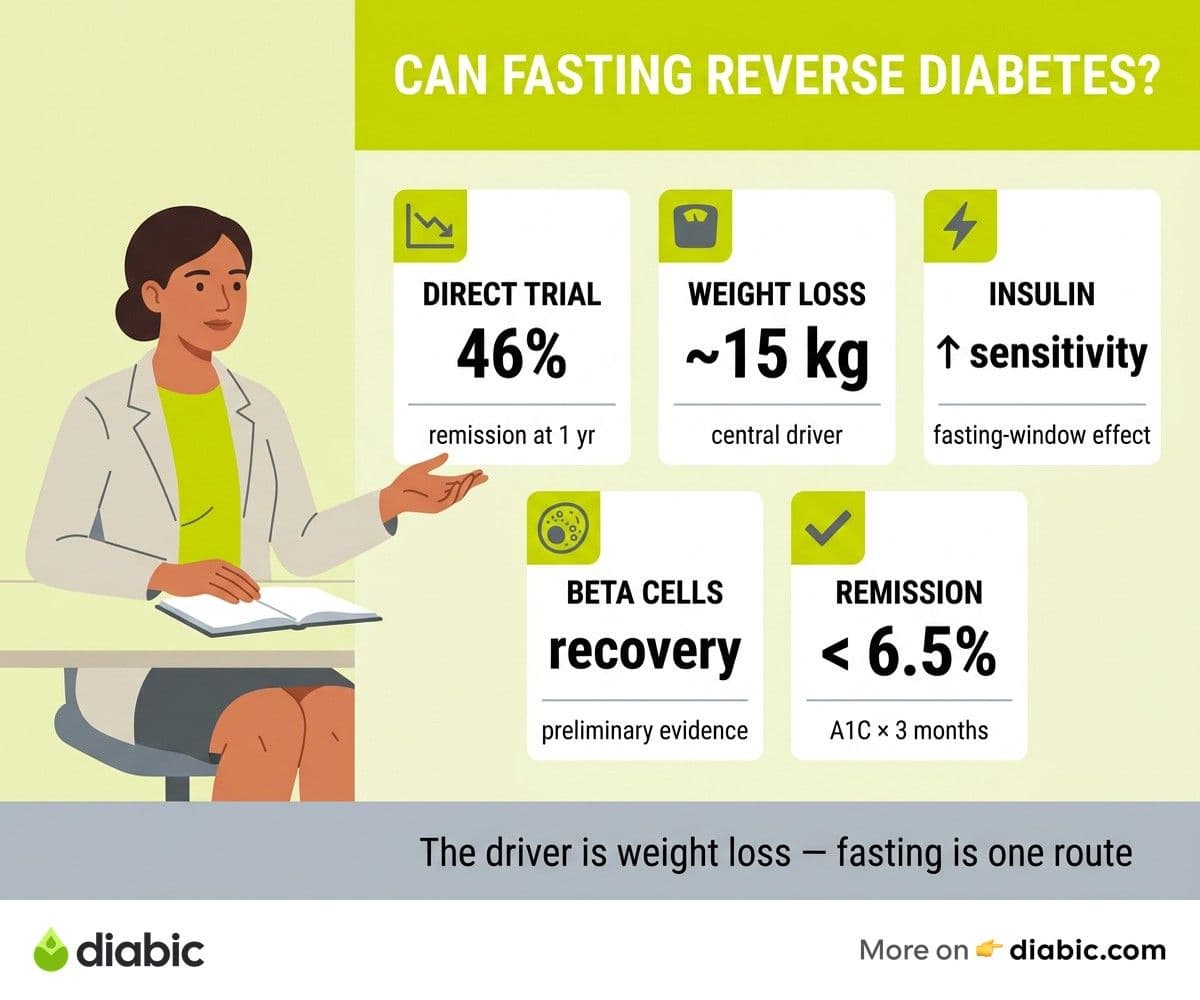
It is worth separating two ideas here. Improved diabetes management means lower blood sugar, less medication, and better daily numbers. True reversal, sometimes called remission, means maintaining normal blood sugar without diabetes medication, usually defined as an HbA1c below 6.5% for at least three months. Both are meaningful. They are not the same thing.
How Fasting Might Help with Diabetes
When we talk about how fasting might help with diabetes, four mechanisms come up repeatedly in the research. None of them are magic. Most of them connect back to the same underlying changes that any sustained dietary improvement can produce.
The first and biggest mechanism is weight loss. The DiRECT trial in the UK showed that intensive weight loss (around 15 kg) put nearly half of participants into type 2 diabetes remission at one year. Fasting is one tool people use to achieve that kind of sustained calorie reduction. According to Diabetes Care, the journal of the American Diabetes Association, weight reduction remains the most consistent predictor of glycemic improvement and remission in people with type 2 diabetes.
Improved insulin sensitivity is the second piece. During fasting periods, insulin levels drop, and cells become more responsive to insulin when food is reintroduced. Over time, this rhythm may help reduce insulin resistance, which is the central problem in type 2 diabetes.
Beta cell function is the third. Beta cells in the pancreas produce insulin. In type 2 diabetes, they are often overworked and underperforming. Some research suggests that giving these cells a rest through fasting periods, combined with reduced fat in the pancreas, may help them recover capacity. The evidence here is more preliminary than the weight loss data.
Fourth, there are metabolic shifts during longer fasts that include increased fat oxidation, ketone production, and changes in hormones like glucagon and growth hormone. Whether these shifts are uniquely therapeutic or simply a byproduct of caloric restriction is still being debated. For a fuller picture of how this works in practice, our fasting and diabetes overview walks through the basics of safe protocols and what to watch for.
From my experience: in 14 years of living with diabetes, I have noticed that any approach which forces me to think about my eating patterns, even briefly, tends to improve my numbers. Fasting did this for me, but so did meal sequencing, and so did simply walking after dinner. The mechanism that matters most is the one you can actually keep doing.
Limitations and What We Still Do Not Know
Conversations about fasting and diabetes can get one-sided fast. To stay honest about the evidence, we have to talk about the limits.
Most studies on fasting and diabetes are small. A trial with 30 or 60 participants over 12 weeks gives us a useful signal, not a definitive answer. The largest, longest trials are still a few years away from publication. The National Institute of Diabetes and Digestive and Kidney Diseases notes that while time-restricted eating has shown metabolic benefits, more research is needed to determine its long-term effects on diabetes outcomes.
Individual response varies more than headlines suggest. Some people in fasting trials see substantial drops in HbA1c. Others see modest changes. A few see no improvement at all. Genetics, baseline insulin function, duration of diabetes, medication regimen, and lifestyle context all shape the result.
Sustainability is a real concern. A protocol that produces excellent results during a 12-week study may be much harder to maintain at month nine, year two, or for the rest of someone's life. When people stop fasting, weight tends to return, and so do the metabolic problems that came with it. This is the rebound risk.
There is also the question of who fasting is not appropriate for. People taking insulin or sulfonylureas are at meaningful risk of hypoglycemia during extended fasts. Pregnant or breastfeeding individuals, people with type 1 diabetes, those with a history of eating disorders, and anyone with significant kidney or cardiovascular disease should not start fasting protocols without close medical guidance. The American Diabetes Association has published cautious guidance on intermittent fasting that emphasizes individualization.
If you are looking at fasting alongside other approaches, our piece on whether diabetes can be reversed by diet and exercise walks through the evidence for non-fasting interventions and how they compare. The honest takeaway is that no single tool wins. Sustained behavior change wins.
Can Fasting Reverse Diabetes: A Balanced View
Here is how we would frame fasting if a friend with type 2 diabetes asked us about it over coffee. Fasting is one possible tool. For some people, it works very well. For others, it does not, or it cannot be sustained. It is not a guaranteed path to remission, and it is rarely effective on its own without other lifestyle changes.
Fasting works best when it is part of a broader approach. Most people in successful remission studies were also moving more, eating mostly whole foods, sleeping better, and managing stress. Fasting was a structure, not a magic bullet.
Medical supervision is not optional, especially in the first weeks. If you are on glucose-lowering medication, your doctor may need to adjust doses to prevent dangerous lows. A continuous glucose monitor can be helpful here, and so can a clinician who has experience with metabolic interventions. If you are weighing options, our guide to intermittent fasting for type 2 diabetes covers safety considerations in more depth.
There is something worth saying about the word "reversal" itself. It can be motivating. It gives people a goal that feels real and achievable. It can also be misleading if it suggests that diabetes goes away forever and never needs attention again. Most clinicians prefer the term "remission" because it acknowledges that the metabolic vulnerability remains. Returning to old patterns often returns the disease. So can fasting reverse diabetes? In some cases, fasting can contribute to remission, particularly for people in the earlier stages of type 2 diabetes who are willing and able to make lasting lifestyle changes. Calling that "reversal" is reasonable, as long as we remember it is not permanent and not universal.
Frequently Asked Questions
Can you reverse type 2 diabetes by fasting?
Some small studies suggest that intermittent fasting may help certain people with type 2 diabetes achieve remission, primarily through significant weight loss and improved insulin sensitivity. The effect appears strongest in people who have had diabetes for less than six years and who can sustain the lifestyle change long-term. Larger trials are still in progress, and remission is not guaranteed for any individual.
What does the research say about fasting and diabetes reversal?
Early research is promising but limited. Several small to mid-sized trials show meaningful improvements in HbA1c, fasting glucose, and medication needs with intermittent fasting protocols. Most experts agree the benefits come primarily from weight loss and reduced fat in the liver and pancreas rather than fasting itself being uniquely therapeutic. Bigger, longer studies are needed before fasting can be recommended as a standard reversal strategy.
Is fasting safe for someone with type 2 diabetes?
Fasting can be safe for many people with type 2 diabetes when done with medical supervision and proper medication adjustments. The main risks are hypoglycemia (especially on insulin or sulfonylureas), dehydration, and disordered eating patterns. Talk to your doctor before starting any fasting protocol, and consider working with a clinician who has experience with metabolic interventions.
How long do you have to fast to see results?
In published studies, meaningful improvements in blood sugar markers typically appear within 8 to 16 weeks of consistent intermittent fasting, though some people notice changes sooner. Sustained results require sustained practice. Fasting for a few weeks and then returning to old patterns generally erases the benefits.
So when someone asks can fasting reverse diabetes, the most useful answer is rarely a yes or a no. The evidence so far suggests that, for some people in the earlier stages of type 2 diabetes, structured fasting paired with broader lifestyle change can produce remission worth celebrating. For others, the same protocol will not move the needle. Talk to your care team before changing your eating pattern, set a realistic timeline of three to six months, and watch your numbers more than the headlines. The answer to can fasting reverse diabetes will keep evolving as larger trials report, and your own data is the version that matters most.
Shahriar P. Shuvo is the founder of Diabic. He has lived with diabetes for over 14 years, and built Diabic to deliver the practical, evidence-based self-management tools he wished existed when he was first diagnosed. By trade, Shahriar is a senior design and frontend engineer with 6+ years shipping products at Agora, Timescale (now Tiger Data), and ShareTrip. He writes from the intersection of lived diabetes experience and product craft, focused on what works in daily management rather than what sounds good in a textbook.
Medically reviewed by
Dr. Shanto Arian is an internal medicine physician now specializing in clinical and aesthetic dermatology, with a parallel academic focus on epidemiology and public health. He holds an MBBS, MPH, MSc (UK), MRCP (UK), MRCPI (Ireland), Diploma in Dermatology (UK), and Diploma in Aesthetic Medicine (USA). Dr. Arian trained in internal medicine, including hospital work on hematology cases such as graft-versus-host disease, before moving toward dermatology. Skin is one of the earliest places diabetes shows itself, from acanthosis nigricans and diabetic dermopathy to slow foot wound healing, and that intersection is where his clinical and Diabic-review work meet. On Diabic, Dr. Arian medically reviews content on diabetes diagnosis, complications, dermatologic manifestations, and pharmacotherapy, ensuring every claim aligns with current ADA, NICE, and peer-reviewed literature.
More from Diet & Fitness
View all
7 Sweet Potato Diabetes Recipes That Keep Blood Sugar Steady
Seven sweet potato diabetes recipes with balanced macros, plus the cooking methods and portion tips that keep this naturally sweet vegetable blood-sugar.

Diabetes Pasta Recipes That Won't Spike Blood Sugar
Five diabetes pasta recipes that keep blood sugar steady, plus the cooking trick and pasta swaps that lower glycemic impact for everyday meals.

Chinese Recipes for Diabetes That Taste Like Takeout
Chinese recipes for diabetes that recreate takeout favorites at home with low-sugar swaps, controlled portions, and stir-fries that keep blood sugar.
Clinician-reviewed habits, plain-language guides, and honest answers - the small shifts that make living with diabetes feel lighter, every day.