Diabetic Friendly Fast Food Options
Diabetic friendly fast food options exist at nearly every chain. Here's how to order at McDonald's, Chipotle, Subway, and more without spiking your blood.

In this article(32)
You pull into a drive-through after a long shift, and the menu board feels like a minefield. Diabetic friendly fast food options exist at virtually every major chain, but finding them takes more than scanning for the word "salad." It takes a small framework you can apply anywhere, and a little practice asking for what you actually want.
This guide walks through the major chains people actually visit, the items that tend to work, and the swaps that turn a blood sugar spike into a steady afternoon. We will cover specific menu items, ordering scripts, and how to think about any unfamiliar restaurant the moment you walk in.
A Complete Guide to Diabetic Friendly Fast Food Options
Searching for diabetic friendly fast food options gets messy fast because most "healthy" lists ignore carb counts entirely. A grilled chicken wrap can carry 50 grams of carbs once you count the tortilla and dressing. A "low-fat" muffin can hit 60 grams before lunch. Marketing language and blood sugar reality often part ways.
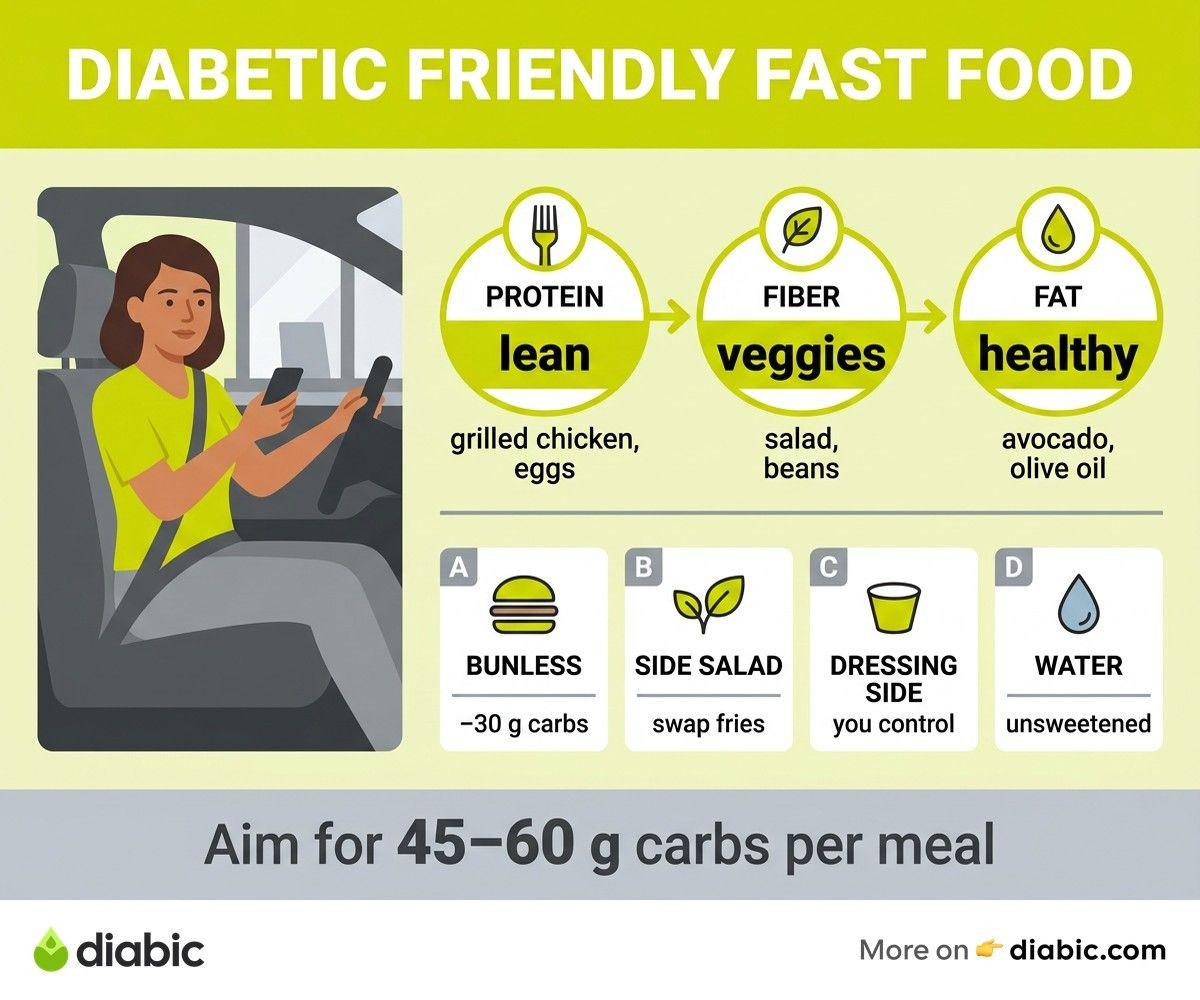
The fix is simple. We evaluate every meal through a protein-fiber-fat lens and worry less about labels. Your goal is a plate that mostly looks like protein and vegetables, with a controlled portion of carbs sitting alongside.
The American Diabetes Association suggests aiming for around 45 to 60 grams of carbohydrate per meal for most adults, though your dietitian may recommend a different range based on your medications and activity (ADA dining out guidance). Hold that target in your head before you order, and most decisions get easier.
We are not chasing perfection here. Skipping fast food entirely is unrealistic for most people, and that is fine. The aim is harm reduction and consistency, not a flawless macro split for every meal of your life.
The protein-fiber-fat framework for evaluating any menu
Before you order, scan the menu for three things: a lean protein source, a fiber source (vegetables, beans, or a small portion of whole grains), and a healthy fat (avocado, olive oil, nuts, cheese in moderation). If a meal hits all three, you have a workable plate.
This framework works at burger joints, taco shops, sandwich counters, and even pizza chains. The combinations change, but the logic does not.
Diabetic Fast Food Options at Major Chains
Diabetic fast food options vary wildly by chain, but a handful of staples tend to repeat. Here is how the biggest names stack up, with rough carb counts pulled from each chain's published nutrition data and cross-checked against USDA FoodData Central. Numbers shift with promotions and recipe changes, so always confirm in the app.
McDonald's
The Egg McMuffin is one of the more workable breakfast picks, with around 30 grams of carbs and 17 grams of protein. The English muffin is the carb load, so pairing it with a black coffee instead of orange juice keeps the meal in range. For lunch, a grilled chicken salad with the Newman's Own balsamic vinaigrette runs around 14 grams of carbs and brings real protein. A four-piece chicken nugget alongside a side salad is another reasonable order when nothing else looks right (McDonald's nutrition info).
What to skip: the McMuffin sandwiches with biscuits, hash browns, sweetened iced coffees, and the McFlurry. The biscuit alone clocks in over 40 grams of carbs.
Burger King
Order the grilled chicken sandwich without the bun, or ask for it lettuce-wrapped. You drop roughly 30 grams of carbs and keep about 28 grams of protein. A garden side salad with light Italian dressing rounds out the plate. The Impossible Whopper without the bun is another solid pick if you want plant-based.
Wendy's
Wendy's is one of the more diabetes-friendly chains because of two items: chili and grilled chicken. A small chili has about 23 grams of carbs, 15 grams of protein, and 6 grams of fiber. Pair it with a grilled chicken sandwich (no bun) and you have a complete meal in the 35 to 40 gram carb range. A half baked potato with chili on top is another option, though the full potato is too much starch for most people in one sitting.
Subway
Subway works best when you skip the bread entirely. Order any sub as a chopped salad or a protein bowl. A turkey breast chopped salad with avocado, olive oil, and vinegar lands around 12 grams of carbs and 25 grams of protein. The wraps are deceptive, often carrying more carbs than a six-inch sub, so the salad route wins.
Taco Bell
The Power Menu Bowl with chicken, black beans, lettuce, cheese, and salsa runs around 50 grams of carbs, which is at the upper end of a single meal but workable if rice is your only starch all day. Ask for fresco style (swap cheese and sauce for pico) to cut 50 calories and a few grams of carbs. The black bean Crunchwrap is a vegetarian pick that stays around 50 grams when you skip the rice.
For more chain-specific picks with carb counts, see our roundup of 10 specific fast food options worth trying.
More Fast Food Diabetic Options to Explore
Fast food diabetic options expand significantly when you move past the burger giants. The fast-casual category, in particular, gives you more control over what ends up on your plate.
Chipotle
Chipotle is arguably the most flexible chain for blood sugar management because you build the meal yourself. A solid bowl looks like this: lettuce or half rice base, double chicken or sofritas, black beans, fajita veggies, salsa, cheese, and guacamole. Skip the tortilla and the chips. That bowl runs about 35 to 45 grams of carbs depending on your rice portion, with 40-plus grams of protein. Use the Chipotle nutrition calculator to see your build before you order.
A few tweaks worth knowing. Half the rice (or none) saves 20 to 25 grams of carbs. Sofritas is the most fiber-rich protein. Guacamole adds healthy fat that slows the carb absorption from the rice and beans.
Chick-fil-A
The grilled nuggets are the standout: 8 pieces deliver 25 grams of protein with only 2 grams of carbs. Pair with a Market Salad (around 25 grams of carbs with the dressing on the side) or a side of fruit cup. The grilled chicken sandwich works on its own, especially if you eat half the bun. Skip the regular nuggets, the polynesian sauce, and the lemonade.
Panera Bread
Panera offers the "You Pick Two" option, which is your best bet here. Pair a half portion of broth-based soup (chicken noodle, ten vegetable, or turkey chili) with a half portion of a salad. Avoid the bread bowls and the creamy soups. The Mediterranean Bowl with chicken is another diabetes-friendly pick at around 50 grams of carbs.
Popeyes
When fried chicken is the only option, here is the play: order a plain grilled-style chicken if available, or remove the breading from a regular piece. Pair with green beans or coleslaw (in a small portion) and skip the biscuit, mashed potatoes with gravy, and Cajun fries. It is not ideal, but it is workable.
Pizza chains
Pizza is doable in moderation. Order a thin-crust personal pizza with extra vegetables and a protein topping like grilled chicken or pepperoni. Two slices of a thin-crust pie with veggies typically lands in the 30 to 40 gram carb range. Pair with a side salad to add fiber. Skip the breadsticks, stuffed crust, and the second helping.
Low-Carb Fast Food Strategies
Low carb fast food for people with diabetes is mostly about subtraction. You are not trying to hunt down keto-certified menus. You are removing the highest-carb pieces of any standard order and leaving the rest intact.
The bun-skip is the single biggest lever. A typical fast food bun adds 25 to 30 grams of carbs and almost no nutritional value. Most chains will lettuce-wrap, fork-and-knife, or simply hand you the patty in a clamshell if you ask. A bunless double cheeseburger from almost any drive-through is a viable low-carb meal at around 5 grams of carbs and 30-plus grams of protein.
Skipping the fries
The fries swap saves the most blood sugar grief. A medium fry runs 45 to 50 grams of refined carbs, which is a full meal's worth on its own. Replace with a side salad, fruit cup, apple slices, side of chili, or a kid-sized portion of fries if you cannot fully say no.
Drinks that quietly add 40 grams of sugar
A medium soda or sweet tea adds 40 to 60 grams of pure sugar to your meal. Switching to unsweetened iced tea, water, or a diet soda eliminates that spike entirely. Lemonades and frozen drinks are usually worse than soda. Coffees with flavored syrups can hide 30 grams of sugar in a single drink, so order yours black, with cream, or with a sugar-free syrup.
Sauces and dressings hide carbs
Honey mustard, BBQ sauce, sweet-and-sour, polynesian, teriyaki, and most "Asian" dressings carry 10 to 20 grams of carbs per serving. A "salad" can become a 60-gram-carb meal once you pour on the dressing. Stick with vinaigrettes, mustard, hot sauce, salsa, mayo, and ranch, all of which are low or no-carb. For a deeper look at where hidden sugars live, see our piece on foods that spike blood sugar.
Read the app, not the menu board
Every major chain has an app or website with nutrition info. The numbers there often differ from what you see on the menu, and they let you customize before you commit. Building your order in the Chipotle, Chick-fil-A, or Subway app and reviewing the carb count before checkout takes 30 seconds and saves a lot of guessing.
How to Order Diabetic Friendly at Any Fast Food Restaurant
The question we get most often is: what fast food restaurants have diabetic-friendly options? The honest answer is almost all of them, if you know how to order. The framework below works whether you are at a chain you have visited a hundred times or a regional spot you have never seen before.
Start with the protein. Pick the leanest option you can identify (grilled chicken, eggs, beans, fish, or even a single beef patty) and build the meal around it. Skip or shrink the starchy carb. Replace the standard side with vegetables, a salad, or a small portion of beans. Choose water or an unsweetened drink. Hold the sweetened sauces.
Questions worth asking at the counter
A few short questions often unlock options that are not on the menu. "Can I get this without the bun?" "What is your lowest-carb dressing?" "Can you swap the fries for a salad?" "Do you have grilled instead of fried?" Most staff are used to substitution requests and will accommodate without a second thought.
Build a "safe order" rotation
The single most useful habit for eating fast food with diabetes is building a memorized safe order at each of your regular spots. Two to three pre-vetted meals per chain. You stop deliberating in the parking lot, you stop being surprised by your numbers, and you stop relying on willpower at the counter.
From my experience: In 14 years of living with diabetes, the move that helped me most was writing a short list in my Notes app of three "always works" orders at each of the chains near my house. I check the list before I walk in. It sounds silly, but it removes the decision fatigue that pushes most of us toward whatever the cashier suggests. The numbers after the meal stopped being a surprise.
Ordering Fast Food If You Have Diabetes
How to order fast food if you have diabetes comes down to context as much as menu choice. The same Wendy's order can land differently depending on whether you ate breakfast, what your morning numbers looked like, and whether you are about to walk for an hour or sit in traffic.
Pre-planning beats impulse ordering almost every time. If you know you are stopping for lunch, pull up the app on your way there and lock in your choice before the menu board pressures you. Impulse ordering is where the highest-carb items usually win. The CDC's healthy eating with diabetes resources emphasize that a consistent meal pattern across the week matters more for A1C than any single perfect meal.
Group meals and peer pressure
Eating with coworkers or family adds a different layer of difficulty. You do not owe anyone an explanation for your order, and most people will not notice what you got. If someone presses, "I am keeping it light today" tends to end the conversation. The internal pressure (matching what others are eating) is usually heavier than any external pressure.
Splitting and shrinking portions
Fast food portions have grown for decades. A "regular" combo is often 1.5 to 2 servings of food. Splitting a meal with a partner, ordering off the kids' menu, or ordering an entrée without a combo can easily drop your meal by 30 to 50 grams of carbs without sacrificing satisfaction.
Apply the plate method to your tray
The same logic that works at home applies here. Aim for half the tray as non-starchy vegetables or salad, a quarter as protein, and a quarter as carbs. Our breakdown of the diabetes plate method shows how this looks in practice and translates directly to fast food trays. A grilled chicken sandwich (cut the bun in half), a side salad, and a fruit cup is a textbook example.
Fast food is not the enemy. Eating diabetic friendly fast food options consistently is a real skill, and it gets easier the more you practice. The chains are not going anywhere, your schedule is not going to suddenly slow down, and the goal is to make peace with the reality that drive-throughs will be part of your week sometimes. Build a few safe orders, learn the swaps, and trust that a workable meal beats a perfect one you never actually eat.
Frequently Asked Questions
What fast food restaurants have diabetic-friendly options?
Nearly every major chain has options that work. Chipotle, Chick-fil-A, Subway, Wendy's, and Panera Bread tend to offer the most flexibility for customization, since you can build or modify the meal heavily. Burger giants like McDonald's and Burger King work too, as long as you focus on grilled chicken, salads, breakfast eggs, and bunless options. The key is knowing how to modify standard menu items rather than searching for a "diabetic" menu item.
How should you order fast food if you have diabetes?
Start with a grilled or baked protein, skip or reduce starchy sides like fries and white rice, swap sweet drinks for water or unsweetened tea, and check nutrition info in the app before ordering when you can. Lettuce-wrap or fork-and-knife the bun on burgers and sandwiches. Hold the sweet sauces and dressings, since these often add 15 to 30 grams of hidden carbs.
Can I eat pizza if I have diabetes?
Yes, in moderation. Choose thin crust over deep dish, pile on vegetables and a lean protein, and limit yourself to two slices paired with a side salad. Pre-bolus if you take mealtime insulin, since cheese and fat slow digestion and can cause delayed spikes. Skip the breadsticks, stuffed crust, and second helpings.
Is grilled chicken always the best fast food choice?
Usually, but not always. Grilled chicken is lean and low in carbs, but the dressing, bun, and sides can change the whole meal's profile. A grilled chicken sandwich with honey mustard, fries, and a soda can carry more carbs than a bunless cheeseburger with a side salad and water. Look at the whole plate, not just the protein.
Are fast food breakfasts okay for diabetes?
Some are. Egg-based breakfasts with a small piece of bread tend to work better than carb-heavy options. An Egg McMuffin, Starbucks egg bites, or a Subway egg-and-cheese flatbread (eaten as half) can all be reasonable. Skip pastries, sweet coffee drinks, hash browns, biscuits, and pancakes when you can.
The reason we keep coming back to this topic is that the diabetic friendly fast food options most people need are usually one or two small modifications away from items already on the menu. Skip the bun, swap the fries, choose water, hold the sweet sauces, and the meal you walk out with will look very different from the default combo. That difference is what keeps your numbers steady through a busy week.
Shahriar P. Shuvo is the founder of Diabic. He has lived with diabetes for over 14 years, and built Diabic to deliver the practical, evidence-based self-management tools he wished existed when he was first diagnosed. By trade, Shahriar is a senior design and frontend engineer with 6+ years shipping products at Agora, Timescale (now Tiger Data), and ShareTrip. He writes from the intersection of lived diabetes experience and product craft, focused on what works in daily management rather than what sounds good in a textbook.
Medically reviewed by
Dr. Shanto Arian is an internal medicine physician now specializing in clinical and aesthetic dermatology, with a parallel academic focus on epidemiology and public health. He holds an MBBS, MPH, MSc (UK), MRCP (UK), MRCPI (Ireland), Diploma in Dermatology (UK), and Diploma in Aesthetic Medicine (USA). Dr. Arian trained in internal medicine, including hospital work on hematology cases such as graft-versus-host disease, before moving toward dermatology. Skin is one of the earliest places diabetes shows itself, from acanthosis nigricans and diabetic dermopathy to slow foot wound healing, and that intersection is where his clinical and Diabic-review work meet. On Diabic, Dr. Arian medically reviews content on diabetes diagnosis, complications, dermatologic manifestations, and pharmacotherapy, ensuring every claim aligns with current ADA, NICE, and peer-reviewed literature.
More from Diet & Fitness
View all
7 Sweet Potato Diabetes Recipes That Keep Blood Sugar Steady
Seven sweet potato diabetes recipes with balanced macros, plus the cooking methods and portion tips that keep this naturally sweet vegetable blood-sugar.

Diabetes Pasta Recipes That Won't Spike Blood Sugar
Five diabetes pasta recipes that keep blood sugar steady, plus the cooking trick and pasta swaps that lower glycemic impact for everyday meals.

Chinese Recipes for Diabetes That Taste Like Takeout
Chinese recipes for diabetes that recreate takeout favorites at home with low-sugar swaps, controlled portions, and stir-fries that keep blood sugar.
Clinician-reviewed habits, plain-language guides, and honest answers - the small shifts that make living with diabetes feel lighter, every day.