16/8 Intermittent Fasting with Type 2 Diabetes
How 16/8 intermittent fasting type 2 diabetes plans work, who they help, and a step-by-step starting guide that keeps blood sugar safe.

In this article(11)
The first three days of a 16/8 intermittent fasting type 2 diabetes schedule are usually the hardest. After that, most people are surprised how quickly the body settles into a rhythm. The protocol itself is straightforward, you eat within an 8-hour window and skip food for the other 16 hours. The trickier part is the planning, the medication conversations, and the early-week glucose dips that catch some people off guard.
We will walk you through how the protocol works, what the research actually says, and how to start without putting yourself at risk for hypoglycemia. None of this replaces a conversation with your doctor, especially if you are on insulin or sulfonylureas, but it should give you a clear picture before you book that appointment.
How 16/8 Intermittent Fasting Type 2 Diabetes Plans Work
16/8 intermittent fasting type 2 diabetes plans rest on a simple framework. You compress all your eating into an 8-hour window each day, then fast for the remaining 16 hours. Two of the most common windows are 10 a.m. to 6 p.m. and 12 p.m. to 8 p.m., but the right one is whichever fits your schedule, your medications, and your social life.
During the fasting window, water, plain black coffee, and unsweetened tea are generally fine. Anything with calories, including milk in your coffee, technically breaks the fast. Sugar-free electrolyte drinks are a gray area, useful if you are dealing with the headaches and fatigue some people get during the first week, but they are not strictly compliant for people aiming for the cleanest version of the protocol.
What is happening in the body during the fasting hours is part of why this approach interests researchers. Insulin levels fall once you stop eating, and after roughly 12 hours your body shifts toward burning more stored fat for fuel. For people with type 2 diabetes, who are often dealing with chronically high insulin levels and insulin resistance, that lower-insulin window may give the body a chance to reset its sensitivity, at least partially. The exact mechanisms are still being studied, but the pattern shows up consistently in trials.
Benefits for Type 2 Diabetes
The reason 16 8 intermittent fasting and type 2 diabetes research has accelerated in the past few years is that early studies have been encouraging. A 2022 randomized trial published in JAMA Network Open found that participants with type 2 diabetes following a time-restricted eating schedule lost more weight and had improvements in HbA1c compared to a control group eating the same calories without time restriction. Other studies in journals like Diabetes Care have shown improvements in fasting insulin and insulin sensitivity.
Three benefits show up most often in the literature and in the experience of people who stick with it. Weight loss is the headline, partly because compressing eating windows tends to reduce calorie intake by 200 to 300 per day even without trying. Better fasting glucose and lower HbA1c often follow, especially when paired with a moderate-carb diet. Many people also report fewer cravings and steadier energy after the first week or two, likely because the body adapts to longer gaps between meals.
A practical benefit that gets less coverage, meal planning becomes simpler. Two to three meals in eight hours is easier to plan than three meals plus snacks across twelve hours. People often find that grocery shopping shrinks and decision fatigue around food drops noticeably.
The caveats matter, though. Not everyone responds the same way, and the early studies are still relatively small. Anyone on insulin or sulfonylureas can have hypoglycemia risk if they fast without medication adjustments. People with a history of disordered eating, pregnant women, and anyone underweight should generally avoid this approach.
How to Start 16/8 Fasting with Diabetes
Intermittent fasting for type 2 diabetes works best when you ramp up gradually instead of jumping straight into a 16-hour fast. The American Diabetes Association emphasizes that any major change to eating patterns should be discussed with your care team first, especially when medications are involved.
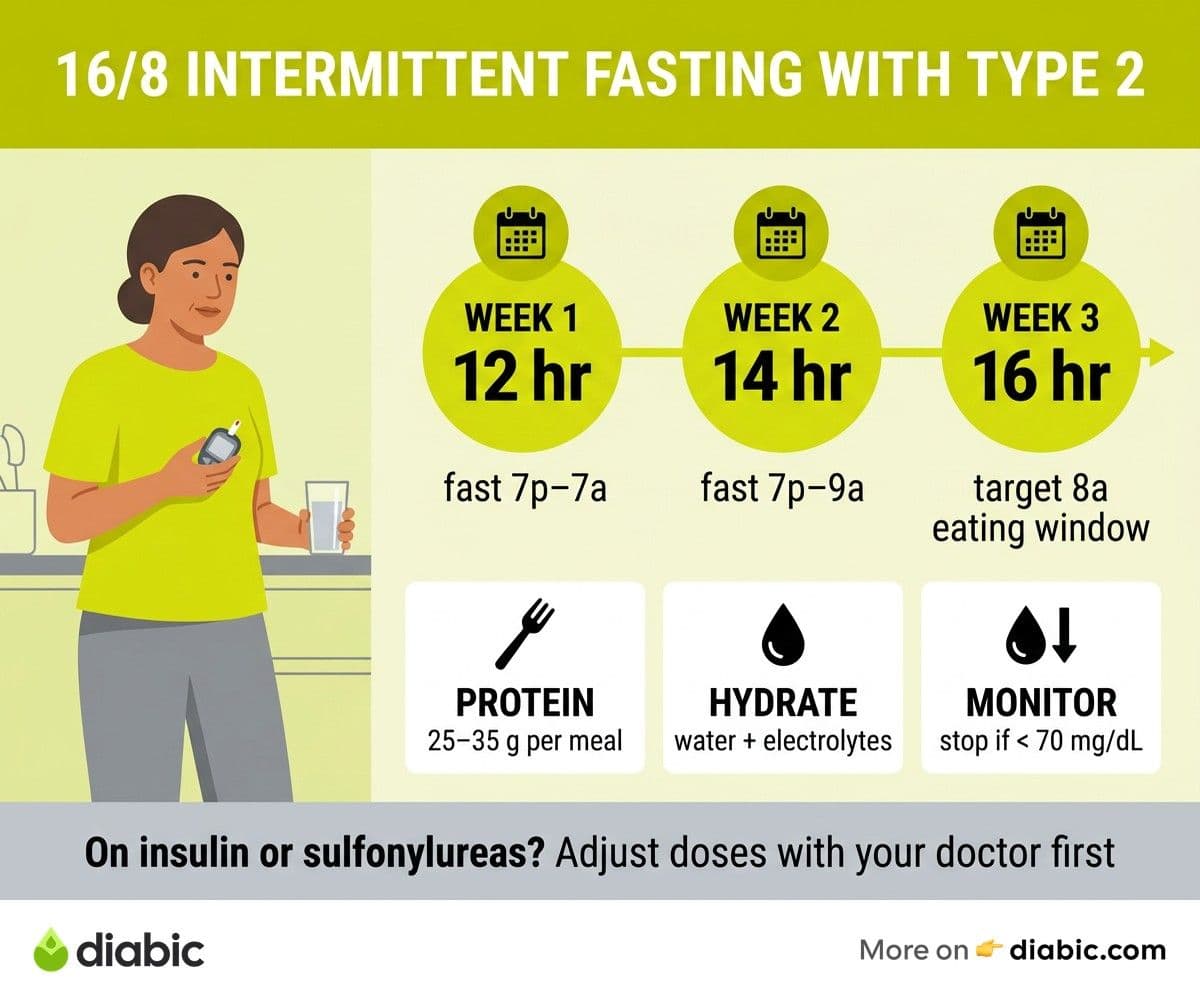
Here is a slow on-ramp that has worked for a lot of people. In week one, extend your overnight fast to 12 hours. If you usually eat dinner at 7 p.m., that means breakfast at 7 a.m. instead of 6 a.m. In week two, push to 14 hours, finishing dinner by 7 p.m. and eating breakfast at 9 a.m. By week three, you are at the full 16 hours, eating between 11 a.m. and 7 p.m. or whichever window suits you.
Pick an eating window that matches your real life. Morning eaters do better with a 9 a.m. to 5 p.m. or 10 a.m. to 6 p.m. window. People who never want breakfast often land at 12 p.m. to 8 p.m. naturally. The best window is the one you can repeat without dreading it.
Monitor your blood sugar more often during the first one to two weeks. Check fasting glucose, check before breaking your fast, check 1 to 2 hours after meals, and check before bed. If you see lows below 70 mg/dL, eat or drink something with fast-acting carbs and pause the fast for the day. Lows are a signal that your medication doses likely need adjustment, not that the protocol failed.
If you are still weighing whether this approach is right for you, our overview on is intermittent fasting safe for type 2 diabetes covers risk factors and contraindications in detail. For broader context across different fasting styles, the fasting and diabetes overview is a useful next read.
From my experience: Living with diabetes for 14 years, I tried 16/8 fasting twice before it stuck. The first attempt failed because I jumped straight to a 16-hour fast and ended up dizzy at hour 14. The second attempt worked because I gave myself three weeks to build up. The lesson, the protocol is forgiving if you respect the on-ramp.
What to Eat During Your Eating Window
The 8-hour eating window is not a free-for-all. The food choices you make inside that window are what determine whether your blood sugar improves or stays exactly where it was.
Build every meal around a meaningful protein portion. A palm-sized serving of chicken, fish, tofu, eggs, or Greek yogurt at each meal helps preserve muscle while you lose weight, and protein has the smallest impact on blood sugar of the three macronutrients. Most people aiming for diabetes-friendly fasting do well with 25 to 35 grams of protein per meal.
Pair that protein with fiber and healthy fats. Non-starchy vegetables, beans, berries, nuts, olive oil, and avocado all slow digestion and keep you full through the fasting hours. Carbs are not banned, but the type and timing matter. Whole-food carbs like quinoa, oats, sweet potatoes, and lentils generally work better than bread, crackers, and sugary breakfast foods. Our guide to a healthy diet for type 2 diabetes gives a practical framework for plate composition.
Breaking your fast with sugar is a setup for a glucose spike followed by a crash. A bowl of cereal, a sweet pastry, or a large glass of juice will produce a much sharper rise after 16 hours of fasting than it would mid-day. Open the eating window with a balanced meal, eggs and avocado, Greek yogurt with nuts and berries, or a quinoa bowl with vegetables and chicken, and save anything sweeter for later in the window when your insulin response is more graded.
Hydration is the other half of feeling decent during the fast. Aim for half your body weight in ounces of water daily, more if you exercise. A pinch of salt in your morning water can help with the headaches some people get during the first week, especially if you are also lower-carb.
Common Challenges and How to Handle Them
Most people hit a few predictable speed bumps in the first month. Knowing what to expect makes them easier to push through.
Hunger pangs in the first week are normal and usually peak around hour 12 to 14 of your fast. They typically fade after 7 to 10 days as ghrelin levels recalibrate. A glass of water, a walk, or a cup of unsweetened green tea handles most early hunger waves. Real hunger that does not pass and comes with shakiness or sweating is different, that is a sign to check your blood sugar and likely break the fast.
Social meals can derail the schedule if you let them, but the protocol is flexible. Shifting your window by 1 to 2 hours for a dinner out is fine. Skipping the fast entirely once a week is also fine. Consistency over weeks matters more than perfection on any given day.
Exercise during a fast is fine for most people once they are adapted, but the first two weeks are not the time to push hard workouts. Save the heavy training for inside your eating window until your body adjusts.
FAQ
Is 16/8 fasting safe for type 2 people with diabetes?
For most people with type 2 diabetes managing with metformin or diet alone, 16/8 fasting is generally considered safe under medical supervision. The picture changes for anyone on insulin, sulfonylureas, or meglitinides, where the risk of hypoglycemia is real and medication adjustments are usually needed before starting. Talk to your doctor about your specific medication list before you begin.
How to start 16/8 intermittent fasting with diabetes?
Start by extending your overnight fast to 12 hours for one week, then 14 hours the next week, and 16 hours by week three. Pick an eating window that matches your work and family schedule, and plan your two to three meals around protein, fiber, and healthy fats. Check your blood sugar more often than usual during the transition, especially before meals and before bed.
Can I drink coffee during a 16/8 fast?
Plain black coffee and unsweetened tea are fine during the fasting window and do not break the fast in any meaningful way. Adding milk, cream, or sweeteners technically introduces calories and can blunt some of the metabolic benefits, though small amounts of plain heavy cream are debated. Skip the sugar and flavored syrups entirely if you are doing this for diabetes management.
Will 16/8 fasting lower my A1C?
Research suggests 16/8 intermittent fasting may help lower HbA1c in people with type 2 diabetes, particularly when paired with a moderate-carb diet and modest weight loss. Studies have shown reductions of 0.3 to 0.7 percentage points over 8 to 12 weeks, though individual results vary. Your A1C reflects the previous 2 to 3 months, so give the protocol at least that long before evaluating it.
What if I take metformin with my fasting plan?
Metformin is generally compatible with 16/8 fasting, but the timing matters. Many people take it with their first or last meal of the eating window to reduce the GI side effects. Your doctor or pharmacist can help you nail down the timing for your specific dose, since the goal is steady coverage without taking it on a fully empty stomach.
A reasonable expectation for the first month, you will feel better some days and worse on others as your body adjusts. Stick with the on-ramp, keep your meter handy, and treat your provider as a partner in the experiment rather than an obstacle. If 16/8 intermittent fasting type 2 diabetes routines fit your life, the changes tend to compound quietly over months rather than dramatically in the first week.
Shahriar P. Shuvo is the founder of Diabic. He has lived with diabetes for over 14 years, and built Diabic to deliver the practical, evidence-based self-management tools he wished existed when he was first diagnosed. By trade, Shahriar is a senior design and frontend engineer with 6+ years shipping products at Agora, Timescale (now Tiger Data), and ShareTrip. He writes from the intersection of lived diabetes experience and product craft, focused on what works in daily management rather than what sounds good in a textbook.
Medically reviewed by
Dr. Shanto Arian is an internal medicine physician now specializing in clinical and aesthetic dermatology, with a parallel academic focus on epidemiology and public health. He holds an MBBS, MPH, MSc (UK), MRCP (UK), MRCPI (Ireland), Diploma in Dermatology (UK), and Diploma in Aesthetic Medicine (USA). Dr. Arian trained in internal medicine, including hospital work on hematology cases such as graft-versus-host disease, before moving toward dermatology. Skin is one of the earliest places diabetes shows itself, from acanthosis nigricans and diabetic dermopathy to slow foot wound healing, and that intersection is where his clinical and Diabic-review work meet. On Diabic, Dr. Arian medically reviews content on diabetes diagnosis, complications, dermatologic manifestations, and pharmacotherapy, ensuring every claim aligns with current ADA, NICE, and peer-reviewed literature.
More from Diet & Fitness
View all
7 Sweet Potato Diabetes Recipes That Keep Blood Sugar Steady
Seven sweet potato diabetes recipes with balanced macros, plus the cooking methods and portion tips that keep this naturally sweet vegetable blood-sugar.

Diabetes Pasta Recipes That Won't Spike Blood Sugar
Five diabetes pasta recipes that keep blood sugar steady, plus the cooking trick and pasta swaps that lower glycemic impact for everyday meals.

Chinese Recipes for Diabetes That Taste Like Takeout
Chinese recipes for diabetes that recreate takeout favorites at home with low-sugar swaps, controlled portions, and stir-fries that keep blood sugar.
Clinician-reviewed habits, plain-language guides, and honest answers - the small shifts that make living with diabetes feel lighter, every day.