Brittle Diabetes: Causes and Coping Strategies
Brittle diabetes causes severe blood sugar swings that disrupt daily life. Learn what causes it, how it's diagnosed, and practical coping strategies.

In this article(10)
Brittle diabetes describes a rare and exhausting form of the condition where blood sugar swings dramatically and unpredictably, making management feel like a moving target. For people living with it, the constant highs and lows can wear down even the most disciplined routine. The frustration is not a sign of failure. The biology and the circumstances behind this pattern are genuinely harder to manage than typical diabetes, and that deserves to be named.
This guide covers what the term means, the underlying causes that contribute to the instability, how it is diagnosed, and the coping strategies that have helped real people steady their numbers. We also talk honestly about the emotional toll, because anyone who has lived through a week of unpredictable blood sugar knows that the mental load is part of the picture.
If you have been told you might have this kind of unstable diabetes, or if your daily glucose pattern has been chaotic enough to make you wonder, this post is for you.
From my experience: I have lived with type 1 for 14 years and have not been labeled brittle, but I have had stretches where the same lunch with the same insulin dose lands at 110 one day and 240 the next. One stretch around 2019 lined up almost perfectly with a stomach bug that took weeks to fully clear, and only later did my endo connect the dots to slowed gastric emptying. That experience taught me to keep a notes-app log of food, sleep, and mood alongside CGM data, because the patterns that explain the chaos rarely show up in a single day.
What Brittle Diabetes Is
Brittle diabetes, also called labile diabetes, refers to severe blood sugar instability that disrupts daily life and often leads to frequent hospitalizations or emergency room visits. The condition is most common in people with type 1 diabetes, although it can rarely occur in advanced type 2. The defining feature is unpredictability: the same insulin dose, meal, and activity level can produce wildly different glucose responses on different days.
The pattern usually involves frequent severe lows, unexpected highs, or both. Sometimes blood sugar drops without warning, leaving the person scrambling to treat hypoglycemia. Other times it rises despite seemingly correct insulin and food choices. Some people experience low blood sugar symptoms that come on so suddenly there is no time to react, and others notice high blood sugar symptoms that linger despite aggressive correction.
The American Diabetes Association does not list this category in the formal classification, and that ambiguity matters. According to resources from the ADA and broader endocrinology literature, the term describes a clinical pattern rather than a distinct disease entity. The instability has identifiable causes in most cases, even when finding them takes time.
What makes the pattern particularly challenging is the cascade effect. A severe low at three in the morning leads to rebound highs the next day, which lead to overcorrection, which leads to another low. Sleep suffers, work suffers, relationships strain, and the loops feed each other. Recognizing it is the first step toward unwinding it.
What Causes the Pattern
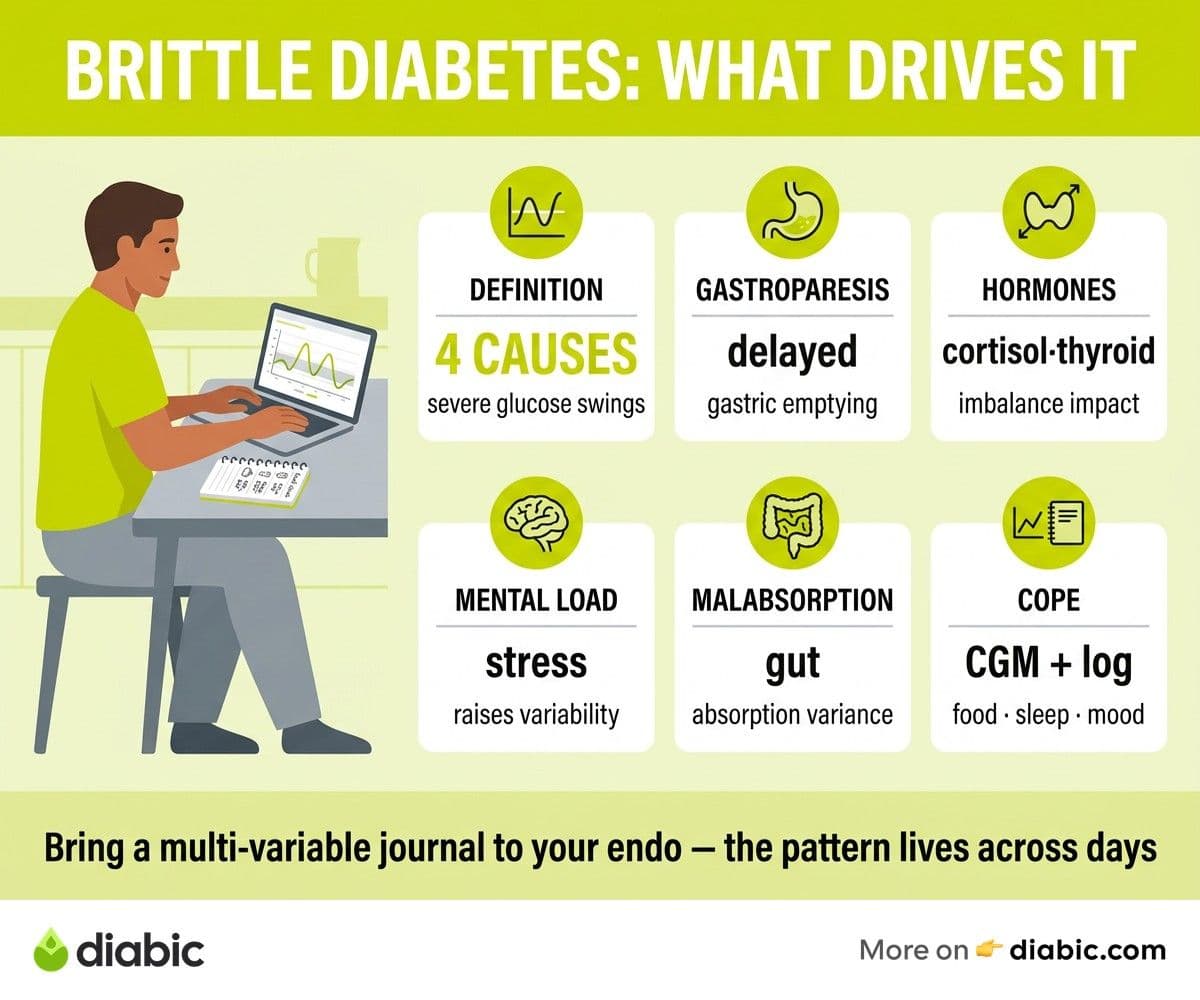
The causes are usually multiple, and pinning them down requires careful investigation with an endocrinologist who is willing to look beyond standard troubleshooting. According to the NIDDK, several physiological and psychological factors are most often involved.
Gastroparesis, or delayed gastric emptying, is one of the most common contributors. When food leaves the stomach unpredictably, the timing of glucose absorption no longer matches the timing of insulin action. A meal might be absorbed quickly one day and slowly the next, producing highs and lows that seem to defy logic. Mayo Clinic resources on gastroparesis describe how diabetes itself can cause this nerve damage in the stomach over time, creating a feedback loop with glucose control.
Hormonal fluctuations play a substantial role for many people, particularly those with menstrual cycles. Estrogen and progesterone shifts can change insulin sensitivity dramatically across the cycle. Cortisol patterns, thyroid disorders, and adrenal issues can also drive instability when not addressed. Hormonal causes are often missed in initial workups because they require specific testing rather than the standard diabetes labs.
Psychological factors deserve their own line. Stress, depression, anxiety, and disordered eating all influence blood sugar both directly through hormones and indirectly through changes in routine, food choices, and self-care. The presence of a mental health condition is not a moral failing or a reason for shame. It is a clinical factor that, when identified, often leads to meaningful improvement in glucose stability.
Inconsistent insulin absorption from injection or pump sites, drug or alcohol interactions, and infections that come and go can also contribute. For a foundational refresher on how the basic system works before diving into what goes wrong, our overview of what is diabetes covers the basics in plain language.
Diagnosing the Condition
There is no single diagnostic test. The diagnosis is made by recognizing a pattern: frequent severe glucose swings that persist despite reasonable management efforts. CGM data is enormously valuable here, because it shows the variability in a way that finger-stick logs simply cannot. A glucose trace with frequent excursions above 250 mg/dL and below 60 mg/dL within the same day, week after week, paints a picture that is hard to ignore.
A thorough workup looks for the contributing factors one by one. Gastric emptying studies can identify gastroparesis. Hormone panels can reveal cycle-related sensitivity changes, thyroid issues, or adrenal problems. A careful medication review picks up drug interactions. A frank conversation about mental health, eating patterns, and life stressors fills in the picture that lab results alone cannot show.
Working with an endocrinologist who specializes in difficult-to-manage cases is often the difference between feeling stuck and finding a way forward. Some larger academic centers run dedicated clinics for unstable diabetes, and a referral can be worth pursuing even if it requires travel. A team approach, including a registered dietitian, a diabetes educator, and a mental health clinician, often produces better outcomes than any single provider working alone.
The diagnostic process can feel slow and frustrating, especially when you are the person running the experiment in real time. Documenting patterns, including timing of meals, exercise, sleep, stress, and medication, gives the team something concrete to work with. Most people who eventually achieve more stability did so by piecing together several contributing factors rather than finding one magic answer.
Coping Strategies That Help
Practical day-to-day diabetes management for difficult cases requires more tools and more flexibility than typical care. The strategies below are not a checklist to perfect overnight. They are a menu to discuss with your care team and adopt as the right ones for your situation come into focus.
A continuous glucose monitor with customized alarms is often the most impactful change. Setting low and high alerts at thresholds that give you time to respond, rather than at the lab norms, can prevent the worst swings. Some people use predictive alerts that warn before glucose actually crosses a threshold. The alarms can be tuned to your sleep, your work, and your specific patterns.
Insulin pump therapy with fine-tuned basal rates gives more flexibility than multiple daily injections for many people in this situation. The ability to adjust delivery in small increments, set temporary basal rates around exercise or menstrual cycles, and integrate with a CGM for hybrid closed-loop systems can substantially smooth out the variability. Our overview of insulin therapy for type 1 walks through the options in more depth.
Treating underlying conditions is often the foundation. Gastroparesis management, mental health care, and hormonal evaluation are not optional add-ons. They are core to long-term stability. When the underlying issues are addressed, the management strategies that previously felt useless often start working.
Structured meal timing and composition can help blunt unpredictable absorption. Smaller, more frequent meals lower in fat may improve glucose response in people with gastroparesis. Consistent carbohydrate amounts at consistent times reduce the variables your insulin has to chase. The exact pattern that works varies by person, and experimenting with the support of a dietitian is more productive than trying alone.
The Emotional Toll and Getting Support
Diabetes distress and burnout are especially common when blood sugar refuses to follow the script, and the emotional toll deserves direct attention rather than being treated as a side effect to power through. The unpredictability is exhausting in a specific way. You cannot trust your own judgment because the rules keep changing. You feel like you are doing everything right, and the numbers do not cooperate. That experience wears on people.
Mental health care alongside medical management is not a luxury. It is part of effective treatment. Therapists who specialize in chronic illness, particularly diabetes, can help with the burnout, the anxiety around lows, the strained relationships, and the loss of confidence that often comes with this pattern. Some endocrinology practices have integrated mental health staff. Others can refer.
Peer support from others living with the same kind of instability makes a difference because the experience is genuinely different from typical diabetes. Online communities, in-person diabetes support groups that include type 1 adults, and patient advocacy organizations can connect you with people who understand the day-to-day reality. The validation alone is worth a great deal, and the practical tips shared in these spaces are often more useful than what fits in a fifteen-minute appointment.
Working with a multidisciplinary care team is the gold standard when it is available. An endocrinologist who knows your case, a dietitian who works with you regularly, a diabetes educator, a mental health professional, and any specialists treating contributing conditions all coordinating around you. Our practical overview of living with type 1 diabetes speaks to many of the everyday strategies that apply here as well, with an honest acknowledgment that some days are harder than others.
Frequently Asked Questions
What causes brittle diabetes?
The pattern can be caused by gastroparesis, hormonal imbalances, inconsistent insulin absorption, psychological stress, depression, or eating disorders. Drug and alcohol interactions and recurring infections can also contribute. Sometimes no single cause is found, and management involves addressing several contributing factors at once with a multidisciplinary care team.
How to manage it day to day?
Daily management often involves using a continuous glucose monitor for real-time monitoring, insulin pump therapy for precise dosing, and structured meal timing tailored to any underlying conditions like gastroparesis. Treating contributing conditions, including mental health concerns, is essential rather than optional. Working closely with an endocrinologist who specializes in difficult-to-manage cases makes a significant difference for many people.
Is it a separate type of diabetes?
It is not officially classified as a separate type. The term describes a pattern of severe blood sugar instability that occurs most often in people with type 1 diabetes. The pattern has identifiable causes in most cases, and addressing those causes is the path toward more stable management.
Can it be cured?
The instability itself is not curable in a clean sense, but it often improves substantially when contributing factors are identified and treated. Many people whose diabetes was once labeled brittle achieve far more stable glucose patterns with the right combination of technology, treatment of contributing conditions, and mental health support. Talk to your doctor about a structured workup if your diabetes has been hard to manage despite consistent effort.
If your blood sugar has felt impossible to predict for weeks or months, you are not failing. Brittle diabetes is genuinely harder to manage, and the path forward usually involves finding the right team and the right tools rather than trying harder on your own. Our broader other-types library has more reading on the conditions and patterns that fall outside standard type 1 and type 2 frameworks.
Shahriar P. Shuvo is the founder of Diabic. He has lived with diabetes for over 14 years, and built Diabic to deliver the practical, evidence-based self-management tools he wished existed when he was first diagnosed. By trade, Shahriar is a senior design and frontend engineer with 6+ years shipping products at Agora, Timescale (now Tiger Data), and ShareTrip. He writes from the intersection of lived diabetes experience and product craft, focused on what works in daily management rather than what sounds good in a textbook.
Medically reviewed by
Dr. Shanto Arian is an internal medicine physician now specializing in clinical and aesthetic dermatology, with a parallel academic focus on epidemiology and public health. He holds an MBBS, MPH, MSc (UK), MRCP (UK), MRCPI (Ireland), Diploma in Dermatology (UK), and Diploma in Aesthetic Medicine (USA). Dr. Arian trained in internal medicine, including hospital work on hematology cases such as graft-versus-host disease, before moving toward dermatology. Skin is one of the earliest places diabetes shows itself, from acanthosis nigricans and diabetic dermopathy to slow foot wound healing, and that intersection is where his clinical and Diabic-review work meet. On Diabic, Dr. Arian medically reviews content on diabetes diagnosis, complications, dermatologic manifestations, and pharmacotherapy, ensuring every claim aligns with current ADA, NICE, and peer-reviewed literature.
More from Diabetes Knowledge
View all
Can Diabetics Eat Fruit? Yes, Best Picks and Tips
Can people with diabetes eat fruit? Yes. Here is how to choose the right fruits, manage portions, and pair them smartly to keep blood sugar steady.

Newly Diagnosed Type 2 Diabetes: Where to Start
Newly diagnosed type 2 diabetes feels overwhelming, but the first steps are simpler than you think. Get a clear, calm starting plan from day one.

Secondary Diabetes: When Another Condition Is the Cause
Secondary diabetes develops because of another medical condition or medication. Learn the causes, how it differs from type 2, and how it's managed.
Clinician-reviewed habits, plain-language guides, and honest answers - the small shifts that make living with diabetes feel lighter, every day.