Diabetes Age Myths: Why Young People Get It Too
Diabetes age myths cause delayed diagnosis in young people. Here is what the research shows about who gets diabetes and at what age, across both types.

In this article(12)
The belief that diabetes is an "old person's disease" still shapes how many people think about risk, even though the data have looked very different for at least two decades. Diabetes age myths can delay diagnosis in younger adults, teenagers, and even children, sometimes with serious consequences.
A young person who feels exhausted, thirsty all the time, and is losing weight unexpectedly may dismiss those symptoms because diabetes does not feel like something that happens to people their age. Parents and primary care providers can do the same. The result is a slower path to diagnosis and, in some cases, dangerous delays.
Understanding who actually gets diabetes, and at what age, can change how you approach prevention, screening, and early detection for yourself and the people you care about.
Where the Diabetes Age Myths Come From
Most diabetes age myths trace back to two historical patterns that no longer match reality. The first is that type 2 diabetes was once almost exclusively diagnosed in middle-aged and older adults. For much of the twentieth century, that was statistically true. It is no longer.
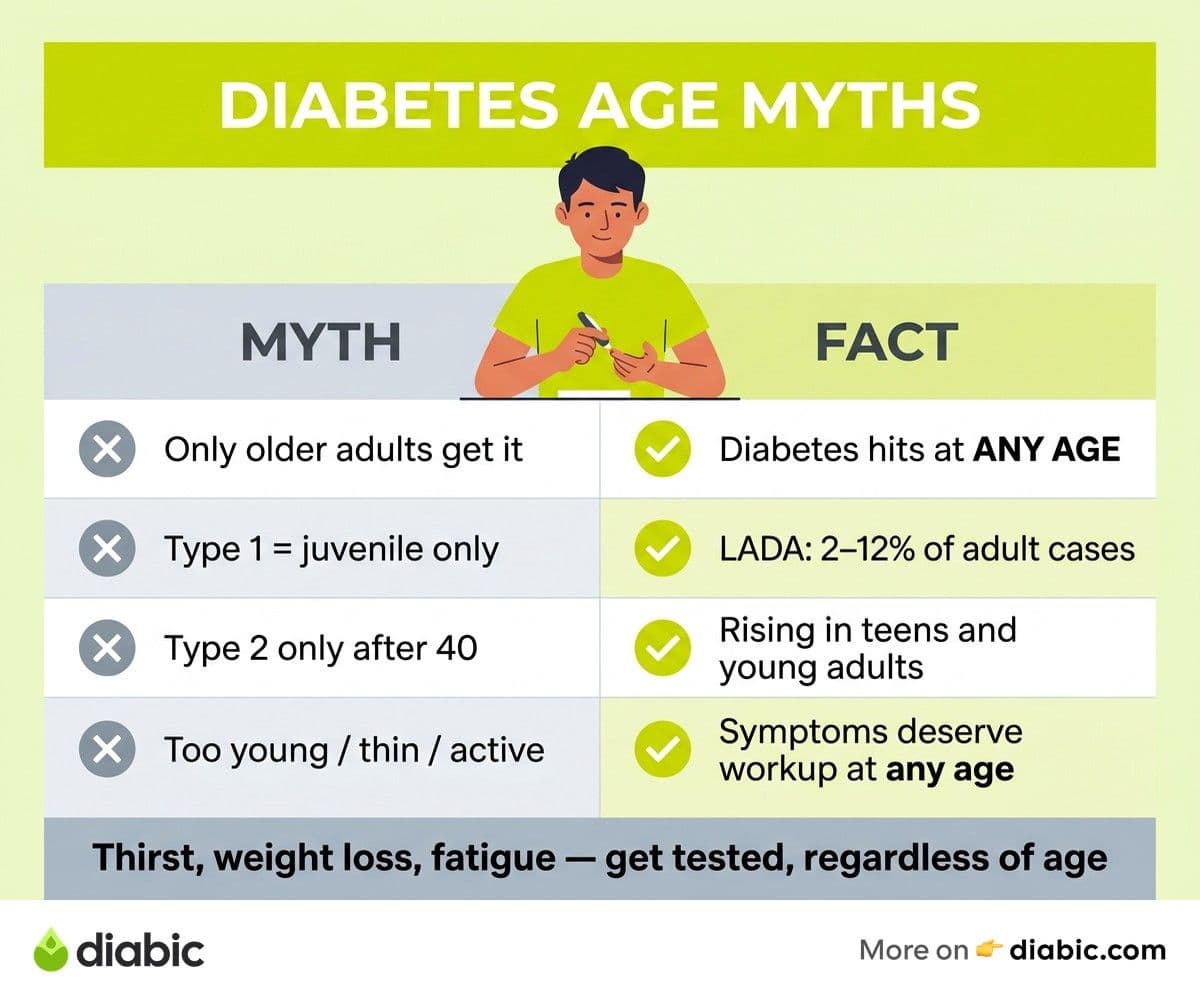
The second is that type 1 diabetes used to be called "juvenile diabetes," which created the impression that anyone diagnosed with diabetes after a certain age must have type 2. The label has been retired by major medical organizations because it was misleading. Type 1 can develop at any age, and a meaningful percentage of new type 1 cases are diagnosed in adults.
The American Diabetes Association has formally recognized the rise of type 2 diabetes in children and adolescents, with position statements specifically addressing pediatric type 2 since the early 2000s. What was once a rare occurrence is now a documented public health concern in many countries.
Cultural messaging takes time to catch up with science. Many people still picture diabetes as something that affects retirees, and that mental image quietly shapes who gets screened, who gets diagnosed promptly, and who waits years for answers. Updating that image is one of the most useful things public health communicators and individual readers can do.
Type 1 vs Type 2 Diabetes: Who Gets What and When
The relationship between age and diabetes type is more complicated than the old stereotypes suggest. Looking at type 1 vs type 2 diabetes through an age lens shows real overlap and real surprises in both directions.
Type 1 diabetes can appear at any age. Childhood and adolescence are the most common diagnosis windows, but a significant number of people are diagnosed as adults. Latent autoimmune diabetes in adults (LADA) is a slower-developing form of type 1 that often gets misdiagnosed as type 2 at first because it appears in adults and progresses gradually. LADA accounts for an estimated 2 to 12 percent of all diabetes cases in adults, depending on the population studied.
Type 2 diabetes was historically diagnosed in adults over 40. Today, it is increasingly diagnosed in children, teenagers, and young adults. The rise has been most dramatic in populations with high rates of obesity, sedentary lifestyle, and processed-food consumption, but no group is unaffected. Some clinics that once saw zero pediatric type 2 cases per year now see dozens.
Age alone does not determine which type of diabetes someone has. Antibody testing, C-peptide levels, and clinical presentation all help distinguish type 1 from type 2 at any age. Anyone diagnosed with diabetes deserves a careful workup to confirm the type, since misclassification leads to inappropriate treatment. Our guide on the key differences between type 1 and type 2 walks through the distinctions in more depth.
Can Young People Get Type 2 Diabetes
Yes, and the trend has been accelerating for years. Data from the CDC's National Diabetes Statistics Report show a meaningful increase in type 2 diabetes diagnoses among adolescents and young adults since the early 2000s. The SEARCH for Diabetes in Youth study, one of the largest US studies tracking pediatric diabetes, has documented annual increases in type 2 incidence in children and teenagers across multiple ethnic groups.
The risk factors driving this rise look different from the classic adult type 2 picture. Family history is a powerful predictor in younger populations, often more so than in older adults. Maternal gestational diabetes raises the risk for the child later in life. Sedentary lifestyle, screen time, sleep deprivation, and access to ultra-processed foods all contribute. Puberty itself temporarily increases insulin resistance, which can tip vulnerable adolescents into clinical type 2.
Type 2 diabetes in younger people often progresses faster than in older adults. Beta cell function tends to decline more rapidly, and complications can develop within years rather than decades. This is one reason early detection matters so much in this age group.
If you are a young adult with a parent or sibling who has type 2 diabetes, screening is reasonable even before age 35. Talk to your doctor about getting an A1c test, especially if you have other risk factors. Our guide on whether diabetes is genetic covers how family history shapes risk for both types.
At What Age Can You Get Diabetes
Diabetes can develop at any age, and the patterns differ between the two main types. Type 1 onset peaks in childhood and adolescence, with a smaller secondary peak in young adulthood. The youngest documented cases occur in infancy, though those are rare and sometimes involve specific genetic forms of diabetes.
Type 2 onset has historically peaked between ages 45 and 64, but the curve is shifting younger. The World Health Organization reports that global diabetes prevalence has roughly doubled in adults since the 1980s, with notable increases in younger age groups. In some populations, type 2 in people under 30 is no longer unusual.
Gestational diabetes adds another age-related dimension. It develops during pregnancy and typically resolves after delivery, but it raises the lifetime risk of type 2 diabetes for both mother and child. Older maternal age (over 35) is one of several risk factors. Women with gestational diabetes should continue screening for type 2 in the years that follow.
Older adults face their own diabetes age considerations. Type 2 diabetes prevalence remains highest in this group, and management can be more complex due to other health conditions, medications, and changes in kidney function. But the assumption that diabetes is primarily an older-adult problem misses the full landscape of who is affected.
For families dealing with a recent diagnosis, our explainer on what type 1 diabetes really is provides a clearer picture of the autoimmune process, especially helpful when the diagnosis surprises a family that did not expect type 1 in their child or young adult.
What Is Diabetes and How It Develops at Any Age
What is diabetes when we set aside the question of who gets it? It is a condition where the body cannot keep blood glucose in a healthy range. Insulin, a hormone made by the pancreas, normally helps glucose move from the bloodstream into cells where it gets used for energy. When insulin is missing or not working effectively, glucose builds up in the blood.
The underlying biology does not respect age boundaries. A child can develop autoimmune destruction of beta cells just as easily as an adult can. An adult can develop insulin resistance just as a teenager can, and both can progress to overt diabetes if the underlying drivers continue.
Genetics, environment, and lifestyle interact across age groups, though the specific mix varies. In children with type 1, the trigger is often viral or otherwise environmental, on top of a genetic predisposition. In adults with type 2, lifestyle and aging interact with inherited risk. In adolescents with type 2, family history and lifestyle dominate, sometimes with rapid progression. The disease process is recognizably the same in each case, even when the patient is six or sixty.
This is why anyone, at any age, with classic diabetes symptoms deserves prompt evaluation. The symptoms include excessive thirst, frequent urination, unexplained weight loss, fatigue, blurred vision, and slow-healing cuts. They can develop quickly in type 1 or gradually in type 2.
From my experience: I was diagnosed with type 1 diabetes at twelve, and the path to diagnosis was longer than it should have been because no one in my family thought a kid my age and weight could have diabetes. By the time I got to the emergency room, I had lost about fifteen pounds in six weeks and was dangerously close to diabetic ketoacidosis. Fourteen years later, I still talk about that experience because so many young people are still hearing "you're too young, too thin, or too active to have diabetes." The biology does not care about those assumptions.
Why Early Detection Matters for Young People
Symptoms in young people often get overlooked or attributed to something else. A teenager who is suddenly tired, drinking water constantly, and losing weight may be assumed to be stressed about school or going through a growth spurt. A young adult with frequent yeast infections and slow-healing cuts may not connect those signs to diabetes. Parents and providers can miss the same patterns, especially when the patient does not fit the stereotypical picture.
Delayed diagnosis carries real risks. For type 1, the danger is diabetic ketoacidosis (DKA), a life-threatening emergency that often becomes the trigger for diagnosis when symptoms are missed. DKA at diagnosis is more common in children than adults and remains a leading cause of death in young people with newly diagnosed type 1. For type 2 in young people, late diagnosis means more time spent with high blood glucose, which accelerates the development of complications.
Steps young adults and parents can take to assess risk include knowing family history for both type 1 and type 2, getting baseline A1c testing if any risk factors are present, and seeking prompt evaluation for classic symptoms regardless of age. Same-day or next-day medical attention is appropriate when symptoms include rapid weight loss, severe thirst, frequent urination, and fatigue together.
Awareness alone shifts outcomes. Studies have shown that public education campaigns about pediatric diabetes symptoms reduce DKA rates at diagnosis. The same logic applies to families: knowing the signs and taking them seriously, even in young people, leads to earlier intervention and better long-term health.
FAQ
Can young people get type 2 diabetes?
Yes. Type 2 diabetes rates have risen significantly among adolescents and young adults over the past two decades, driven by factors like family history, weight, sedentary lifestyle, and dietary patterns. Some clinics that rarely saw pediatric type 2 cases now diagnose them regularly. Young people with risk factors should talk to their doctor about screening.
At what age can you get diabetes?
Diabetes can develop at any age. Type 1 most commonly appears in childhood through young adulthood, though it can occur in older adults too. Type 2 historically peaked in middle age but is now diagnosed in children, teenagers, and young adults with growing frequency. Gestational diabetes specifically develops during pregnancy.
What are the symptoms of diabetes in young people?
The classic symptoms are similar across age groups: excessive thirst, frequent urination, unexplained weight loss, fatigue, blurred vision, and slow-healing cuts. In young people, these can develop rapidly (especially in type 1) or gradually (more common in type 2). Any combination of these symptoms warrants prompt medical evaluation.
Is type 1 diabetes only diagnosed in children?
No. While type 1 is most commonly diagnosed in childhood and adolescence, adults can develop it too. LADA, a slower-developing form of type 1 that occurs in adults, is often misdiagnosed as type 2 at first. Antibody testing helps distinguish the two.
Should young adults get screened for diabetes?
Routine screening generally starts at age 35, but the American Diabetes Association recommends earlier screening for anyone with risk factors like family history, obesity, gestational diabetes history, or certain ethnicities at higher risk. Talk to your doctor about whether earlier screening makes sense for you.
The diabetes age myths that linger in public conversation are easy to update once you know what the data actually show. Diabetes can affect a six-year-old, a sixteen-year-old, a twenty-six-year-old, or a sixty-year-old. Knowing the symptoms, knowing your family history, and being willing to push for evaluation when something feels off can change the trajectory of a diagnosis at any age.
Shahriar P. Shuvo is the founder of Diabic. He has lived with diabetes for over 14 years, and built Diabic to deliver the practical, evidence-based self-management tools he wished existed when he was first diagnosed. By trade, Shahriar is a senior design and frontend engineer with 6+ years shipping products at Agora, Timescale (now Tiger Data), and ShareTrip. He writes from the intersection of lived diabetes experience and product craft, focused on what works in daily management rather than what sounds good in a textbook.
Medically reviewed by
Dr. Shanto Arian is an internal medicine physician now specializing in clinical and aesthetic dermatology, with a parallel academic focus on epidemiology and public health. He holds an MBBS, MPH, MSc (UK), MRCP (UK), MRCPI (Ireland), Diploma in Dermatology (UK), and Diploma in Aesthetic Medicine (USA). Dr. Arian trained in internal medicine, including hospital work on hematology cases such as graft-versus-host disease, before moving toward dermatology. Skin is one of the earliest places diabetes shows itself, from acanthosis nigricans and diabetic dermopathy to slow foot wound healing, and that intersection is where his clinical and Diabic-review work meet. On Diabic, Dr. Arian medically reviews content on diabetes diagnosis, complications, dermatologic manifestations, and pharmacotherapy, ensuring every claim aligns with current ADA, NICE, and peer-reviewed literature.
More from Diabetes Knowledge
View all
Can Diabetics Eat Fruit? Yes, Best Picks and Tips
Can people with diabetes eat fruit? Yes. Here is how to choose the right fruits, manage portions, and pair them smartly to keep blood sugar steady.

Newly Diagnosed Type 2 Diabetes: Where to Start
Newly diagnosed type 2 diabetes feels overwhelming, but the first steps are simpler than you think. Get a clear, calm starting plan from day one.

Secondary Diabetes: When Another Condition Is the Cause
Secondary diabetes develops because of another medical condition or medication. Learn the causes, how it differs from type 2, and how it's managed.
Clinician-reviewed habits, plain-language guides, and honest answers - the small shifts that make living with diabetes feel lighter, every day.