Blood Sugar After Food: What's Normal
What blood sugar after food should look like, from ADA targets to peak timing. See normal ranges, CGM patterns, and ways to improve post-meal numbers.

In this article(26)
You finish a meal, watch the number on your meter or CGM climb, and the question shows up almost automatically: is this normal? Understanding what blood sugar after food should look like is one of the most common questions people with diabetes ask, and the honest answer is that there is no single number that fits everyone.
Your post-meal targets depend on your diabetes type, the medications you take, your age, how long you have lived with diabetes, and what your healthcare team recommends. The same 165 mg/dL reading at 90 minutes after lunch might be perfectly fine for one person and a signal to adjust for another.
This guide walks through what current guidelines actually say, how to read your numbers in context, when to act on them, and a few practical strategies that consistently improve post-meal patterns.
Blood Sugar After Food: What the Numbers Mean
A post-meal reading captures one moment in a much longer story. Your blood sugar after food rises as glucose from your meal enters the bloodstream, peaks somewhere between 60 and 120 minutes for most people, and then falls back toward your fasting baseline as insulin moves that glucose into cells.
The CDC recommends checking blood sugar at consistent times to spot patterns. For post-meal testing, the two most common windows are one hour and two hours after the first bite. Different guidelines emphasize different timing, which is part of why the topic feels confusing.
The single most important thing to understand is that one reading rarely tells you much. Patterns over many meals tell you almost everything. A 200 mg/dL spike after pizza one Friday night is not the same as routinely hitting 200 after every dinner.
The difference between fasting and post-meal blood sugar
Fasting blood sugar reflects how your body handles glucose when you have not eaten for at least eight hours. It is largely a measure of how your liver releases glucose overnight and how well your basal insulin (or your body's own background insulin) covers that release.
Post-meal blood sugar reflects something different: how your body handles a glucose load right now. It depends on what you ate, how much you ate, what you drank, how active you have been, what medications you took and when, and a long list of other factors. The two numbers tell different stories, and both matter.
When to test after eating: 1 hour vs. 2 hours
Some guidelines focus on the one-hour mark, where glucose typically peaks. Others focus on two hours, when most non-diabetic people are back near baseline. Both have value. One-hour testing catches the peak, which is where the highest spikes show up. Two-hour testing shows how quickly your body clears the glucose, which is what insulin sensitivity is mostly about.
If you only test occasionally, two hours is the more common reference point. If you use a CGM, you get the full curve and do not have to choose.
Normal Blood Sugar Levels After Eating
Blood sugar levels after food vary by population. The numbers below are general references; your personal targets should come from your healthcare provider.
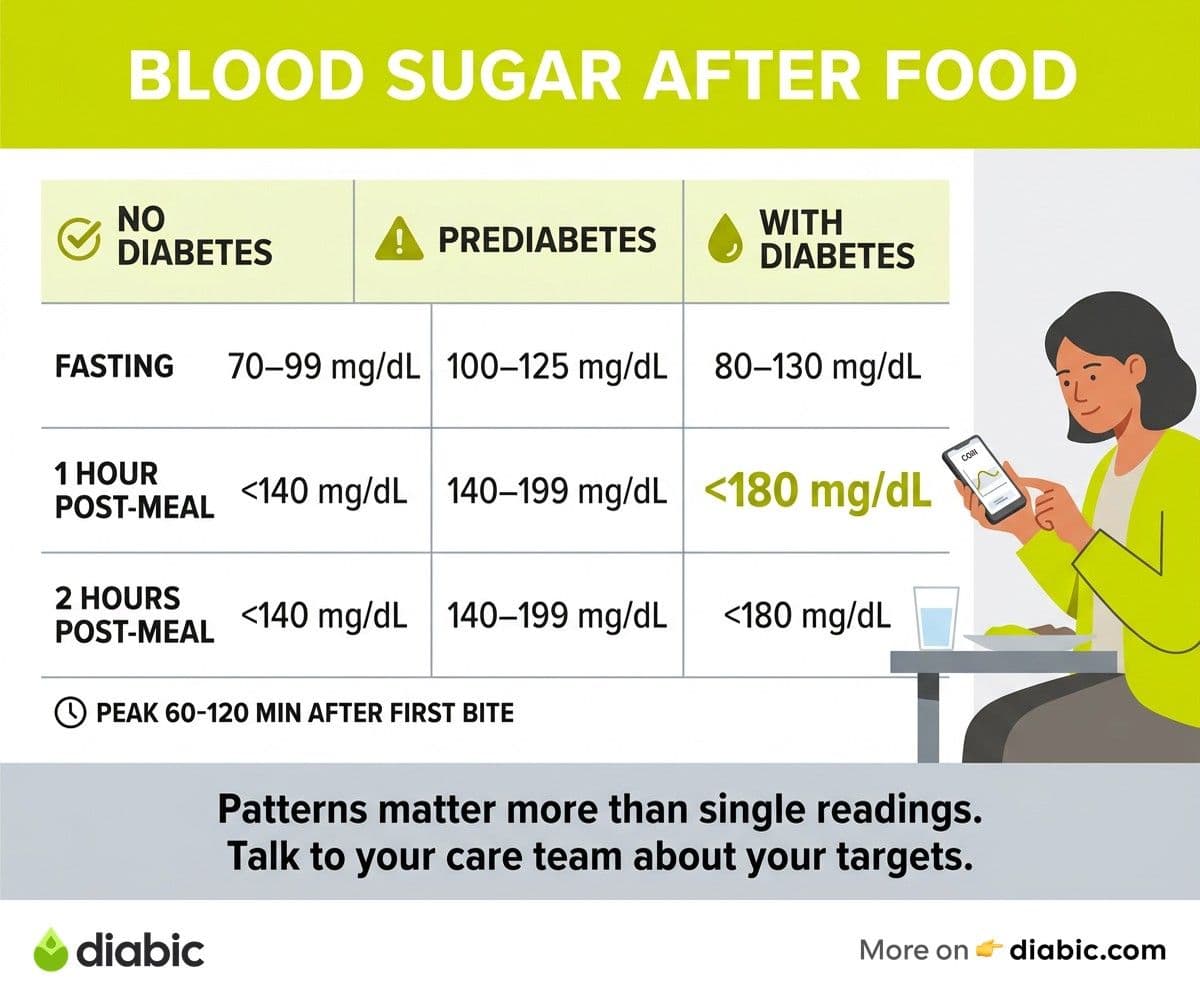
For people without diabetes, post-meal levels typically stay below 140 mg/dL at one to two hours and return to fasting levels (usually 70 to 99 mg/dL) within three hours. For people with prediabetes, post-meal numbers often land in the 140 to 199 mg/dL range at the two-hour mark on a glucose tolerance test.
For people with diabetes, the American Diabetes Association Standards of Care recommend a post-meal target of less than 180 mg/dL at one to two hours after eating for most non-pregnant adults. Some people, particularly those early in their diagnosis or younger adults, may aim for tighter targets. Older adults or those with hypoglycemia unawareness may have more relaxed targets.
Pre-diabetes ranges and what they mean
The diagnostic threshold for prediabetes on a two-hour glucose tolerance test is 140 to 199 mg/dL. Routinely seeing post-meal numbers in that range, especially after typical mixed meals, is worth a conversation with your doctor even if you do not have a formal diagnosis.
Prediabetes is not a sentence. Lifestyle changes, particularly around diet and movement, can move those numbers in the right direction within months for most people.
How targets differ by diabetes type and age
People with type 1 diabetes often see wider swings around meals because the timing and dose of insulin must approximate what a healthy pancreas would do automatically. Targets are usually similar to type 2 (under 180 mg/dL post-meal), but the variability is greater. People with type 2 diabetes who do not use insulin often have more stable patterns once their treatment is dialed in.
Older adults, people with limited life expectancy, and those at high risk of severe hypoglycemia may have post-meal targets closer to 200 mg/dL or higher, because the harms of low blood sugar can outweigh the benefits of tight control. Targets are individualized, and tighter is not always better.
What Is a Normal Blood Sugar Range After Food?
Searching "blood sugar after food normal" pulls up a confusing mix of charts. Here is the simplified version, with the caveat that your personal range should come from your care team.
For people without diabetes:
- Fasting: 70 to 99 mg/dL
- 1 hour after eating: typically below 140 mg/dL
- 2 hours after eating: below 140 mg/dL
- 3 hours after eating: back near fasting baseline
For people with diabetes (per ADA general targets):
- Fasting: 80 to 130 mg/dL
- Peak post-meal (1 to 2 hours): less than 180 mg/dL
The blood sugar normal range after food is wider than many people realize. A reading of 155 mg/dL at 90 minutes after eating, for someone with diabetes, is well within target. A reading of 210 mg/dL at the same time, repeated regularly, is worth investigating. The International Diabetes Federation post-meal glucose guidelines align closely with ADA recommendations on these targets.
When to be concerned about post-meal numbers
A single high reading is rarely a crisis. Patterns are what matter. Consistently seeing post-meal numbers above 200 mg/dL when your target is under 180, especially after meals that should not push you that high, is a signal to look at meal composition, portion sizes, medication timing, or whether something has changed in your treatment plan.
Very low post-meal numbers (under 70 mg/dL) within a few hours of eating, especially in people on insulin or sulfonylureas, are also worth flagging to your provider. They can indicate over-medication for the meal you ate.
How to interpret CGM data after meals
Continuous glucose monitors give you the full curve, which changes how you think about post-meal blood sugar. A few practical reading points: peak height (highest value reached), time to peak (how fast you got there), peak duration (how long you stayed elevated), and recovery (how quickly you came back down).
A short, sharp spike that returns to baseline quickly is generally easier on the body than a moderate elevation that lingers for hours. Two meals with the same peak number can produce very different curves and very different downstream effects.
Patterns vs. single readings: what matters more
Look at trends over a week, not snapshots from one meal. Most clinicians want to see the average post-meal pattern across typical meals you actually eat, because that reflects how your management is really working. One outlier reading, especially after an unusual meal or a stressful day, is rarely worth changing your routine over.
How Long After Eating Does Blood Sugar Peak?
For most people and most meals, blood sugar peaks 60 to 90 minutes after the first bite. That number can stretch or shrink depending on what is on the plate.
Research summarized in Diabetes Care shows that peak timing depends heavily on meal composition. High-carb, low-fiber meals (think a bagel with juice) push glucose up fast, often peaking within 45 to 60 minutes. Meals balanced with protein, fat, and fiber peak later, usually 75 to 120 minutes, and the peak is lower.
How different macronutrients affect timing
Carbohydrates drive most of the post-meal rise. Pure carbs (white rice, white bread, juice) absorb fastest. Carbs with fiber (whole grains, legumes) absorb more slowly. Carbs paired with fat and protein absorb more slowly still.
Protein has a smaller, slower effect on blood sugar in most people, though large amounts can produce a modest delayed rise, especially in people with type 1 diabetes. Fat slows down the entire absorption curve, which is why a fatty meal often produces a delayed and prolonged glucose response.
High-fat meals and their delayed glucose response
Pizza is the famous example. The combination of refined carbs (crust), fat (cheese), and protein (toppings) often produces a small initial rise followed by a much larger delayed peak three to five hours later. People with type 1 diabetes who match insulin only to the carbs in the meal often see this delayed climb and learn to dose differently for high-fat meals.
This is one of the most useful pieces of CGM data. Once you see your own delayed-peak meals on a graph, the pattern becomes obvious and you can plan around it.
Using CGM to identify your personal peak timing
If you have access to a CGM, even a short trial, take a week to test the same meals at the same times. You will quickly learn which foods spike you fast, which spike you slow, and which barely move you at all. That personal map is more useful than any general chart.
Foods That Cause the Biggest Post-Meal Spikes
Some foods predictably push blood sugar harder than others. Refined carbs that lack fiber and protein top the list: white bread, white rice, sugary drinks, pastries, candy, and breakfast cereals built around refined grains. Liquid carbohydrates absorb fastest of all, which is why juice and soda can produce sharper spikes than the equivalent grams of carbohydrate from solid food.
Common breakfast foods are surprisingly high on the spike list. A bagel with cream cheese, a bowl of corn flakes with skim milk, a glass of orange juice, or a stack of pancakes can each push post-meal blood sugar higher than many "obviously" sugary foods because the morning is often a time of increased insulin resistance.
For a deeper look at the worst offenders and what to swap them with, our guide to foods that spike blood sugar and what to eat instead covers the practical alternatives.
The difference between glycemic index and glycemic load
Glycemic index (GI) measures how fast a food raises blood sugar relative to pure glucose. Glycemic load (GL) factors in portion size, which is what actually matters at the meal level. Watermelon has a high GI but low GL because a normal portion contains relatively little carbohydrate. Pasta has a moderate GI but the typical portion size produces a high GL.
GL is the more practical concept. A small portion of a high-GI food often spikes you less than a large portion of a moderate-GI food.
How food combinations change your post-meal curve
Adding protein, fat, and fiber to a meal blunts the glucose response significantly. The same slice of bread with avocado and an egg produces a flatter curve than that bread with jam alone. The order in which you eat foods at a meal also matters. Eating vegetables and protein first, then carbs, tends to produce lower post-meal numbers than eating in the reverse order.
Our guide to the best order to eat food for blood sugar walks through this in more detail. It is one of the simplest changes with measurable effect on post-meal numbers.
How to Improve Your Post-Meal Numbers
The strategies that consistently work for what is a normal blood sugar level after eating tend to be the same handful, in different combinations.
Meal composition is the biggest lever. Pair every meal with protein, healthy fat, and fiber. Aim for a plate with non-starchy vegetables taking up roughly half, lean protein a quarter, and higher-fiber carbs the remaining quarter, with a thumb-sized serving of healthy fat. This single habit alone changes most people's post-meal curves dramatically.
Portion control is the second lever. Even healthy carbs spike blood sugar in large portions. Cutting carb portions by 25% often produces noticeable improvements in post-meal numbers, especially for evening meals.
Post-meal walking and its proven impact
A 10 to 15 minute walk after a meal is one of the most effective and underused tools for managing post-meal blood sugar. Multiple studies show that even a short walk reduces the size of the post-meal glucose peak by 15 to 30%, because active muscles pull glucose out of the bloodstream without much help from insulin.
You do not need a long, intense workout. A casual walk around the block after dinner, repeated consistently, often does more for post-meal numbers than any single dietary swap.
Medication timing relative to meals
For people on rapid-acting insulin, taking it 10 to 20 minutes before eating, rather than at the first bite, can significantly improve post-meal control. Insulin needs time to start working, and matching that onset to when food actually hits the bloodstream makes a real difference. This is something to discuss with your provider, since the right pre-bolus timing varies by person.
For people on metformin or other oral medications, taking them at the recommended time relative to meals (usually with food for metformin) makes a measurable difference in post-meal numbers and tolerance.
For broader meal-pattern guidance that supports steady post-meal numbers, our rules for a healthy diet with type 2 diabetes collects the highest-impact habits in one place.
From my experience: After 14 years of living with diabetes, the single change that did the most for my post-meal numbers was a 15-minute walk after dinner. I had spent years tweaking carb counts, insulin timing, and meal composition, all of which mattered, but the walk was the thing that quietly made the biggest difference. It also made evenings feel calmer, which is its own kind of benefit. Every now and then I check the curve on my CGM and remember how much one small habit can move.
The bigger picture with blood sugar after food is that it is a moving conversation between what you ate, when you ate it, what your body is doing, and how your management plan is set up. A single number is data. A pattern is information. The patterns are what you and your care team should be looking at together.
FAQ
What is a normal blood sugar level after eating?
For people with diabetes, the ADA recommends post-meal blood sugar below 180 mg/dL one to two hours after eating. For people without diabetes, post-meal levels typically stay below 140 mg/dL. Your healthcare provider may set different targets based on your individual situation.
How long after eating does blood sugar peak?
Blood sugar typically peaks 60 to 90 minutes after starting a meal, though this varies by food type. High-carb, low-fiber meals peak faster, while meals with protein, fat, and fiber produce a slower, more gradual rise. Using a CGM helps you identify your personal pattern.
Is 200 mg/dL after eating normal for someone with diabetes?
A single reading of 200 mg/dL after a high-carb meal is not unusual, but routinely hitting 200 mg/dL or higher after typical meals is worth discussing with your provider. Most diabetes treatment plans aim for under 180 mg/dL at one to two hours post-meal.
Why is my morning blood sugar higher after breakfast than other meals?
Morning insulin resistance, called the "dawn phenomenon," makes many people more sensitive to carbs at breakfast. The same bowl of oatmeal that barely moves your blood sugar at lunch may produce a noticeable spike in the morning. Lower-carb, higher-protein breakfasts often work better for this reason.
Should I test my blood sugar at one hour or two hours after eating?
Two hours after the first bite is the most common reference point and what most ADA guidelines use for blood sugar after food checks. One-hour testing catches the peak more reliably. If you only test occasionally, two-hour testing gives you a more standard comparison. If you have a CGM, you see both windows on the same curve and can match your reading habits to whichever moment in the meal tells you the most.
Shahriar P. Shuvo is the founder of Diabic. He has lived with diabetes for over 14 years, and built Diabic to deliver the practical, evidence-based self-management tools he wished existed when he was first diagnosed. By trade, Shahriar is a senior design and frontend engineer with 6+ years shipping products at Agora, Timescale (now Tiger Data), and ShareTrip. He writes from the intersection of lived diabetes experience and product craft, focused on what works in daily management rather than what sounds good in a textbook.
Medically reviewed by
Dr. Shanto Arian is an internal medicine physician now specializing in clinical and aesthetic dermatology, with a parallel academic focus on epidemiology and public health. He holds an MBBS, MPH, MSc (UK), MRCP (UK), MRCPI (Ireland), Diploma in Dermatology (UK), and Diploma in Aesthetic Medicine (USA). Dr. Arian trained in internal medicine, including hospital work on hematology cases such as graft-versus-host disease, before moving toward dermatology. Skin is one of the earliest places diabetes shows itself, from acanthosis nigricans and diabetic dermopathy to slow foot wound healing, and that intersection is where his clinical and Diabic-review work meet. On Diabic, Dr. Arian medically reviews content on diabetes diagnosis, complications, dermatologic manifestations, and pharmacotherapy, ensuring every claim aligns with current ADA, NICE, and peer-reviewed literature.
More from Diet & Fitness
View all
7 Sweet Potato Diabetes Recipes That Keep Blood Sugar Steady
Seven sweet potato diabetes recipes with balanced macros, plus the cooking methods and portion tips that keep this naturally sweet vegetable blood-sugar.

Diabetes Pasta Recipes That Won't Spike Blood Sugar
Five diabetes pasta recipes that keep blood sugar steady, plus the cooking trick and pasta swaps that lower glycemic impact for everyday meals.

Chinese Recipes for Diabetes That Taste Like Takeout
Chinese recipes for diabetes that recreate takeout favorites at home with low-sugar swaps, controlled portions, and stir-fries that keep blood sugar.
Clinician-reviewed habits, plain-language guides, and honest answers - the small shifts that make living with diabetes feel lighter, every day.