Realistic 2 Month Metformin Weight Loss Results
Honest 2 month metformin weight loss results: realistic ranges, factors that influence the scale, and how to maximize benefits while on metformin.

In this article(14)
Searching for honest 2 month metformin weight loss results usually means you want numbers, not marketing. Maybe your prescriber mentioned that some people lose a few pounds on this medication, or maybe you read a forum thread where one person dropped 20 pounds and another gained two. Both stories can be true, and that gap is exactly why a realistic look at the eight-week mark matters before you read too much into your own scale.
Metformin is one of the most prescribed medications for type 2 diabetes worldwide, and weight changes are a well-documented side effect rather than a primary purpose. The eight-week window is long enough for early effects to show up but short enough that you should not expect dramatic transformations. Knowing what is typical helps you separate medication effects from the lifestyle changes that almost always accompany a new diagnosis.
How Metformin Affects Weight
Metformin belongs to a class of drugs called biguanides, and it works through a few overlapping mechanisms. The main effect is reducing how much glucose your liver releases between meals, which lowers fasting blood sugar. It also improves how your muscle and fat cells respond to insulin, which means your body can move glucose out of the bloodstream more efficiently after eating.
Weight changes seem to come from a mix of these metabolic shifts and a modest reduction in appetite. Some people on metformin report feeling fuller faster, less interested in sweet foods, or simply less driven to snack. The National Institute of Diabetes and Digestive and Kidney Diseases groups metformin among medications associated with modest weight loss or weight neutrality, in contrast to some older diabetes drugs linked with weight gain.
Clinical studies show modest average results over many months rather than weeks. The long-running Diabetes Prevention Program found participants on metformin lost roughly 4 to 7 pounds on average over the first year, with effects sustained over time. Importantly, weight loss is a side effect of better metabolic regulation, not a guaranteed outcome, and the medication is not approved as a weight loss drug.
What this means for your two-month check-in
Two months is early. Most clinical data on metformin and weight track results over six months to a year, so the figures you see online for shorter windows are usually anecdotal. If your scale is barely moving at week eight, that is not a sign the medication has failed. It is a sign you are still inside the normal early window.
What 2 Month Metformin Weight Loss Results Look Like
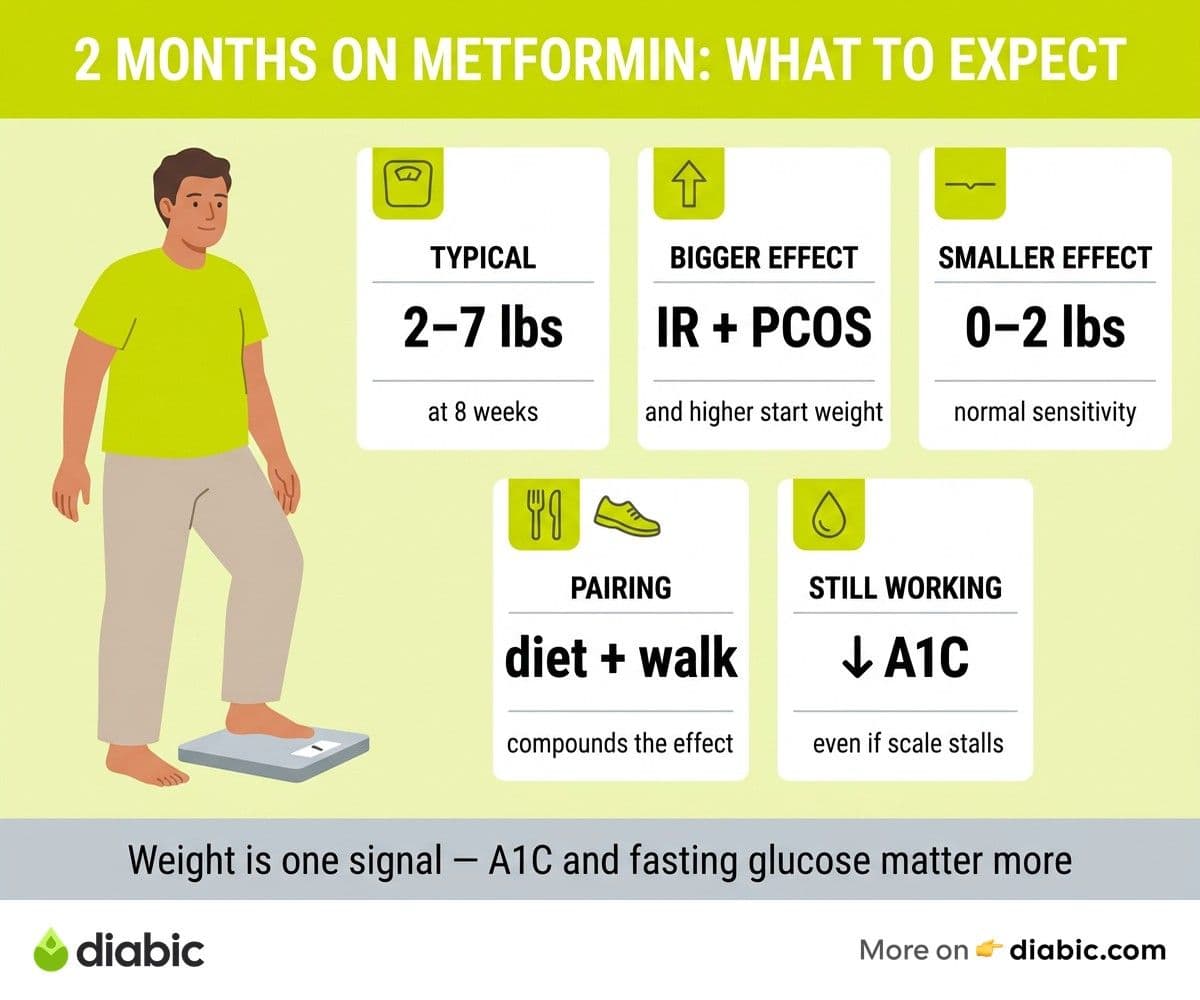
For most people, realistic 2 month metformin weight loss results land somewhere between 2 and 7 pounds. Some lose more, especially if they are also making meaningful changes to food and movement. Others see no change on the scale at all during the first eight weeks, and a smaller group temporarily gain weight as their bodies adjust. None of these outcomes is unusual.
A handful of factors push results in either direction. People who start with insulin resistance, prediabetes, or polycystic ovary syndrome (PCOS) often see more noticeable changes because their bodies were holding onto weight in ways the medication directly addresses. People whose insulin sensitivity is already reasonable may notice less. Studies published in journals like Diabetes Care consistently show wide individual variability, with the largest effects appearing when metformin is paired with diet and activity changes.
The question of "what diabetic medication helps with weight loss" comes up often, and metformin is usually the first answer because it is widely prescribed, inexpensive, and weight-neutral to weight-reducing for most people. Newer GLP-1 medications produce larger weight changes, but they sit in a different class with different cost and access considerations. Talk to your provider about what fits your situation.
How diet and exercise change the picture
Metformin alone is not a weight loss program. The reason clinical trials report consistent results is that participants are usually following structured nutrition and activity protocols alongside the medication. If you are taking metformin without changes to how you eat or move, expect the smaller end of the range or no change at all.
Pairing the medication with even modest food and activity adjustments tends to compound the effect. Our piece on diabetic weight loss strategies walks through which lifestyle levers actually move the needle, separate from medication choices. Reading that alongside this article will give you a fuller picture of what eight weeks can realistically produce.
From my experience: When I first started metformin years into my diabetes management, I expected the scale to drop fast based on stories I had read online. By week eight, I was down about four pounds, which initially felt underwhelming. Looking back, those four pounds turned into a steadier downward trend over the next six months precisely because I did not give up when the early numbers were modest. The two-month mark is a checkpoint, not a verdict.
Factors That Influence Results
The conversation around diabetic and weight loss often skips over how much individual context matters. Two people on the same dose of metformin can have very different two-month results, and most of the variance comes from things outside the pill itself.
Starting weight and metabolic health set the baseline. People with higher baseline insulin resistance often see clearer changes, while people closer to a healthy weight may see only small shifts. Body composition, age, sex, and hormonal factors like PCOS or perimenopause all play a role. None of this is something to feel discouraged by. It just means your results are yours, not a benchmark against someone else's forum post.
Diet quality is the biggest modifiable factor. If you continue eating the same way you ate before the prescription, the medication is doing the heavy lifting alone. If you are also reducing refined carbs, eating more protein and fiber, and cutting back on sugary drinks, your results at eight weeks will likely look better. Our guide on losing weight with insulin resistance covers food strategies that pair well with metformin's mechanism.
Activity, sleep, and stress
Physical activity amplifies metformin's effect on insulin sensitivity. Even short post-meal walks help your muscles use glucose more efficiently, and that compounds over weeks. Resistance training adds another layer because muscle tissue is metabolically active and improves long-term glucose handling. You do not need a gym membership to see this benefit, but you do need consistency.
Sleep and stress are the quiet variables. Poor sleep raises cortisol, which raises blood sugar and can blunt weight loss. Chronic stress does the same. If you are taking metformin while running on five hours of sleep and high stress, expect your results to lag the average. These factors do not show up on prescription bottles, but they show up on the scale.
Other medications matter too. Some drugs for blood pressure, depression, or steroids can promote weight gain, partially offsetting metformin's effects. If your two-month results look surprising in either direction, your prescriber can help you sort out what might be contributing.
Side Effects That Affect Weight
Metformin's most common side effects are gastrointestinal: nausea, loose stools, gas, and reduced appetite. For some people, these symptoms create a temporary calorie deficit during the first few weeks, which can show up on the scale as early weight loss that has more to do with the GI adjustment than the medication's metabolic effects.
According to the Mayo Clinic, most GI side effects ease within two to four weeks as your body adjusts. Some people find the symptoms persist longer or become a quality-of-life issue. If that is happening to you, the conversation to have with your prescriber is whether the timing of doses, taking the medication with food, or switching from immediate-release to extended-release formulations might help.
The extended-release version tends to cause fewer GI side effects because it dissolves more gradually. If you are weighing eight-week results and find your appetite is steadily lower because you feel queasy, that is not the same as sustainable weight loss. Sustainable change usually shows up after the GI symptoms calm down and your eating patterns stabilize.
Maximizing Your Results While on Metformin
Pair the medication with a diabetes-friendly eating pattern that emphasizes vegetables, lean proteins, healthy fats, and high-fiber carbohydrates. Approaches like the insulin resistance diet align well with how metformin works because both reduce demand on your insulin response. There is no single "metformin diet," but lower-glycemic, whole-food patterns consistently produce better results than continuing a high-refined-carb intake.
Add movement in a way you can sustain for months, not weeks. Walking after meals, two to three short strength sessions a week, and reducing long stretches of sitting are all evidence-based and beginner-friendly. The compounding effect over the first two months is often invisible on the scale but visible in fasting blood sugar and energy levels.
Track progress beyond the scale. Waist measurements, how clothes fit, fasting blood glucose trends, A1C at your next lab draw, and how you feel after meals are all meaningful signals. Weight is one data point, and it can fluctuate by several pounds based on hydration, sodium, and hormonal cycles. Looking at multiple markers over eight weeks gives a more honest read than the scale alone.
Stay in regular contact with your prescriber
Two months is also a natural check-in window. Your provider may want to look at fasting glucose, kidney function, or B12 levels, which metformin can affect over time. If your results are far off what you expected, that is worth a conversation rather than a self-directed change to dose or schedule. We never recommend dosage adjustments outside of your provider's guidance.
FAQ
How much weight can you lose on metformin in 2 months?
Most people lose between 2 and 7 pounds in eight weeks, though individual results vary widely. People who pair metformin with meaningful diet and activity changes tend to see results closer to the upper end of that range, while people relying on medication alone often see less. Two months is early, and longer-term studies show effects continuing to develop over six to twelve months.
Does metformin help with weight loss for non-people with diabetes?
Some research suggests modest weight loss benefits in non-people with diabetes, particularly people with insulin resistance or PCOS. That said, metformin is not approved as a weight loss medication, and 2 month metformin weight loss results non diabetic users report tend to be small and similar to the ranges seen in people with diabetes. Any off-label use should be a conversation with a prescriber rather than something you pursue independently.
Why am I not losing weight on metformin after 2 months?
Several reasons are possible: starting metabolic context, diet that has not shifted, low activity levels, sleep or stress factors, or other medications affecting weight. It can also simply be your individual response, since not everyone loses weight on metformin. If your blood sugar markers are improving even when the scale is flat, the medication is still doing meaningful work. Talk to your provider if you are unsure how to interpret your results.
Is the weight loss from metformin permanent?
Weight changes tend to persist as long as you continue the medication and the supporting habits that produced them. Stopping metformin can lead to gradual weight regain in some people, especially if lifestyle habits revert. The most durable results come from using the medication as one tool alongside food and movement changes you can keep up.
The two-month mark is a snapshot, not the full picture. If your 2 month metformin weight loss results feel underwhelming, the most useful next step is usually to look at the habits surrounding the prescription rather than the prescription itself. Steady, modest change at eight weeks is exactly the foundation that turns into something meaningful at six months.
Dr. Shanto Arian is an internal medicine physician now specializing in clinical and aesthetic dermatology, with a parallel academic focus on epidemiology and public health. He holds an MBBS, MPH, MSc (UK), MRCP (UK), MRCPI (Ireland), Diploma in Dermatology (UK), and Diploma in Aesthetic Medicine (USA). Dr. Arian trained in internal medicine, including hospital work on hematology cases such as graft-versus-host disease, before moving toward dermatology. Skin is one of the earliest places diabetes shows itself, from acanthosis nigricans and diabetic dermopathy to slow foot wound healing, and that intersection is where his clinical and Diabic-review work meet. On Diabic, Dr. Arian medically reviews content on diabetes diagnosis, complications, dermatologic manifestations, and pharmacotherapy, ensuring every claim aligns with current ADA, NICE, and peer-reviewed literature.
Medically reviewed by
Dr. Rezwana Parvin Rumpa is an obstetrics and gynaecology specialist with clinical focus on gestational diabetes, PCOS, and fertility. She holds the MRCOG (Final Part) from the Royal College of Obstetricians and Gynaecologists in London, the MRCPI (Final Part) from the Royal College of Physicians of Ireland, and an MBBS from Shaheed Monsur Ali Medical College under Dhaka University. Dr. Rumpa serves as a Senior Medical Officer in the Obs and Gynae department at BRB Hospitals Ltd, where she has spent three years managing prenatal care, emergency obstetric cases, and women's-health surgery. On Diabic, she medically reviews content for women living with diabetes, with particular attention to pregnancy, PCOS, and reproductive-health intersections.
More from Diet & Fitness
View all
7 Sweet Potato Diabetes Recipes That Keep Blood Sugar Steady
Seven sweet potato diabetes recipes with balanced macros, plus the cooking methods and portion tips that keep this naturally sweet vegetable blood-sugar.

Diabetes Pasta Recipes That Won't Spike Blood Sugar
Five diabetes pasta recipes that keep blood sugar steady, plus the cooking trick and pasta swaps that lower glycemic impact for everyday meals.

Chinese Recipes for Diabetes That Taste Like Takeout
Chinese recipes for diabetes that recreate takeout favorites at home with low-sugar swaps, controlled portions, and stir-fries that keep blood sugar.
Clinician-reviewed habits, plain-language guides, and honest answers - the small shifts that make living with diabetes feel lighter, every day.