Low Carb for Prediabetes: A Starter Guide
A beginner-friendly guide to going low carb for prediabetes, with carb targets, food lists, a one-week meal framework, and common mistakes to avoid.

In this article(10)
Going low carb for prediabetes is one of the most talked-about strategies for getting blood sugar back on track. The challenge is that "low carb" means different things to different people, and the advice online ranges from gentle reductions to strict keto plans. If you have never tried cutting carbs before, knowing where to start can be the hardest part.
This starter guide breaks the approach into manageable pieces: how reducing carbs affects your blood sugar, how many carbs are reasonable for prediabetes, what to eat, and the missteps that trip up most beginners. The goal is a plan you can actually live with, not a 30-day reset that falls apart at week four.
You do not need to count every gram or buy specialty products. You need a clear picture of which foods work for you, a target range to aim at, and a way to keep your meals interesting enough to stick with.
How Low Carb for Prediabetes Helps Your Blood Sugar
Every carbohydrate you eat eventually breaks down into glucose. That glucose enters your bloodstream and triggers your pancreas to release insulin, which moves the sugar into your cells for energy or storage. With prediabetes, your cells have started to resist insulin, so the same meal produces a higher and longer-lasting blood sugar spike than it would in someone with normal insulin sensitivity.
Reducing the carb load at each meal is a direct way to reduce that spike. Less glucose hitting the bloodstream at once means less insulin demand, which gives your system room to recover. The link between a low-carb diet and diabetes risk has been studied repeatedly, and the pattern is consistent.
A study in Diabetes Care found that adults with prediabetes who reduced their carbohydrate intake saw measurable improvements in fasting blood glucose and HbA1c compared to those eating a standard diet. The CDC's prediabetes resources emphasize that lifestyle interventions, including dietary changes that lower glucose load, can cut the risk of progressing to type 2 diabetes by more than half.
Importantly, low carb does not have to mean no carb. Many people see benefits from a moderate reduction rather than a strict ketogenic plan. The point is to right-size your carb intake to what your body can handle, not to eliminate an entire food group. Our broader prediabetes diet guide on what to eat covers the full picture if you are still mapping out your overall approach.
How Many Carbs Should You Eat with Prediabetes
There is no single number that works for every person with prediabetes. Most research and clinical guidance, including the American Diabetes Association's nutrition therapy recommendations, points to a flexible range rather than a fixed prescription.
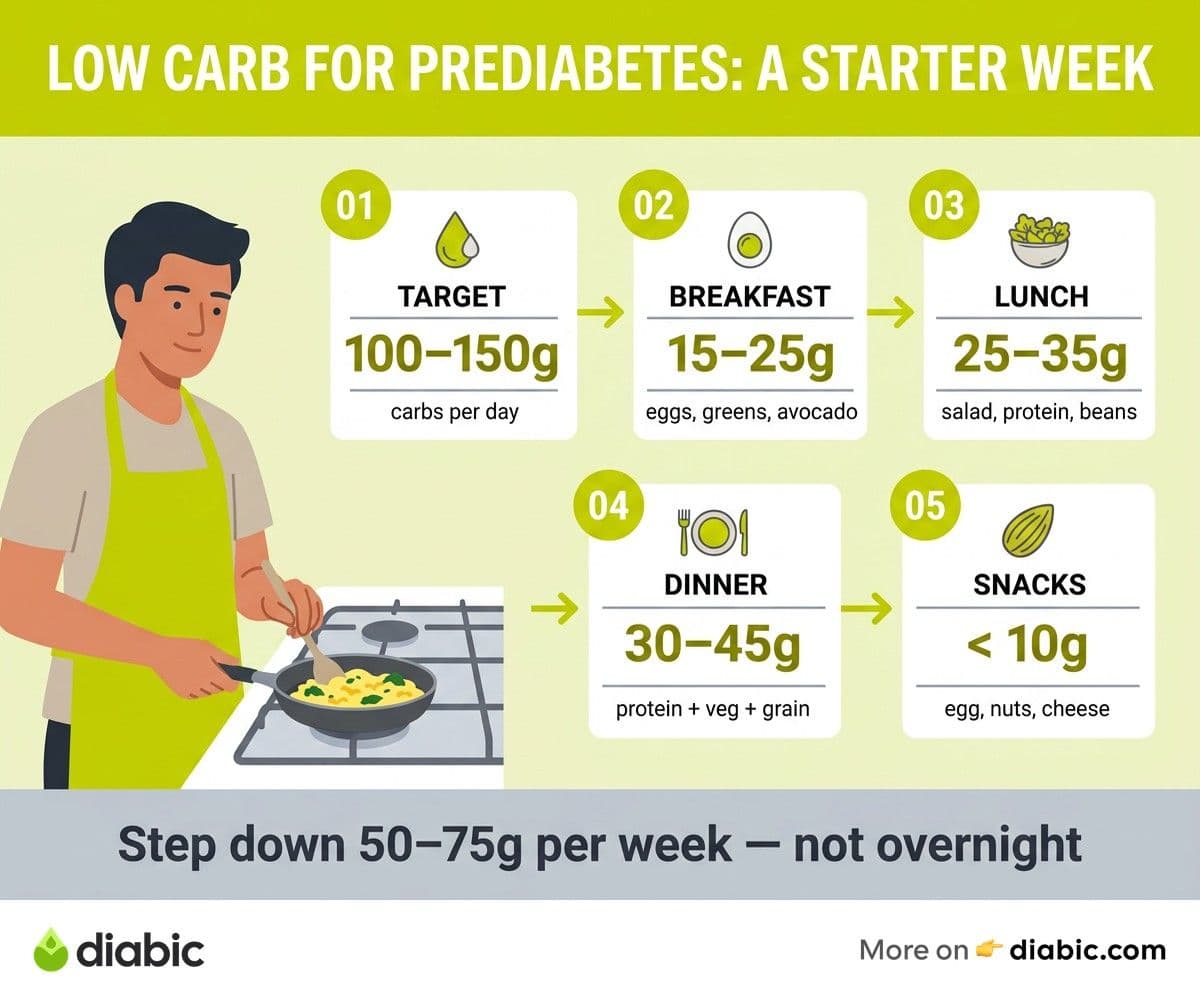
A common moderate low-carb target is 100 to 150 grams of carbohydrates per day. That is about half of what a typical Western diet delivers, but it still leaves room for fruit, legumes, whole grains, and starchy vegetables in smaller portions. Stricter low-carb plans drop to 50 to 100 grams per day, and ketogenic plans go below 50. The sweet spot for most people with prediabetes sits in the moderate range.
To find your starting point, track what you currently eat for three or four days using any free app or a notebook. The number that comes back is often higher than people expect, sometimes 250 to 350 grams per day. That baseline tells you how big a change you are actually proposing and helps you set a realistic target.
Working with your doctor or a registered dietitian matters here, especially if you take any medication that affects blood sugar. Cutting carbs too sharply while on glucose-lowering medication can cause hypoglycemia, which is a real safety issue. Talk to your doctor before making large changes, and ask whether your medication doses might need adjustment as your blood sugar improves.
What to Eat on a Low-Carb Prediabetes Diet
A practical diet for prediabetes built around lower carbs leans on protein, healthy fats, and vegetables, with smaller portions of carbohydrate-dense foods. The plate stays full and satisfying because you are not just removing food, you are rebalancing it.
Proteins give you staying power and have minimal effect on blood sugar:
- Chicken, turkey, and lean beef
- Fish and shellfish (salmon, sardines, shrimp, cod)
- Eggs
- Tofu and tempeh
- Greek yogurt and cottage cheese (lower-sugar versions)
Healthy fats add flavor and help slow digestion of any carbs you do eat:
- Olive oil and avocado oil
- Avocados
- Nuts and seeds (almonds, walnuts, pumpkin seeds, chia)
- Cheese in modest portions
- Olives
Low-carb vegetables can fill most of your plate:
- Leafy greens (spinach, kale, arugula, romaine)
- Cruciferous vegetables (broccoli, cauliflower, Brussels sprouts)
- Zucchini, peppers, mushrooms, asparagus
- Cucumbers, tomatoes, green beans
Smart carb choices in measured portions still belong on the plate. Berries, legumes, and small servings of whole grains bring fiber and nutrients you do not want to lose. A half-cup of black beans, a cup of strawberries, or a quarter-cup of cooked quinoa fits well within a moderate low-carb day. Our deeper look at the low-carb diet and diabetes goes into the science of what to keep and what to cut.
If you do include grains, choose minimally processed options. Our guide to whole grains for prediabetes covers which ones cause the smallest blood sugar response.
A Beginner's One-Week Low-Carb Meal Framework
You do not need a recipe book to start. A simple framework that repeats with small variations is easier to maintain than a complicated meal plan. Here is one week's worth of structure to adapt.
Breakfast options (15 to 25g carbs):
- Two eggs scrambled with spinach and feta, plus half an avocado
- Greek yogurt with raspberries, chia seeds, and a small handful of walnuts
- A protein smoothie with unsweetened almond milk, spinach, half a banana, and protein powder
Lunch options (25 to 35g carbs):
- Large salad with grilled chicken, mixed greens, cucumber, peppers, olive oil, and a half-cup of black beans
- Lettuce wraps with ground turkey, avocado, salsa, and a side of roasted vegetables
- Tuna or salmon over cauliflower rice with steamed broccoli and a drizzle of tahini
Dinner options (30 to 45g carbs):
- Baked salmon, roasted Brussels sprouts, and a small serving of barley
- Stir-fried tofu and vegetables over a small portion of brown rice or zucchini noodles
- Grilled chicken thighs, cauliflower mash, and a green salad with vinaigrette
Snack ideas under 10g carbs:
- A hard-boiled egg with a few cherry tomatoes
- Cheese cubes with cucumber slices
- A small handful of almonds
- Celery sticks with two tablespoons of natural peanut butter
Meal prep makes this framework realistic on busy weeks. Roasting a tray of vegetables, grilling a few chicken breasts, and hard-boiling six eggs on Sunday gives you components that mix and match all week. The decision fatigue of "what should I eat" is what derails most low-carb attempts, and prep solves it.
From my experience: The first time I cut carbs, I did it too aggressively and quit within ten days because I was tired and irritable. The second attempt, I dropped from about 300 grams a day to 150 grams over three weeks, and it stuck. Slow and steady actually works for blood sugar, energy, and the practical reality of feeding yourself every day.
Common Mistakes When Starting Low Carb
Most people who give up on a low-carb approach do so for one of a few predictable reasons. Knowing them in advance is the simplest way to avoid them.
Cutting carbs too drastically too fast is the biggest mistake people make when starting low carb for prediabetes. Going from 300 grams to 50 grams overnight usually brings on the "low carb flu", which includes headaches, fatigue, and brain fog. A gradual reduction over two to four weeks lets your body adjust without the rough landing.
Not eating enough vegetables or fiber is another common pitfall. Some people interpret "low carb" as "all meat and cheese" and end up missing the fiber that helps with digestion, satiety, and blood sugar stability. Your plate should still be mostly plants by volume, even when carbs come down.
Ignoring how medications may need adjustment can be dangerous. If you take metformin, sulfonylureas, or insulin, a sharp drop in carb intake can cause low blood sugar. Talk to your doctor before starting, ask about how your dosing might change, and monitor your blood sugar closely in the first few weeks.
Treating "low carb" as low fat too is another trap. Fat helps you stay full and adds flavor, both of which matter for sustainability. Olive oil, nuts, avocado, and full-fat dairy in reasonable portions belong on a low-carb plan, not the fat-free versions of the same foods.
Forgetting that processed "low-carb" products are still processed matters too. Low-carb tortillas, bars, and snacks have their place, but a diet built around them tends to disappoint. Whole foods almost always work better for both blood sugar and how you feel.
FAQ
How many carbs should you eat with prediabetes?
There is no universal number, but many people with prediabetes find benefit in the 100 to 150 grams per day range. Stricter approaches drop below 100 grams, and ketogenic plans go under 50. Your healthcare provider can help determine the right target based on your blood sugar levels, medications, and activity level.
Does cutting carbs help with prediabetes?
Research suggests that reducing carbohydrate intake can lower fasting blood sugar and improve insulin sensitivity in people with prediabetes. The key is making sustainable changes rather than extreme cuts. Most studies showing benefit used moderate reductions paired with higher protein and vegetable intake, not extreme restriction.
Can you reverse prediabetes with a low-carb diet alone?
Diet is one of the most powerful levers, but most successful prediabetes reversal stories combine reduced carbs with regular movement, better sleep, and modest weight loss when applicable. A low-carb approach can be a strong foundation, but adding even 30 minutes of walking most days makes the results more reliable.
Will I have to give up bread and pasta forever?
Not necessarily. Going low carb for prediabetes does not have to mean cutting out specific foods permanently. Many people stabilize blood sugar by reducing portions, choosing whole-grain versions, and pairing those carbs with protein and fat to slow digestion. The goal is a sustainable pattern, not a permanent restriction list.
A starter month is enough to see real shifts in fasting glucose and energy. The first weeks are the hardest, and the next ones are where new habits start to feel ordinary.
Shahriar P. Shuvo is the founder of Diabic. He has lived with diabetes for over 14 years, and built Diabic to deliver the practical, evidence-based self-management tools he wished existed when he was first diagnosed. By trade, Shahriar is a senior design and frontend engineer with 6+ years shipping products at Agora, Timescale (now Tiger Data), and ShareTrip. He writes from the intersection of lived diabetes experience and product craft, focused on what works in daily management rather than what sounds good in a textbook.
Medically reviewed by
Dr. Rezwana Parvin Rumpa is an obstetrics and gynaecology specialist with clinical focus on gestational diabetes, PCOS, and fertility. She holds the MRCOG (Final Part) from the Royal College of Obstetricians and Gynaecologists in London, the MRCPI (Final Part) from the Royal College of Physicians of Ireland, and an MBBS from Shaheed Monsur Ali Medical College under Dhaka University. Dr. Rumpa serves as a Senior Medical Officer in the Obs and Gynae department at BRB Hospitals Ltd, where she has spent three years managing prenatal care, emergency obstetric cases, and women's-health surgery. On Diabic, she medically reviews content for women living with diabetes, with particular attention to pregnancy, PCOS, and reproductive-health intersections.
More from Diabetes Knowledge
View all
Can Diabetics Eat Fruit? Yes, Best Picks and Tips
Can people with diabetes eat fruit? Yes. Here is how to choose the right fruits, manage portions, and pair them smartly to keep blood sugar steady.

Newly Diagnosed Type 2 Diabetes: Where to Start
Newly diagnosed type 2 diabetes feels overwhelming, but the first steps are simpler than you think. Get a clear, calm starting plan from day one.

Secondary Diabetes: When Another Condition Is the Cause
Secondary diabetes develops because of another medical condition or medication. Learn the causes, how it differs from type 2, and how it's managed.
Clinician-reviewed habits, plain-language guides, and honest answers - the small shifts that make living with diabetes feel lighter, every day.