Flying with Diabetes Supplies: TSA Rules Explained
Wondering what can I bring on plane diabetes supplies? Here's exactly what TSA allows, how to pack, and how to breeze through screening.

In this article(10)
The first time you fly after a diabetes diagnosis, the security line feels like a pop quiz you did not study for. Insulin pens, lancets, a glucose meter, juice boxes for lows. Will any of it make the X-ray operator pause? The honest answer is that flying with diabetes supplies, TSA rules included, is a settled question for the Transportation Security Administration, and the framework is more relaxed than most travelers expect. If you have been asking what can I bring on plane diabetes supplies, this guide walks through every step, from packing to boarding.
We will cover what TSA explicitly allows, how to pack so screening goes smoothly, what to do if an officer pulls your bag aside, and a few practical habits that have helped countless travelers avoid stress at the airport. None of this requires a doctor's note, though we will explain when one helps. Before you head to the airport, you may also want to read our diabetes road trip planning guide for tips that apply to ground travel too.
What Can I Bring on Plane Diabetes Supplies, Specifically
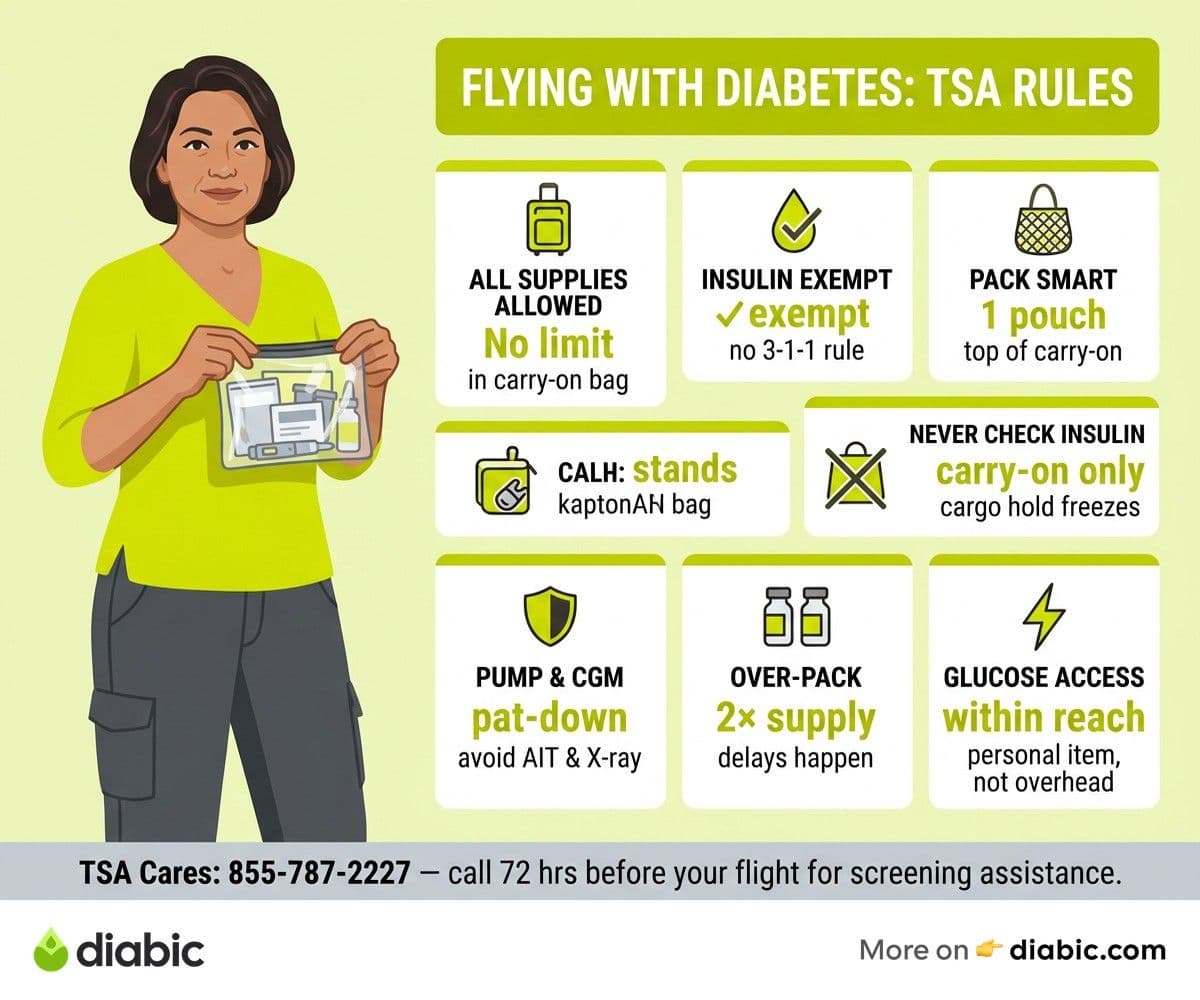
The short answer is everything. According to the TSA's official guidance for passengers with diabetes, all diabetes supplies are permitted in carry-on bags with no quantity limits. That includes insulin in any form, syringes, pen needles, lancets, glucose meters, continuous glucose monitors, insulin pumps, and the fast-acting glucose you carry to treat lows.
Insulin is specifically exempt from the 3-1-1 liquid rule. You do not need to pour it into a 3.4 ounce container, and you do not need to fit it in a quart-size bag. The same goes for liquid medications, juice, glucose gel, and the gel packs in your insulin cooler. The American Diabetes Association confirms that medically necessary liquids can be carried in any reasonable quantity.
A doctor's letter listing your supplies is not required by TSA. Many travelers carry one anyway because it can speed up an unexpected conversation, especially during international transfers. A letter on letterhead that lists your diagnosis, your medications, and your devices is enough. Pair it with a current prescription label on your insulin box if you can.
Sharps containers, used pens, and old pen needles are all allowed in carry-on too. If you would rather not travel with a hard sharps container, a clearly labeled rigid pill bottle works for the trip home.
Flying with Diabetes Supplies: TSA Rules for Packing
Pack everything in your carry-on. The cargo hold of an aircraft can swing well below freezing during a long flight, and frozen insulin is degraded insulin. The FDA notes that insulin must not freeze, and once it does, it should be discarded. Checked bags also get lost, and replacing insulin in an unfamiliar city is its own headache.
Keep your supplies organized in a single clear or mesh pouch. When the TSA officer asks to see them, you want one zip rather than a scavenger hunt across your backpack. A pencil case or a packing cube works well. Pack your meter, lancets, test strips, glucose tabs, pens, and pen needles together so the whole kit moves as a unit.
Use an insulin cooler designed for travel. Frio wallets are popular because they activate with cold water rather than a freezer, which means they are TSA-friendly and refresh easily during long trips. Vivi Cap insulated pen sleeves are another option for shorter days when you only need to keep one or two pens regulated. We cover the full landscape of products in our insulin storage tips for travel post.
Bring more than you think you need. A two-day trip can easily turn into four if a flight is canceled or a connection is missed. Most travel-savvy people with diabetes carry double their expected supply, split between a carry-on and a personal item, in case one bag gets lost or delayed.
Navigating TSA Screening with Diabetes Devices
Before you place anything on the belt, tell the officer you have diabetes supplies. You do not need to list every item, but a quick heads-up changes the dynamic at screening. They will often direct you to the standard lane and let you keep your supplies in your bag.
Insulin pumps and continuous glucose monitors do not need to be removed. Both manufacturers and TSA agree that travelers can wear them through walk-through metal detectors. The picture gets more nuanced with full-body scanners and X-ray machines. Dexcom, Medtronic, Tandem, and Omnipod all advise against putting their devices through advanced imaging technology scanners or X-ray machines, because the radiation can damage internal electronics. Check your specific device's manufacturer guidance before you fly.
If you wear a pump or CGM, you can request a pat-down instead of going through the body scanner. Just say "I have a medical device, I would like a pat-down." The officer will perform a private screening if you ask. You can also request a visual inspection of any device or supply rather than X-ray. For more detail, our piece on airport security with diabetes supplies walks through real screening scenarios.
TSA Cares is a helpline for travelers with medical conditions and disabilities. Call 855-787-2227 at least 72 hours before your flight to arrange screening assistance. A passenger support specialist can meet you at the airport, walk you through security, and help if anything unexpected comes up. The service is free.
If an officer challenges a supply, stay calm and ask for a supervisor. TSA's published policy is the final word, and supervisors are trained on medical exceptions. A respectful tone almost always resolves these situations.
Tips for a Stress-Free Boarding Experience
Arrive earlier than you normally would. Even a routine screening with diabetes supplies takes a few extra minutes, and a pat-down adds time on top of that. Giving yourself an extra 30 minutes of buffer turns a tense morning into a manageable one.
Carry a printed or digital copy of your prescription. The label on your insulin box is usually enough proof of medical necessity, but a screenshot of your prescription on your phone is a fine backup. The CDC's traveler's health page also recommends keeping a list of your medications and dosages on you in case of an emergency abroad.
Keep fast-acting glucose accessible in your personal item, not at the bottom of an overhead bag. Glucose tabs, juice boxes, gummies, or gel packets all work. Treat any low the same way you would on the ground, and recheck before you take off if the numbers were borderline.
Set phone reminders for insulin doses, adjusted to your destination time zone. This is more important than people realize, because jet lag scrambles your usual cues. Our adjusting insulin across time zones post covers the timing logic in detail.
From my experience: I have flown more than 100 segments since my type 1 diagnosis 14 years ago. Across all of them, I have had exactly two screening conversations that went past the standard 30-second exchange, and both were resolved by calmly asking for a supervisor. The thing that made the biggest difference was telling the officer about my pump before stepping into any scanner. That single sentence sets the tone for everything that follows.
Travel insurance is worth a quick mention. Most general travel policies do not cover lost or damaged insulin or a missed dose due to a delay. Specialty providers exist for chronic conditions, and our [travel insurance for people with diabetes](/traveling-with-diabetes/travel-insurance-for-people with diabetes-whats-covered) breakdown explains what to look for. Knowing the flying with diabetes supplies TSA rules in advance is half the battle; the other half is having a fallback plan when supplies go missing on the road.
FAQ
Can TSA confiscate my insulin or syringes?
No. TSA explicitly permits insulin, syringes, pen needles, lancets, and all related diabetes supplies in carry-on bags. There is no quantity limit for medically necessary liquids, including insulin. If an officer is unsure, calmly request a supervisor.
Do I need a doctor's note to fly with diabetes supplies?
A doctor's note is not required by TSA. Many travelers carry one because it speeds up unexpected conversations, especially on international trips. A letter on official letterhead listing your diagnosis, medications, and devices is sufficient if you choose to bring one.
Can I wear my insulin pump through the body scanner?
Most pump and CGM manufacturers advise against it. Dexcom, Medtronic, Tandem, and Omnipod all recommend avoiding advanced imaging technology scanners and X-ray machines. Request a pat-down instead by telling the officer you have a medical device. Walk-through metal detectors are generally fine, but check your manufacturer's guidance before flying.
Can I take insulin on a plane through TSA?
Yes. TSA allows insulin in any form on planes, in carry-on bags, with no quantity limit. Insulin is exempt from the 3-1-1 liquid rule. Keep it in your carry-on, never in checked luggage, because cargo hold temperatures can damage it.
What about juice boxes and glucose gel for lows?
Both are allowed without quantity restrictions when used to treat hypoglycemia. Mention them to the officer when you reach the screening lane so they are not surprised by a liquid above 3.4 ounces.
Flying with diabetes supplies, TSA rules and all, is a learnable skill more than a high-stakes test. Pack carry-on, label clearly, talk to the officer at the start, and you will move through security as smoothly as anyone else. The next time you find yourself searching what can I bring on plane diabetes kits typically include, the answer is almost always "all of it, in your carry-on, with a quick word to the officer." The supplies you depend on belong on the plane with you, and the published guidance is firmly on your side.
Shahriar P. Shuvo is the founder of Diabic. He has lived with diabetes for over 14 years, and built Diabic to deliver the practical, evidence-based self-management tools he wished existed when he was first diagnosed. By trade, Shahriar is a senior design and frontend engineer with 6+ years shipping products at Agora, Timescale (now Tiger Data), and ShareTrip. He writes from the intersection of lived diabetes experience and product craft, focused on what works in daily management rather than what sounds good in a textbook.
Medically reviewed by
Dr. Rezwana Parvin Rumpa is an obstetrics and gynaecology specialist with clinical focus on gestational diabetes, PCOS, and fertility. She holds the MRCOG (Final Part) from the Royal College of Obstetricians and Gynaecologists in London, the MRCPI (Final Part) from the Royal College of Physicians of Ireland, and an MBBS from Shaheed Monsur Ali Medical College under Dhaka University. Dr. Rumpa serves as a Senior Medical Officer in the Obs and Gynae department at BRB Hospitals Ltd, where she has spent three years managing prenatal care, emergency obstetric cases, and women's-health surgery. On Diabic, she medically reviews content for women living with diabetes, with particular attention to pregnancy, PCOS, and reproductive-health intersections.
More from Living with Diabetes
View all
Retirement Planning with Diabetes: Costs to Know
Retirement planning with diabetes means budgeting for insulin, Medicare gaps, and rising supply costs. Here is a clear framework to prepare your finances.

Napping and Blood Sugar: What the Research Actually Says
Napping and blood sugar have a complicated relationship. Short naps may help, long naps may raise type 2 diabetes risk. Here is what research shows.

Marijuana and Diabetes: What Research Actually Says
What research says about marijuana and diabetes, including effects on blood sugar, insulin sensitivity, appetite, and safety considerations to discuss.
Clinician-reviewed habits, plain-language guides, and honest answers - the small shifts that make living with diabetes feel lighter, every day.