Retirement Planning with Diabetes: Costs to Know
Retirement planning with diabetes means budgeting for insulin, Medicare gaps, and rising supply costs. Here is a clear framework to prepare your finances.

In this article(12)
- Retirement Planning with Diabetes: Why It Is Different
- Understanding the Real Cost of Diabetes Management
- Medicare and Insurance Coverage for Diabetes in Seniors
- Comparing Coverage Plan Types
- Diabetes in Seniors: Budgeting for Rising Costs
- Strategies for Reducing Diabetes Costs in Retirement
- Creating Your Retirement Healthcare Budget
Most retirement calculators ask about your mortgage, your travel goals, and whether you plan to downsize. Very few ask whether you take insulin or see an endocrinologist twice a year. That blind spot leaves people approaching retirement with a budget that looks reasonable on paper and falls apart the first time they pick up a prescription. If you are working through retirement planning with diabetes in the picture, you need a framework that accounts for steady supply costs and the occasional surge of complication-related expenses.
We hear from readers in their fifties and sixties who feel blindsided by what their financial advisor missed. They saved diligently and assumed Medicare would handle the rest, then ran the actual numbers and the math stopped working. This guide walks through what those numbers look like, where the coverage gaps sit, and how to build a plan that holds up.
From my experience: I am still decades out from Medicare, but I started tracking my T1D spending as a separate line item around 2019, the year I switched to a Dexcom G6 and watched my supply costs jump. Even with employer insurance, sensors, pump pods, and quarterly endo visits add up to a number that surprised me the first time I saw it on one page. Looking at that running total is what convinced me retirement planning has to start the moment you stop ignoring the numbers, not the moment you turn 60.
Retirement Planning with Diabetes: Why It Is Different
Standard retirement guides assume relatively predictable healthcare costs that grow gradually with age. Diabetes changes that curve in two ways. Your baseline spending is higher every year because you are managing a chronic condition that needs daily inputs, and your risk of expensive cardiovascular events, kidney issues, vision changes, and neuropathy treatment climbs as you age. That means your healthcare line item can jump sharply rather than rise smoothly.
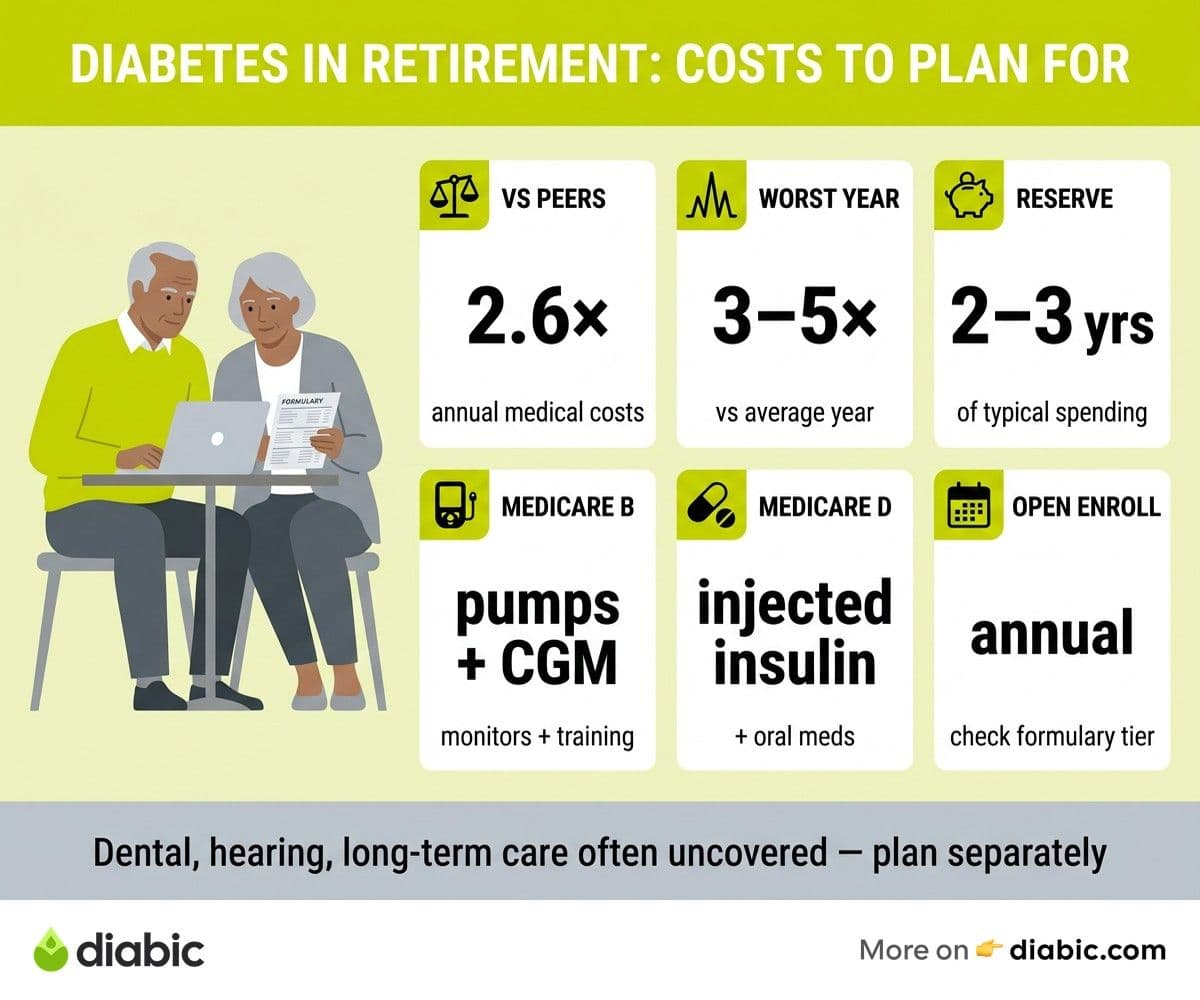
The shift away from employer insurance is where this hits hardest. While you were working, your employer absorbed a share of premiums and your formulary was set by benefits negotiators. The day you retire, you become responsible for choosing your Medicare path, layering supplemental coverage, and paying for anything outside those plans. According to the American Diabetes Association's Economic Costs of Diabetes report, people with diagnosed diabetes incur roughly 2.6 times the medical costs of peers without the condition.
Starting your planning early gives you options that late planning cannot match. If you build a retirement healthcare reserve in your fifties, you have time to fund it through tax-advantaged accounts, consider long-term care insurance while premiums are lower, and structure withdrawals to avoid higher Medicare premium brackets. We encourage readers to treat the decade before retirement as a planning runway, not a final sprint.
Understanding the Real Cost of Diabetes Management
Before you can budget, you need a clear-eyed look at what diabetes costs you in a year. Most people underestimate this number because they pay for things in scattered ways: a copay here, a pharmacy charge there, a specialist visit billed months later. Reading the real cost of diabetes management gives you a fuller picture, but the categories below capture the major buckets you will plan around.
Daily supplies form the steady baseline, including insulin, oral medications, test strips and lancets, CGM sensors and transmitters, and pump supplies. These costs recur every month and are highly sensitive to your insurance plan and pharmacy benefit manager, so small plan differences translate into hundreds of dollars per year. Specialist care adds another layer, including an annual eye exam, quarterly endocrinologist or primary care visits, regular A1C and lipid panels, kidney function tests, and podiatry. The National Institute of Diabetes and Digestive and Kidney Diseases recommends a full set of annual screenings that can generate meaningful copay totals even with good insurance.
Then there are the costs that retirement planning has to account for even though they do not show up monthly. Hospitalizations from severe hypoglycemia, escalating infections, cardiovascular events, and procedures related to long-term complications can each cost thousands out of pocket even with Medicare. A reasonable rule: assume your worst diabetes-related year will cost three to five times your average year, and ensure your savings can absorb that hit.
Medicare and Insurance Coverage for Diabetes in Seniors
Medicare is the foundation for most American retirees, but its coverage of diabetes supplies is more fragmented than people expect. Part B covers blood glucose monitors, test strips, lancets, and continuous glucose monitors when you meet specific medical criteria, along with self-management training and medical nutrition therapy. Insulin used in a pump falls under Part B as well. The covered supply list and documentation requirements live on Medicare.gov, and we recommend reviewing it before you finalize any plan choices.
Part D handles most prescription medications, including injected insulin and oral diabetes drugs. The Inflation Reduction Act capped insulin copays under Part D, lowering out-of-pocket costs for many beneficiaries, though formulary tiers and pharmacy networks still vary widely. When comparing Part D plans, do not just look at premiums. Pull up each plan's formulary, confirm your specific medications sit on a tier you can afford, and review insurance coverage for diabetes supplies before enrollment season.
Medigap and Medicare Advantage represent two different paths for filling Medicare's gaps. Medigap pairs with Original Medicare and offers predictable copays, often a strong fit for people who travel and prefer cost certainty. Medicare Advantage bundles Part A, B, and usually D into a managed care plan, sometimes with extras like vision and hearing but with narrower networks and prior authorization. The Kaiser Family Foundation publishes detailed analyses of how these options affect people with chronic conditions.
The gaps that remain after Medicare still matter. Dental care, hearing aids, and vision beyond the annual retinal exam for diabetes often fall outside coverage, and long-term care including assisted living and extended skilled nursing is largely out of scope. Foot care can be partially covered but with restrictions that surprise people when they need orthotics, so map these gaps before you retire.
Comparing Coverage Plan Types
When choosing between coverage paths, a side-by-side view helps. The table below summarizes how the major options tend to handle diabetes-specific needs.
This table is a starting point, not a recommendation. The right plan depends on your medications, providers, geography, and tolerance for plan administration. Run a personalized comparison every fall during Medicare Open Enrollment because terms shift annually, and readers outside the United States should consult your country's equivalent national health authority.
Diabetes in Seniors: Budgeting for Rising Costs
Diabetes in seniors does not behave like a flat line on a spending chart. Costs tend to rise as disease duration grows and as age-related changes in kidney function, vision, and circulation create new line items. The challenges of diabetes after 65 include shifting medication needs, more frequent monitoring, and a higher likelihood of needing assistive devices. A flat diabetes budget through retirement understates what most people will spend.
Inflation in pharmaceutical pricing compounds the issue. Even with recent caps on insulin, other medications continue to see price increases that outpace general inflation, and CGM sensors, pump supplies, and GLP-1 drugs have all seen pricing pressure that retirees on fixed incomes feel acutely. Model healthcare inflation at a higher rate than groceries when you build your retirement budget, and revisit that assumption every few years.
Projecting your future spending requires honesty about your current health trajectory. If you have well-managed numbers and stable medication needs, near-term costs may stay relatively predictable, but if you see signs of kidney involvement, neuropathy, or cardiovascular risk, your savings target should reflect that. A dedicated healthcare savings fund changes how you experience these costs because instead of pulling from your general retirement portfolio every time a medical expense lands, you draw from a bucket built for the purpose.
Strategies for Reducing Diabetes Costs in Retirement
Cost reduction in retirement is not about cutting corners on care. It is about being deliberate with the levers that exist. Patient assistance programs from insulin manufacturers and GLP-1 producers can meaningfully reduce out-of-pocket costs, and eligibility extends to many Medicare beneficiaries. The Centers for Disease Control and Prevention maintains resources pointing to legitimate programs, and your diabetes educator can help you navigate applications.
Generic and biosimilar options have expanded in recent years. Biosimilar insulins now offer real cost relief, and generics of metformin, statins, and blood pressure medications keep daily costs manageable. Talk to your healthcare provider about whether a generic alternative is clinically appropriate, and ask your pharmacist to compare prices because the same medication can carry very different costs across Part D plans.
Tax-advantaged strategies deserve attention well before you retire. HSAs paired with a high-deductible health plan during your working years give you a triple tax advantage. Once you reach Medicare eligibility you cannot contribute further, but the balance remains available for qualified medical expenses, including Medicare premiums. State pharmaceutical assistance programs are underused, and the Social Security Administration can point you to programs in your state.
Creating Your Retirement Healthcare Budget
Building the actual budget is where planning becomes a usable document instead of a vague worry. Start by listing every diabetes-related expense you pay in a year, including premiums, copays, supplies, prescriptions, and specialist visits. Add a category for annual screenings and another for one-time replacements like a new pump or CGM receiver. This baseline gives you a starting figure to project forward.
Separate essential expenses from optional ones. Insulin, glucose monitoring, prescribed medications, and primary care are non-negotiable, while CGM coverage may be essential or optional depending on your situation. Size your emergency fund for diabetes-related surprises by looking at worst-case scenarios, and we suggest a healthcare-specific reserve equal to two to three years of typical spending, held in liquid accounts and separate from your general emergency fund.
An annual review keeps the budget honest. Each year before Medicare Open Enrollment, walk through your spending from the prior twelve months, compare it to your plan, and update your projections. Tools from organizations like AARP provide templates that work well as a starting framework. Strong retirement planning with diabetes pairs medical reality with financial structure, and your financial advisor can tailor these templates to diabetes-specific line items.
FAQ
How should you plan for retirement with diabetes costs?
Calculate your current annual diabetes expenses across every category, from premiums to supplies to specialist copays. Project those costs forward using a healthcare-specific inflation rate, research Medicare options before you turn 65, and build a healthcare emergency fund equal to two to three years of typical spending. Talk to your financial advisor about HSA contributions and structuring withdrawals to avoid higher Medicare premium brackets.
What are typical healthcare costs in retirement with diabetes?
According to the American Diabetes Association, people with diagnosed diabetes incur medical costs roughly 2.6 times higher than peers without the condition. Your specific costs depend heavily on Medicare plan choices, medications, and complication status. Expect to budget significantly more than peers without diabetes, and plan for individual years to spike if you experience a hospitalization.
Does Medicare cover continuous glucose monitors?
Medicare Part B covers CGMs for beneficiaries who meet specific medical criteria, which have expanded in recent years to include more people with type 1 and type 2 diabetes. The covered list and documentation requirements are on Medicare.gov. Talk to your healthcare provider about whether you meet the criteria and how to document medical necessity.
What if you cannot afford diabetes care in retirement?
Several paths exist before rationing care, and they should be central to retirement planning with diabetes when budgets get tight. Manufacturer patient assistance programs, state pharmaceutical assistance programs, federally qualified health centers, and dual eligibility for Medicaid alongside Medicare can each provide meaningful relief. Reach out to your healthcare provider and a benefits counselor before reducing medication or skipping appointments, because skipping care almost always costs more in the long run.
Shahriar P. Shuvo is the founder of Diabic. He has lived with diabetes for over 14 years, and built Diabic to deliver the practical, evidence-based self-management tools he wished existed when he was first diagnosed. By trade, Shahriar is a senior design and frontend engineer with 6+ years shipping products at Agora, Timescale (now Tiger Data), and ShareTrip. He writes from the intersection of lived diabetes experience and product craft, focused on what works in daily management rather than what sounds good in a textbook.
Medically reviewed by
Dr. Rezwana Parvin Rumpa is an obstetrics and gynaecology specialist with clinical focus on gestational diabetes, PCOS, and fertility. She holds the MRCOG (Final Part) from the Royal College of Obstetricians and Gynaecologists in London, the MRCPI (Final Part) from the Royal College of Physicians of Ireland, and an MBBS from Shaheed Monsur Ali Medical College under Dhaka University. Dr. Rumpa serves as a Senior Medical Officer in the Obs and Gynae department at BRB Hospitals Ltd, where she has spent three years managing prenatal care, emergency obstetric cases, and women's-health surgery. On Diabic, she medically reviews content for women living with diabetes, with particular attention to pregnancy, PCOS, and reproductive-health intersections.
More from Living with Diabetes
View all
Flying with Diabetes Supplies: TSA Rules Explained
Wondering what can I bring on plane diabetes supplies? Here's exactly what TSA allows, how to pack, and how to breeze through screening.

Napping and Blood Sugar: What the Research Actually Says
Napping and blood sugar have a complicated relationship. Short naps may help, long naps may raise type 2 diabetes risk. Here is what research shows.

Marijuana and Diabetes: What Research Actually Says
What research says about marijuana and diabetes, including effects on blood sugar, insulin sensitivity, appetite, and safety considerations to discuss.
Clinician-reviewed habits, plain-language guides, and honest answers - the small shifts that make living with diabetes feel lighter, every day.