Diabetes Bread Recipes That Actually Taste Good
5 diabetes bread recipes that actually taste good, with carb counts, fiber, and tips for baking lower-carb loaves that keep blood sugar steady.

In this article(14)
Bread is usually the first thing people are told to give up after a diabetes diagnosis, and it is also the one food many of us miss the most. The good news is that the right diabetes bread recipes can give you the toast, sandwiches, and warm slices you actually want, without the same blood sugar climb that store-bought white bread brings.
A loaf made with almond flour, seeds, eggs, or oats is a different animal from a supermarket sandwich loaf. It is denser, more filling, and absorbs slowly enough to fit into a normal meal. Below are five recipes worth keeping in your weekly rotation, plus the baking tricks that make alternative flours behave.
Why Homemade Bread Is Better for Diabetes
Most store-bought breads are built around refined wheat flour, added sugars, and dough conditioners that bump up the glycemic load. The American Diabetes Association's guidance on grains leans toward whole grains, seeds, and minimally processed options, but those choices can be hard to find on a typical bread aisle.
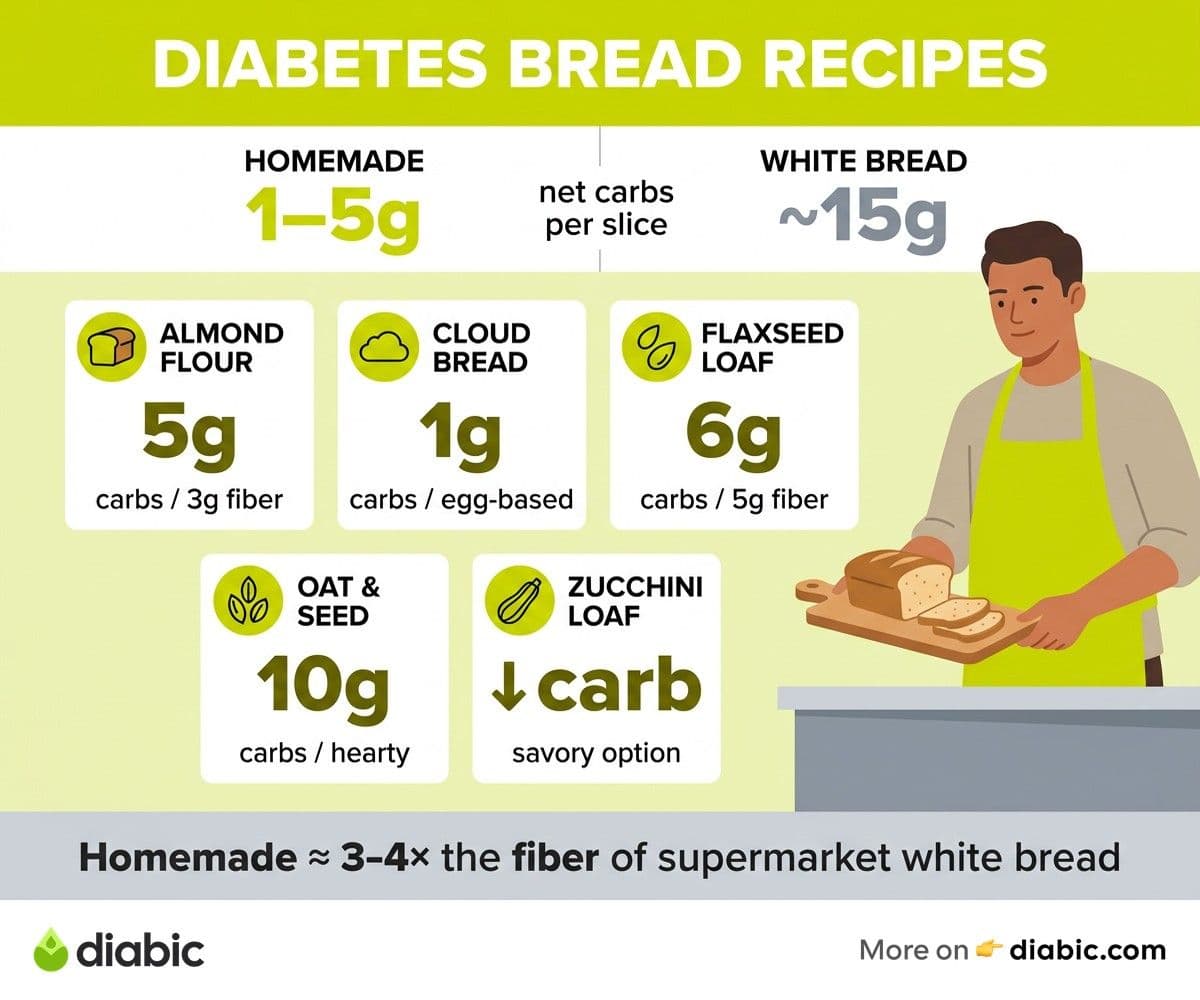
Homemade puts you in charge of every ingredient. You decide the flour, the fat, the sweetener, and the seeds. You can lean on alternatives like almond flour, coconut flour, flaxseed meal, and oat flour, all of which deliver more fiber and protein per slice than refined wheat. According to USDA nutrient data, a slice of almond flour bread can deliver three to four times the fiber of standard white bread. The American Heart Association's overview of whole grains, refined grains, and dietary fiber explains why intact grain structure matters for both blood sugar and cardiovascular risk.
The other advantage is portion clarity. When you slice your own loaf, you know exactly what is in your hand. Store-bought slices vary in thickness and carb content from brand to brand, which makes carb counting harder than it needs to be. For more easy bakes that follow this same logic, see our diabetes muffin recipes.
From my experience: after fourteen years of living with diabetes, switching to homemade almond flour bread was one of the few changes I made that I actually stuck with. It was not because the recipe was perfect on day one. It was because I got my morning toast back, and that mattered.
Five Diabetes Bread Recipes Worth Baking
These diabetes friendly bread recipes are dense, hearty, and built to keep blood sugar steady. Each one uses different flours and binders, so you can pick whichever fits the texture you miss most.
1. Almond Flour Sandwich Bread
A sturdy, sliceable loaf that holds up to peanut butter, eggs, or a real sandwich.
Ingredients (1 loaf, ~12 slices): 2.5 cups blanched almond flour, 1/4 cup ground flaxseed, 1 tsp baking soda, 1/2 tsp salt, 5 large eggs, 1/4 cup olive oil, 1 tbsp apple cider vinegar.
Instructions: Preheat oven to 350 F and line a 9x5 loaf pan with parchment. Whisk almond flour, flaxseed, baking soda, and salt. In another bowl whisk eggs, olive oil, and vinegar. Combine wet and dry, pour into pan, and bake 35 to 40 minutes until a toothpick comes out clean. Cool fully before slicing.
Per slice: ~180 calories, 5g carbs, 3g fiber, 7g protein. Why it works: almond flour is mostly fat and protein with very little starch, so the carbs per slice stay low and the fiber from flaxseed slows what little carb load is there.
2. Cloud Bread (Egg-Based, Nearly Zero Carb)
A pillowy, soft option that works as buns, wraps, or quick breakfast bread.
Ingredients (6 rounds): 3 large eggs (separated), 3 tbsp cream cheese (softened), 1/4 tsp cream of tartar, pinch of salt.
Instructions: Preheat oven to 300 F. Whip egg whites with cream of tartar until stiff peaks form. In a separate bowl, beat yolks with cream cheese until smooth. Gently fold yolks into whites. Spoon 6 rounds onto a parchment-lined sheet. Bake 25 to 30 minutes until golden. Cool 10 minutes.
Per round: ~50 calories, 1g carbs, 0g fiber, 3g protein. Why it works: virtually no carbs, almost all protein and fat, which means a near-zero blood sugar response. Great for sandwich rounds when you want bread without the load.
3. Flaxseed Bread
A high-fiber loaf that toasts beautifully and holds up to spreads.
Ingredients (1 loaf, ~12 slices): 2 cups ground flaxseed, 1 tbsp baking powder, 1 tsp salt, 6 large eggs, 1/2 cup water, 1/3 cup olive oil, 1 tbsp apple cider vinegar.
Instructions: Preheat oven to 350 F. Mix flaxseed, baking powder, and salt. In another bowl whisk eggs, water, oil, and vinegar. Combine, pour into a parchment-lined 9x5 loaf pan, smooth the top. Bake 30 to 35 minutes until firm. Cool fully.
Per slice: ~150 calories, 6g carbs, 5g fiber, 6g protein. Why it works: net carbs are roughly 1g per slice once you subtract fiber. Flaxseed also delivers omega-3 fats, which have research-backed cardiovascular benefits for people with diabetes.
4. Oat and Seed Bread
A heartier loaf for people who want a chewier, more rustic texture.
Ingredients (1 loaf, ~12 slices): 1.5 cups rolled oats, 1/2 cup almond flour, 1/2 cup sunflower seeds, 1/4 cup pumpkin seeds, 1/4 cup chia seeds, 3 tbsp psyllium husk, 1.5 tsp salt, 2 tbsp olive oil, 1.5 cups water.
Instructions: Stir all dry ingredients in a bowl. Add olive oil and water, mix into a thick dough. Press into a parchment-lined loaf pan and let sit 2 hours (or overnight) so the chia and psyllium absorb the water. Bake at 350 F for 20 minutes, lift out of pan onto an oven rack, and bake another 30 to 40 minutes until firm. Cool fully.
Per slice: ~190 calories, 18g carbs, 6g fiber, 6g protein. Why it works: even with oats, the high fiber and seed content slow digestion. Oats contain beta-glucan, which research suggests may help blunt post-meal glucose response.
5. Lower-Sugar Zucchini Bread
A sweet bread option that swaps refined sugar for a small amount of natural sweetener and leans on zucchini for moisture.
Ingredients (1 loaf, ~12 slices): 1.5 cups almond flour, 1/2 cup oat flour, 1/4 cup coconut flour, 1.5 cups grated zucchini (squeezed dry), 3 eggs, 1/4 cup olive oil, 1/4 cup unsweetened applesauce, 2 tbsp pure maple syrup or monk fruit equivalent, 1 tsp baking soda, 1 tsp cinnamon, 1/2 tsp salt, 1 tsp vanilla.
Instructions: Preheat oven to 350 F. Whisk dry ingredients. Whisk wet ingredients in another bowl. Fold in zucchini. Combine, pour into a parchment-lined loaf pan, bake 45 to 50 minutes until a toothpick comes out clean. Cool fully.
Per slice: ~180 calories, 13g carbs, 4g fiber, 6g protein. Why it works: zucchini brings moisture without sugar, almond and coconut flours keep starch low, and the small amount of maple syrup spreads across twelve slices for a manageable carb count.
If you want simpler bakes with shorter ingredient lists, our 4 ingredient recipes for diabetes round-up has more options.
Baking Tips for Lower-Carb Bread
Working with alternative flours takes a small adjustment. Almond flour and coconut flour behave nothing like wheat. They do not have gluten, which means dough cannot stretch the way it does with wheat flour, and the structure has to come from somewhere else.
Coconut flour is the trickiest. It absorbs three to four times more liquid than wheat flour. If a recipe calls for 1 cup of wheat flour, you cannot just swap in 1 cup of coconut flour. Stick to recipes written specifically for the flour you are using.
Eggs, psyllium husk, and ground flaxseed are your binders. They give bread its hold and chew. Cutting eggs in half almost always means a crumbly loaf. Psyllium husk is the closest thing to "magic" in low-carb baking because it forms a gel that mimics gluten's springiness.
Moisture matters more than you think. Without gluten, alternative breads can dry out fast. Adding a tablespoon of olive oil, a few tablespoons of yogurt, or grated vegetables like zucchini keeps the loaf tender for several days.
Storage and freezing keep things sustainable. Slice your loaf fully once it cools, separate slices with parchment, and freeze in a zip-top bag. Pop a slice into the toaster directly from frozen. It is the easiest way to keep fresh diabetes-friendly bread on hand without baking every other day.
If you are layering these recipes into a broader nutrition plan, our overview on low-carb diet for diabetes walks through how lower-carb baking fits in.
FAQ
What kind of bread can people with diabetes eat?
Whole grain, sprouted grain, and homemade breads made with almond flour, coconut flour, oat flour, or seeds are better choices than refined white bread. Look for slices with at least 3g of fiber, less than 2g of added sugar, and a recognizable ingredient list. The diabetes bread recipes in this post all hit those targets.
How to make homemade bread for people with diabetes?
Start with alternative flours like almond, coconut, or oat. Add ground flaxseed, chia, or psyllium husk for fiber and structure. Use eggs as your main binder, skip added sugars (or use a small amount of monk fruit or maple syrup), and bake at moderate temperatures. Slice fully, store in the fridge, and freeze extras for fresh slices later in the week.
Are there diabetes biscuits recipes that work the same way?
Yes. Most almond flour bread recipes can be adapted into biscuit-style rounds by dropping spoonfuls of dough onto a sheet pan instead of a loaf pan. Cut the bake time roughly in half and check at 18 to 20 minutes. The same logic applies for muffins. If you are baking sweet bakes regularly, our diabetes muffin recipes post covers more options with fruit and chocolate.
Will these breads still raise blood sugar?
Most foods, including these, will raise blood sugar somewhat. The point of lower-carb, higher-fiber breads is to make the rise smaller and slower. Pair a slice with protein or healthy fat (eggs, peanut butter, avocado) to flatten the curve further. Talk to your doctor or diabetes educator about how a slice fits into your meal plan.
Is whole wheat bread fine if I do not want to bake?
It can be, in moderation. Look for 100% whole grain or sprouted grain on the label, with at least 3g of fiber and minimal added sugar. Two slices of dense, seedy whole grain bread will affect blood sugar very differently from two slices of soft white sandwich bread.
A loaf cooling on the counter is a small reminder that diabetes management does not have to mean giving up the foods you love. With a few good diabetes bread recipes in rotation, toast and sandwiches stay on the menu, and the rest of your week gets a little easier.
Shahriar P. Shuvo is the founder of Diabic. He has lived with diabetes for over 14 years, and built Diabic to deliver the practical, evidence-based self-management tools he wished existed when he was first diagnosed. By trade, Shahriar is a senior design and frontend engineer with 6+ years shipping products at Agora, Timescale (now Tiger Data), and ShareTrip. He writes from the intersection of lived diabetes experience and product craft, focused on what works in daily management rather than what sounds good in a textbook.
Medically reviewed by
Dr. Rezwana Parvin Rumpa is an obstetrics and gynaecology specialist with clinical focus on gestational diabetes, PCOS, and fertility. She holds the MRCOG (Final Part) from the Royal College of Obstetricians and Gynaecologists in London, the MRCPI (Final Part) from the Royal College of Physicians of Ireland, and an MBBS from Shaheed Monsur Ali Medical College under Dhaka University. Dr. Rumpa serves as a Senior Medical Officer in the Obs and Gynae department at BRB Hospitals Ltd, where she has spent three years managing prenatal care, emergency obstetric cases, and women's-health surgery. On Diabic, she medically reviews content for women living with diabetes, with particular attention to pregnancy, PCOS, and reproductive-health intersections.
More from Diet & Fitness
View all
7 Sweet Potato Diabetes Recipes That Keep Blood Sugar Steady
Seven sweet potato diabetes recipes with balanced macros, plus the cooking methods and portion tips that keep this naturally sweet vegetable blood-sugar.

Diabetes Pasta Recipes That Won't Spike Blood Sugar
Five diabetes pasta recipes that keep blood sugar steady, plus the cooking trick and pasta swaps that lower glycemic impact for everyday meals.

Chinese Recipes for Diabetes That Taste Like Takeout
Chinese recipes for diabetes that recreate takeout favorites at home with low-sugar swaps, controlled portions, and stir-fries that keep blood sugar.
Clinician-reviewed habits, plain-language guides, and honest answers - the small shifts that make living with diabetes feel lighter, every day.