What Food Causes High Blood Sugar (and Why)
Learn what food causes high blood sugar and why, from refined carbs to hidden health-food culprits, plus practical swaps to keep glucose steady.

In this article(11)
Understanding what food causes high blood sugar goes deeper than just avoiding sweets, because the real drivers of post-meal spikes are often foods that people consider healthy or harmless. A bowl of granola, a green smoothie, or a "light" wrap can move glucose just as fast as a candy bar, and the reasons behind that have less to do with calories and more to do with how a food is built and processed.
The "why" matters as much as the "what." Once you understand the mechanics behind a spike, you can look at any plate and make a reasonable prediction about how your body will respond. That kind of awareness beats memorizing avoidance lists every time.
What Food Causes High Blood Sugar
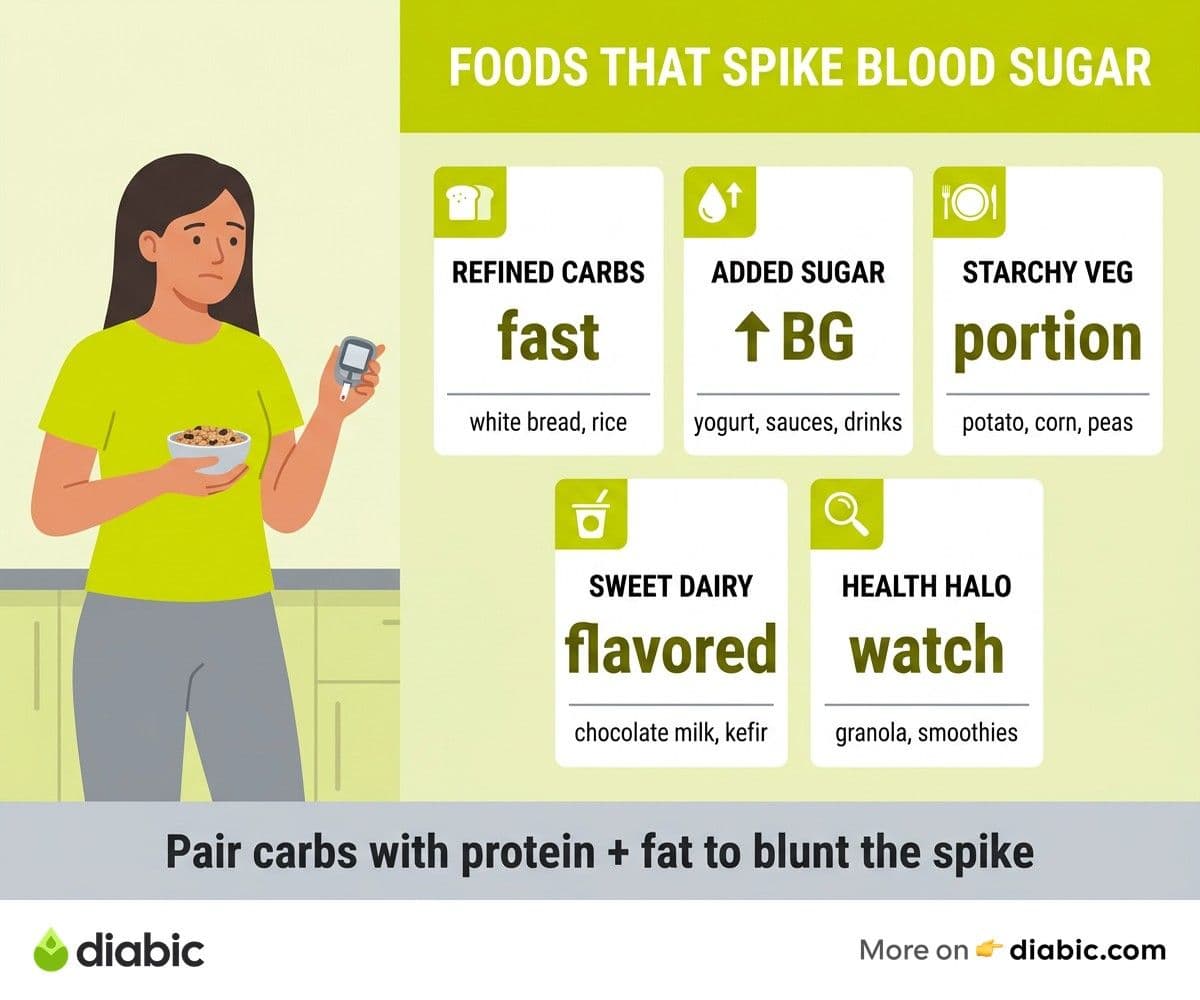
When we talk about what food causes high blood sugar, four broad categories show up again and again. Refined carbohydrates lead the list, including white bread, regular pasta, white rice, and most boxed cereals. These foods have had their fiber and bran stripped away during processing, which means your body breaks them down into glucose almost as fast as table sugar.
Added sugars are the second category, and they hide in places most people would not expect. Yogurt cups, pasta sauce, salad dressings, granola bars, and flavored coffee drinks routinely carry double-digit grams of added sugar per serving. The USDA FoodData Central database makes it easy to compare carbohydrate and fiber content across similar products, and the differences are often dramatic.
Starchy vegetables in large portions form the third group. Potatoes, corn, and peas are nutritious foods, but a heaped serving of mashed potatoes acts much more like white rice than like broccoli. Portion size flips the script here.
The fourth category is sweetened dairy. Flavored yogurts, chocolate milk, sweetened oat milk, and dessert-style kefir often have as much sugar per cup as a soft drink. Plain dairy is fine. Plain dairy with fruit you added yourself is even better. The CDC's healthy eating with diabetes hub outlines how added sugars and refined carbs in everyday products quietly drive glucose higher than people expect.
Finally, there is the cumulative effect. A wrap, a side of fruit, a granola bar, and a sweetened latte all sound moderate on their own, but stacked into one meal they add up to a heavy carb load that overwhelms the body's insulin response.
Foods That Raise Blood Sugar: Beyond the Obvious
The trickiest food that raises blood sugar is the one wearing a health halo. Granola sounds wholesome, yet a typical half-cup serving carries 30 to 40 grams of carbs and 12 grams of added sugar. Smoothies blend several servings of fruit into one liquid dose, removing the chewing time and intact fiber that normally slow glucose absorption. Acai bowls topped with honey, granola, and dried fruit can push past 80 grams of carbs in a single bowl.
Condiments and sauces add up faster than people realize. Two tablespoons of barbecue sauce can hold 12 grams of sugar. Teriyaki, sweet chili sauce, ketchup, honey mustard, and most "Asian-style" salad dressings follow the same pattern. None of these will spike you on their own. Used heavily across a meal, they layer on top of whatever carbs are already on your plate.
Gluten-free products are another quiet trap. Many gluten-free breads, crackers, and pastas use rice flour, tapioca starch, or potato starch as their base, which can produce a faster and higher glucose response than the wheat versions they replace. Gluten-free does not mean low carb, and it rarely means high fiber.
Protein bars and meal-replacement shakes deserve a careful read of the label. Some are genuinely useful. Others are essentially candy bars with a sprinkle of whey, carrying 25 to 40 grams of carbs with added sugars listed near the top of the ingredient panel.
Foods That Increase Blood Sugar: Understanding the Mechanism
To understand the food that increase blood sugar response, it helps to follow what happens after you swallow. Carbohydrates break down into glucose in your small intestine, then travel into your bloodstream. Insulin, made in the pancreas, signals your cells to absorb that glucose for energy or storage. When insulin works well and the carb load is moderate, blood sugar rises gently and returns to baseline within a couple of hours.
Fiber changes that timeline. Soluble fiber forms a gel-like layer in the gut that physically slows the absorption of sugars. Insoluble fiber adds bulk and slows gastric emptying. A bowl of oatmeal with berries and chia seeds delivers carbs, but the fiber spread across that meal turns the glucose curve from a sharp peak into a gentle hill.
Glycemic index is a useful starting point but not a complete picture. The number reflects how a fixed amount of carbohydrate from a single food affects blood sugar in a controlled study, usually on an empty stomach. Real meals are mixed, portion sizes vary, and glycemic load (which factors in actual serving size) often tells a more honest story. Research published in the American Journal of Clinical Nutrition shows that adding fat or protein to a high-carb meal blunts the glucose response, sometimes substantially.
The difference between a rapid spike and a sustained rise also matters. A 50-point jump in 30 minutes followed by a steep drop is harder on the body than a 30-point rise that holds steady for 90 minutes. Both can register as "high," but they feel different and have different long-term effects.
Why Certain Foods Raise Blood Sugar More Than Others
Five variables explain most of the variation. The first is processing. A whole wheat berry takes time for your gut to break apart. Whole wheat flour, even the "100 percent whole grain" kind, is already pulverized, so the surface area exposed to digestive enzymes is enormous. The same calories produce a faster spike when the structure is destroyed.
Cooking method comes next. Pasta cooked al dente has a measurably lower glycemic response than pasta cooked soft, because the starch granules stay more intact. Potatoes that are boiled and cooled (then eaten cold or reheated) develop resistant starch, which behaves more like fiber. Toasting bread, surprisingly, can also lower its glycemic impact slightly.
Ripeness is the third factor. A green-tipped banana has more resistant starch and less sugar than a fully ripe banana with brown spots. Both are healthy. They simply move blood sugar at different speeds.
Food combinations are the fourth lever, and probably the most useful one in daily life. The order in which you eat your food can change your glucose response without changing what you eat. Eating vegetables and protein before carbs has been shown in small studies to reduce post-meal spikes meaningfully.
The fifth factor is you. Two people can eat the same meal and get very different glucose curves based on insulin sensitivity, gut microbiome composition, sleep, stress, recent activity, and medication. The Harvard team behind the Harvard Health glycemic index database emphasizes this individual variation, which is why personal data from a glucose meter or CGM beats any general chart.
From my experience: after 14 years living with diabetes, the single biggest lesson is that no food list applies cleanly to everyone. White rice spikes me hard. A friend with type 2 handles it fine if she walks for 15 minutes after the meal. Test, observe, adjust. The food is just one input.
Which Foods Cause the Biggest Blood Sugar Spikes
Ranked by glycemic load per typical serving, the most spike-prone foods cluster into three meal types. Beverages sit at the top. Fruit juice, regular soda, sweetened iced tea, sweetened coffee drinks, and sports drinks deliver fast-absorbing sugar in liquid form, which means no chewing, no fiber, and almost immediate uptake. A 12-ounce glass of orange juice can move blood sugar more than a glass of cola in some people.
Breakfast is the second danger zone. Sweetened cereals, instant oatmeal packets, toast with jam, white bagels with low-fat cream cheese, and pastries each carry a heavy carb load with little protein or fat to slow them down. Pairing toast with eggs and avocado is a different meal than toast with jam, even if the bread is identical.
Dinner traps follow the same pattern at the other end of the day. White rice, mashed potatoes, plain pasta with tomato sauce, and dinner rolls eaten in restaurant portions often deliver 60 to 90 grams of carbs in a single sitting. For a deeper breakdown of the worst offenders and what to swap them for, our guide on foods that spike blood sugar and better alternatives walks through specific trades that keep meals satisfying.
Making Better Choices Without Giving Up Flavor
The phrase "what food increase blood sugar" implies a list of villains, but most of the practical work happens through swaps and additions rather than elimination. Trading refined grains for whole-grain or minimally processed versions is the highest-uses change. Steel-cut oats instead of instant. Brown or wild rice instead of white. Sourdough or 100 percent whole-grain bread instead of standard white. Lentil pasta or chickpea pasta instead of regular pasta when you want to keep portions modest.
Adding protein and fat to carb-heavy meals is the second move. A piece of toast on its own is a carb. Toast with avocado, eggs, and a sprinkle of seeds is a meal. The American Diabetes Association nutrition guidelines describe this kind of plate building in plain terms, and it tracks closely with what most diabetes educators teach.
Portion awareness beats elimination for most people. A half-cup of jasmine rice next to a generous serving of salmon and roasted broccoli rarely causes problems. Two cups of the same rice with a small piece of chicken usually does. The plate method (half the plate non-starchy vegetables, a quarter lean protein, a quarter starch or grain) is a simple visual that works in restaurants, at home, and at family meals.
Cooking technique is the underrated lever. Cooling cooked starches in the fridge develops resistant starch. Cooking pasta al dente lowers its glycemic response. Adding vinegar to a meal (a salad with vinaigrette, a splash of apple cider vinegar in a sauce) has been shown in several small studies to blunt post-meal glucose. For a fuller framework on building meals around glycemic impact, our guide on the low glycemic diet for diabetes offers a structured starting point.
FAQ
What foods cause blood sugar to spike the most?
Sugary beverages, white bread, white rice, sweetened breakfast cereals, and potato-based dishes cause the most significant spikes. Liquid calories such as juice, soda, and sweetened coffee tend to spike blood sugar faster than solid foods because they are absorbed more quickly and lack the fiber and chewing time that slow digestion. Pairing carbs with protein, fat, and fiber softens the response.
Why do certain foods raise blood sugar more than others?
The main factors are carbohydrate content, fiber content, processing level, and what else you eat alongside them. Refined carbs without fiber are absorbed rapidly, causing a quick spike, while whole foods with intact fiber, protein, or fat slow absorption and create a more gradual rise. Cooking method, ripeness, portion size, and individual factors like insulin sensitivity also shape the response, which is why two people can eat the same meal and see very different numbers.
Are all carbs bad for blood sugar?
No. Carbohydrates from beans, lentils, whole grains, fruits, and starchy vegetables come bundled with fiber, protein, and micronutrients that slow their digestion. The category that consistently raises blood sugar fastest is refined carbs and added sugars, especially in liquid form. Plenty of carb-containing foods belong in a diabetes-friendly diet when chosen and portioned thoughtfully.
Does eating fat with carbs help with blood sugar?
Research suggests that adding fat to a carb-heavy meal can slow gastric emptying and reduce the immediate post-meal spike. The effect is real but modest, and very high-fat meals can sometimes cause a delayed rise hours later. Talk to your doctor or a registered dietitian about how to balance fat, protein, and carbs for your specific situation.
The honest answer to what food causes high blood sugar is rarely a single ingredient. It is a combination of how processed the food is, how much you eat, what else is on the plate, and how your own body handles it that day. Once you have a working sense of those four levers, the question shifts from "is this food bad" to "how do I want to build this meal." That mindset makes daily eating less anxious and more predictable, and your numbers usually follow.
Shahriar P. Shuvo is the founder of Diabic. He has lived with diabetes for over 14 years, and built Diabic to deliver the practical, evidence-based self-management tools he wished existed when he was first diagnosed. By trade, Shahriar is a senior design and frontend engineer with 6+ years shipping products at Agora, Timescale (now Tiger Data), and ShareTrip. He writes from the intersection of lived diabetes experience and product craft, focused on what works in daily management rather than what sounds good in a textbook.
Medically reviewed by
Dr. Shanto Arian is an internal medicine physician now specializing in clinical and aesthetic dermatology, with a parallel academic focus on epidemiology and public health. He holds an MBBS, MPH, MSc (UK), MRCP (UK), MRCPI (Ireland), Diploma in Dermatology (UK), and Diploma in Aesthetic Medicine (USA). Dr. Arian trained in internal medicine, including hospital work on hematology cases such as graft-versus-host disease, before moving toward dermatology. Skin is one of the earliest places diabetes shows itself, from acanthosis nigricans and diabetic dermopathy to slow foot wound healing, and that intersection is where his clinical and Diabic-review work meet. On Diabic, Dr. Arian medically reviews content on diabetes diagnosis, complications, dermatologic manifestations, and pharmacotherapy, ensuring every claim aligns with current ADA, NICE, and peer-reviewed literature.
More from Diet & Fitness
View all
7 Sweet Potato Diabetes Recipes That Keep Blood Sugar Steady
Seven sweet potato diabetes recipes with balanced macros, plus the cooking methods and portion tips that keep this naturally sweet vegetable blood-sugar.

Diabetes Pasta Recipes That Won't Spike Blood Sugar
Five diabetes pasta recipes that keep blood sugar steady, plus the cooking trick and pasta swaps that lower glycemic impact for everyday meals.

Chinese Recipes for Diabetes That Taste Like Takeout
Chinese recipes for diabetes that recreate takeout favorites at home with low-sugar swaps, controlled portions, and stir-fries that keep blood sugar.
Clinician-reviewed habits, plain-language guides, and honest answers - the small shifts that make living with diabetes feel lighter, every day.