Type 3 Diabetes: Symptoms, Causes, and Diagnosis
Type 3 diabetes describes the link between brain insulin resistance and Alzheimer's. Learn what research shows about symptoms, causes, and diagnosis.

In this article(10)
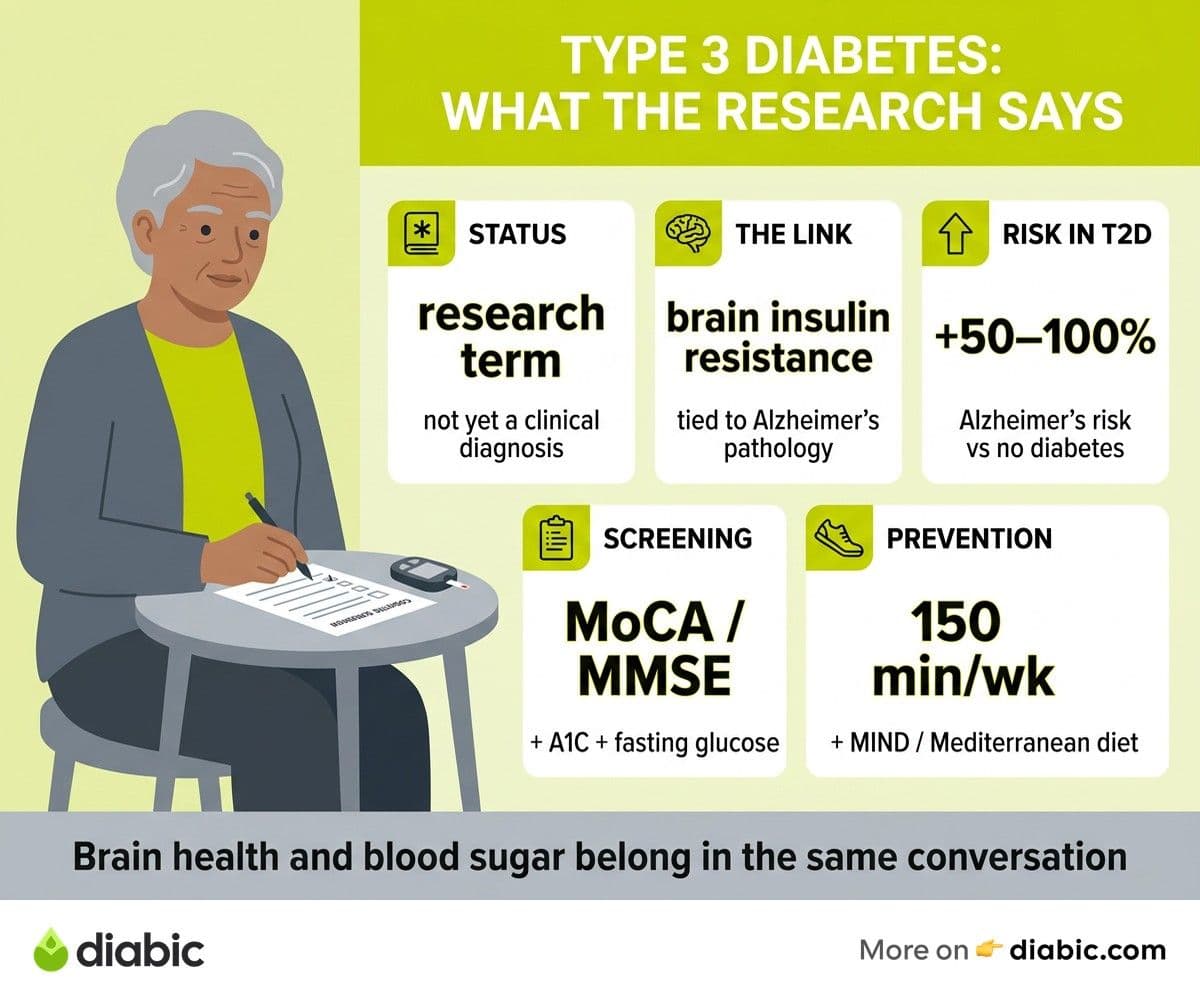
Type 3 diabetes is a term that has gained traction in medical research to describe the apparent link between insulin resistance in the brain and Alzheimer's disease. It is not yet an official clinical diagnosis recognized by the American Diabetes Association or the World Health Organization, but the connection between glucose metabolism and cognitive decline is real and increasingly well-studied.
If you have heard the phrase from a family member, in a podcast, or in a news article and walked away unsure whether it is a separate disease or a metaphor, you are not alone. The label sits in an uncomfortable middle ground: too established to dismiss, too unsettled to treat as a formal diagnosis. Researchers, clinicians, and people living with diabetes are all trying to figure out what to do with it.
This guide walks through what the term actually means, where it came from, what symptoms researchers associate with it, how it is currently evaluated, and what the science suggests about prevention. We will keep it grounded in what is supported by research and clear about what is still under study.
What Is Type 3 Diabetes
The label is a research term used to describe brain insulin resistance and the metabolic dysfunction that may contribute to Alzheimer's disease. The phrase was popularized in a 2008 paper by Suzanne de la Monte and Jack Wands published in the Journal of Diabetes Science and Technology, in which the authors argued that Alzheimer's disease shares enough features with diabetes to be considered a brain-specific form of the condition.
The basic idea: insulin is not just a peripheral hormone. The brain has its own insulin receptors, and insulin signaling plays a role in memory formation, neuron survival, and how the brain uses glucose for energy. When that signaling breaks down, neurons may not get the energy they need, and the resulting damage looks similar to what is seen in early Alzheimer's disease.
Despite the name, this condition is not currently classified alongside type 1 and type 2. The ADA does not list it as a diabetes type, and you will not see it on a lab report. It is best understood as a hypothesis that ties together two large bodies of research: one on diabetes and one on dementia. The Alzheimer's Association acknowledges the link between diabetes and Alzheimer's risk while continuing to use traditional Alzheimer's disease terminology.
How does the framing differ from type 1 and type 2? Type 1 involves autoimmune destruction of pancreatic beta cells. Type 2 involves systemic insulin resistance that affects muscle, liver, and fat tissue. The proposed third category, as researchers describe it, focuses on insulin resistance specifically in the brain. The type 1 vs type 2 differences are clinically established; this newer framing is still primarily a research lens.
Symptoms Associated With Brain Insulin Resistance
Because the condition is not a standalone diagnosis, the symptoms people search for under this term are usually the early symptoms of Alzheimer's disease and related cognitive decline. These overlap heavily with what neurologists call mild cognitive impairment.
Common cognitive diabetes symptoms reported in research on brain insulin resistance and Alzheimer's include:
- Memory loss that disrupts daily life, especially short-term memory
- Difficulty completing familiar tasks at home or work
- Confusion about time, dates, or places
- Trouble understanding visual images and spatial relationships
- New problems with speaking or writing words
- Misplacing things and losing the ability to retrace steps
- Changes in mood, personality, or social withdrawal
These symptoms are not unique to people with diabetes. Anyone can develop Alzheimer's disease, and most people who do have not been diagnosed with type 1 or type 2 diabetes. What the research suggests is that having type 2 diabetes or significant insulin resistance may increase the rate at which these symptoms develop. The WHO dementia fact sheet reports that dementia is now a leading cause of disability among older adults globally, with diabetes among the modifiable risk factors.
Symptoms that should prompt a medical evaluation include any noticeable, sustained change in memory, language, or judgment that is out of character or affecting daily life. Family members often notice these changes before the person experiencing them does. Cognitive symptoms in someone with poorly managed diabetes deserve attention sooner rather than later, because some causes of cognitive change in this population are reversible (such as severe hypoglycemia, sleep apnea, or vitamin B12 deficiency), while others are not.
What Causes Brain Insulin Resistance
The proposed mechanism centers on brain insulin resistance. In a healthy brain, insulin crosses the blood-brain barrier and binds to receptors on neurons, supporting glucose uptake and influencing the formation of memories. When neurons stop responding to insulin efficiently, several things may go wrong at once.
First, neurons may struggle to use glucose for energy. The brain is the most metabolically demanding organ in the body, and even a modest reduction in glucose uptake can affect function. PET imaging studies of people with Alzheimer's show reduced glucose metabolism in specific brain regions years before symptoms appear, which has been one of the most consistent findings in this research area.
Second, brain insulin signaling appears to influence the buildup of amyloid plaques and tau tangles, two of the hallmark features of Alzheimer's disease. The National Institute on Aging has funded multiple studies on the relationship between insulin signaling, amyloid clearance, and the rate of cognitive decline. Reduced insulin signaling may slow the brain's ability to clear amyloid, allowing it to accumulate.
Third, type 2 diabetes and metabolic syndrome appear to compound risk. People with type 2 diabetes have roughly a 50 to 100 percent higher risk of developing Alzheimer's compared to people without diabetes, depending on the study. Vascular contributions matter too: diabetes affects small blood vessels in the brain, and reduced cerebral blood flow contributes to cognitive decline independent of insulin signaling.
Genetic factors also play a role. The APOE4 gene variant, the strongest known genetic risk factor for late-onset Alzheimer's, may interact with diabetes risk in complex ways. Research suggests APOE4 carriers with type 2 diabetes face a higher risk of cognitive decline than carriers without diabetes, though the picture is still being clarified.
How the Condition Is Diagnosed
There is no standalone diagnostic test for this proposed category, because it is not a recognized clinical entity. What clinicians actually evaluate is whether a person has Alzheimer's disease or mild cognitive impairment, and separately whether they have diabetes or prediabetes. The diagnosis is built from these two layers, not from a single test.
Cognitive evaluation usually starts with screening tools. The Mini-Mental State Examination (MMSE) and the Montreal Cognitive Assessment (MoCA) are quick, validated tests that can flag early cognitive changes. A score below the cutoff prompts deeper evaluation, often by a neurologist or geriatrician.
Brain imaging plays a role for people whose cognitive symptoms are progressing. MRI scans rule out other causes of cognitive change such as stroke, tumor, or hydrocephalus. PET scans can show reduced glucose metabolism in specific brain regions or detect amyloid buildup directly. These tests are not used for screening but for diagnosis when symptoms are already present.
Diabetes evaluation runs in parallel. Fasting glucose, A1C, and sometimes an oral glucose tolerance test confirm whether a person has diabetes or is in the prediabetic range. Understanding glycohemoglobin A1C test results is part of this picture, because A1C reflects average glucose over the past 2 to 3 months and gives a clearer signal than a single fasting reading. The A1C normal range sits below 5.7 percent, with prediabetes from 5.7 to 6.4 percent and diabetes at 6.5 percent or higher.
Why early diabetes screening matters for brain health: by the time cognitive symptoms appear, the underlying metabolic and neurological changes may have been developing for a decade or more. Catching diabetes or prediabetes early gives more time for management to influence long-term cognitive risk. The ADA Standards of Care 2026 recommend regular diabetes screening starting at age 35 for all adults and earlier for those with risk factors.
Prevention and What You Can Do
Research in this area points toward the same set of habits that support overall metabolic and cardiovascular health, but the framing matters. These are not magic bullets, and no single change can guarantee that a person will not develop Alzheimer's. What the evidence does suggest is that managing blood sugar, blood pressure, and cardiovascular risk over decades may help reduce dementia risk for at least some people.
Blood sugar management is the central lever. Studies suggest that people with well-managed type 2 diabetes have a lower rate of cognitive decline than those with consistently high blood sugar. This does not mean perfection. It means time in range, fewer extreme highs and lows, and an A1C trending toward goals you set with your provider. Tools that make management more consistent, including CGMs, diabetes management apps, and structured meal planning, are useful here for people who find them sustainable.
Exercise has independent benefits for both metabolic health and brain health. Aerobic activity improves insulin sensitivity throughout the body, including in the brain. Strength training supports muscle mass, which is one of the largest sites of glucose disposal in the body. The ADA recommends at least 150 minutes per week of moderate-intensity activity for most adults with diabetes, ideally spread over the week.
Diet patterns associated with reduced cognitive decline include the Mediterranean diet, the DASH diet, and the MIND diet (which combines elements of both). These eating patterns share an emphasis on vegetables, whole grains, legumes, fish, nuts, and olive oil, with limited processed foods and added sugars. None of these patterns is a treatment, but they support stable blood sugar and cardiovascular health.
Sleep is often underweighted in diabetes care and dementia prevention conversations. Poor sleep increases insulin resistance, raises stress hormones, and disrupts the brain's ability to clear amyloid through the glymphatic system. Treating sleep apnea, if present, has been shown to improve both glucose control and cognitive function in some studies.
Ongoing research on diabetes drugs and cognitive protection is worth watching. GLP-1 receptor agonists, originally developed for type 2 diabetes and now widely used for weight management, are being studied in Alzheimer's trials. Early findings on liraglutide and semaglutide in cognitive outcomes are promising but not yet definitive. Talk to your doctor about whether these medications fit your overall health picture; they are not currently approved for Alzheimer's prevention.
From my experience: Living with type 1 diabetes for 14 years, this conversation hits differently. We focus so much on the daily numbers, the alarms, the dosing math, that the long-term cognitive picture can feel abstract. What helped me was reframing day-to-day management as long-term brain care, not just blood sugar care. It does not change what I do each morning, but it changes the why, and that has made the consistency easier to sustain.
Working With Your Doctor
If you have type 2 diabetes or prediabetes and are concerned about cognitive health, bring it up at your next appointment. A good provider will not dismiss the question. Ask about your A1C trend, your cardiovascular risk factors, and whether a baseline cognitive screening makes sense for your age and history. If you have a family history of dementia, mention it.
If you are caring for an older relative who has diabetes and is showing cognitive changes, advocate for a workup that addresses both. Sometimes blood sugar issues, medication side effects, or sleep problems are contributing more than the family realized. A geriatrician can be especially helpful in untangling what is treatable and what is not.
The science around this proposed link will continue to evolve. New imaging techniques, new medications, and new biomarkers may shift the picture in the next decade. For now, the best response is the boring one: manage what you can manage, screen on schedule, and treat brain health and metabolic health as part of the same conversation rather than two separate problems.
Frequently Asked Questions
What is type 3 diabetes and how is it diagnosed?
The phrase is a research term that describes brain insulin resistance and its proposed link to Alzheimer's disease. It is not currently a recognized clinical diagnosis, so there is no specific test for it. Diagnosis instead involves two parallel evaluations: cognitive testing using tools like the MoCA or MMSE, sometimes followed by MRI or PET imaging, and standard diabetes testing using fasting glucose and A1C. A clinician then interprets the picture as a whole. If you have concerns about cognitive symptoms, talk to your doctor about both cognitive screening and diabetes screening.
Is the condition related to Alzheimer's?
Yes, the term specifically refers to the proposed connection between brain insulin resistance and Alzheimer's disease. Research shows that people with type 2 diabetes have a higher risk of developing Alzheimer's, and that the two conditions share several biological features, including impaired insulin signaling, reduced glucose use in brain cells, and inflammation. The link is not deterministic. Many people with type 2 diabetes never develop Alzheimer's, and most people with Alzheimer's do not have type 2 diabetes. The relationship is one of increased risk, not certainty.
Can managing diabetes reduce Alzheimer's risk?
Research suggests that managing diabetes well may reduce some of the risk factors for Alzheimer's disease. Stable blood sugar, healthy blood pressure, regular physical activity, and adequate sleep all support brain health independent of diabetes. Treatments specifically aimed at preventing Alzheimer's in people with diabetes are still being studied, including some GLP-1 medications. Talk to your doctor about a management plan that addresses both metabolic and cognitive risk factors, especially if the type 3 diabetes framing has caught your attention. The goal is not perfect numbers but consistent, sustainable habits over time.
Shahriar P. Shuvo is the founder of Diabic. He has lived with diabetes for over 14 years, and built Diabic to deliver the practical, evidence-based self-management tools he wished existed when he was first diagnosed. By trade, Shahriar is a senior design and frontend engineer with 6+ years shipping products at Agora, Timescale (now Tiger Data), and ShareTrip. He writes from the intersection of lived diabetes experience and product craft, focused on what works in daily management rather than what sounds good in a textbook.
Medically reviewed by
Dr. Shanto Arian is an internal medicine physician now specializing in clinical and aesthetic dermatology, with a parallel academic focus on epidemiology and public health. He holds an MBBS, MPH, MSc (UK), MRCP (UK), MRCPI (Ireland), Diploma in Dermatology (UK), and Diploma in Aesthetic Medicine (USA). Dr. Arian trained in internal medicine, including hospital work on hematology cases such as graft-versus-host disease, before moving toward dermatology. Skin is one of the earliest places diabetes shows itself, from acanthosis nigricans and diabetic dermopathy to slow foot wound healing, and that intersection is where his clinical and Diabic-review work meet. On Diabic, Dr. Arian medically reviews content on diabetes diagnosis, complications, dermatologic manifestations, and pharmacotherapy, ensuring every claim aligns with current ADA, NICE, and peer-reviewed literature.
More from Devices & Technology
View all
Diabetes Alert Dog vs CGM: Which Catches Lows First
Diabetes alert dog vs CGM: an honest look at accuracy, response time, cost, and lifestyle so you can decide which catches lows first for you.

Twiist Insulin Pump Release Date and Features
Latest Twiist insulin pump release date updates from Sequel Med Tech, expected features, and how it may compare to Tandem, OmniPod, and Medtronic.

Fasting vs Postprandial Glucose: What's the Difference
Fasting vs postprandial glucose readings tell different stories about your blood sugar. Learn what each number means and how to act on it.
Clinician-reviewed habits, plain-language guides, and honest answers - the small shifts that make living with diabetes feel lighter, every day.